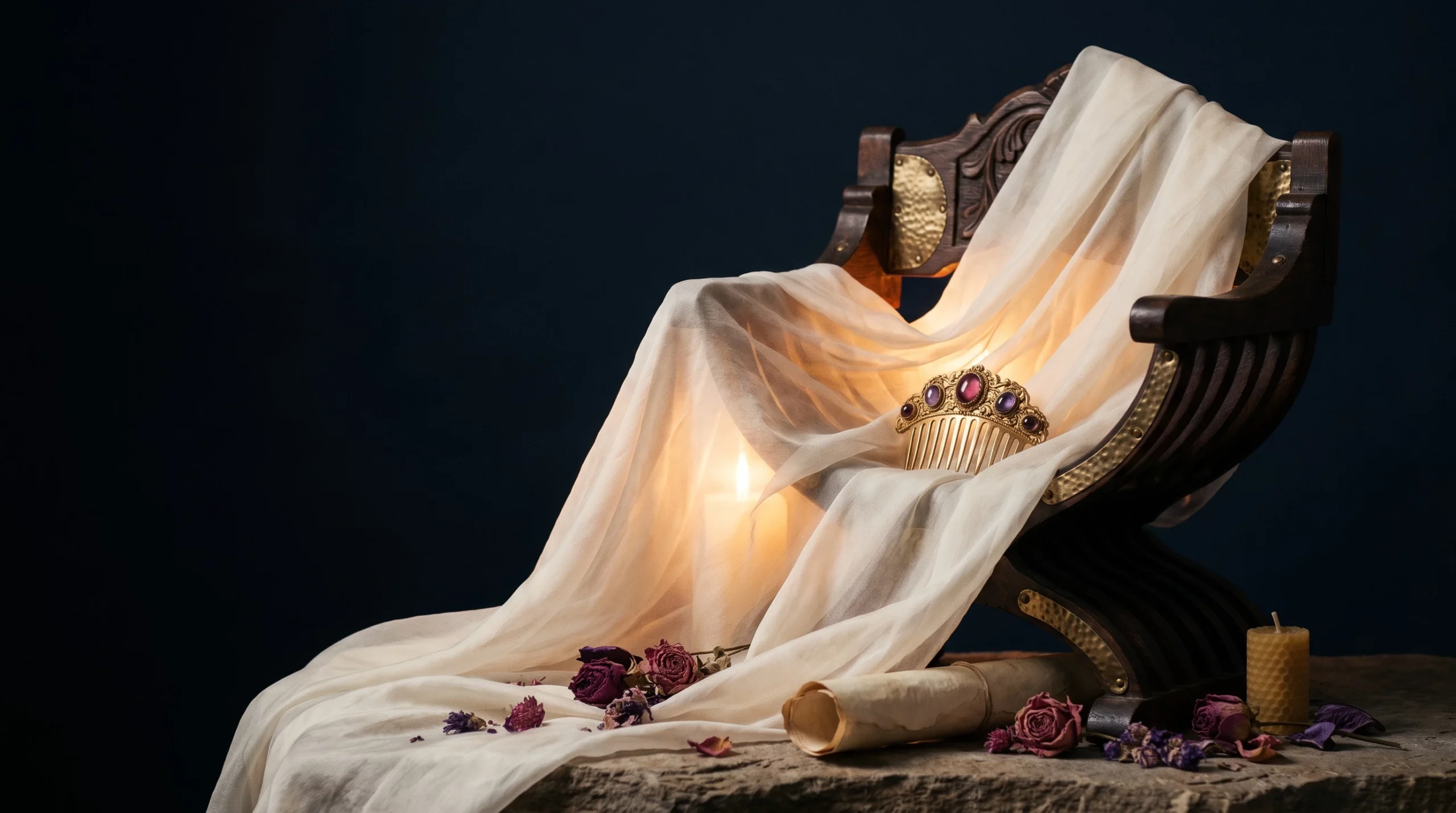
Brides wear a veil for reasons that have shifted over 2,000 years. The Romans veiled a bride in flame-colored cloth to hide her from jealous spirits. Medieval Europe read the veil as modesty and virginity. The Victorians made it a status symbol — the longer and finer the veil, the wealthier the family. Today, for most brides, it’s none of those things: it’s a piece of transformation, worn because it marks the moment.
Here’s the full history, what lifting the veil means, and why the tradition survives even after its original reasons stopped applying.
The Roman Reason: Protection
The earliest Western wedding veil is the Roman flammeum — a large veil dyed deep yellow-orange, the color of fire. A Roman bride was wrapped in it almost entirely.
The purpose was protection. Marriage was believed to be a moment of spiritual exposure, when the bride was vulnerable to evil spirits and the “evil eye” — envy made supernatural. The flame-colored veil hid her, and its color (associated with the household hearth goddess, Vesta) warded off harm. The same logic explains carrying a bride over the threshold and the bridal party wearing similar dresses: confuse the spirits about which woman is the bride.
The Medieval and Religious Reason: Modesty and Revelation
As Christianity spread, the veil’s meaning shifted from protection to modesty and purity. A veiled bride approached the altar covered; the lifting of the veil after the vows symbolized the “revealing” of the bride to her husband, and — in some readings — a soul unveiled before God.
In arranged marriages, the veil also had a practical edge: the bride’s face stayed hidden until the marriage was legally sealed. (The same anxiety produced the “don’t see the dress beforehand” superstition.)
The Victorian Reason: Status
Queen Victoria’s 1840 wedding reset bridal fashion for a century. Her long lace veil — handmade, absurdly expensive — turned the veil into a display of wealth and craftsmanship. Cathedral-length veils, blusher layers, and elaborate lace all trace to this period. The veil stopped being about spirits or modesty and became about how much this wedding cost.
What Lifting the Veil Means
The “blusher” — the short front layer worn over the face — is the part with the most ritual weight. Traditionally:
- The bride’s father lifts the blusher at the end of the processional, presenting her, then she walks the last steps to the altar with her face uncovered.
- Or the partner lifts it after the vows, as the “revealing” — the first look at each other as a married couple.
Many modern couples do a “first look” before the ceremony instead, which removes the surprise but keeps the veil as a purely aesthetic and symbolic object. Some brides skip the blusher entirely and wear only the back layer, keeping the visual without any face-covering.
Veil Lengths and What They Signal
| Length | Where it falls | Reads as |
|---|---|---|
| Birdcage | Just below the chin | Vintage, 1950s, playful |
| Elbow | At the elbow | Practical, works with a fuller gown |
| Fingertip | At the fingertips | The most common “traditional” length |
| Waltz / ballet | Between the knee and ankle | Soft, romantic, still easy to move in |
| Chapel | Pools ~1 ft on the floor | Formal, matches a train |
| Cathedral | Extends past the train | Maximum drama; the “Victoria” choice |
Length is now purely aesthetic — none of it carries the old status meaning — but it’s worth matching to the formality of the venue and the dress.
Does the Veil Still Mean Anything?
Its original meanings — warding off spirits, proving virginity, displaying wealth — have all fallen away. What’s left is quieter and more personal: the veil is a costume change. It’s the one garment a woman wears exactly once, for a few hours, and it visibly marks her as the bride in a way the dress alone doesn’t.
For a lot of brides that’s enough. The veil is the moment you stop being a person getting married and start being the bride — and the moment it lifts, you’re a wife.
If that threshold feeling is what interests you — who you are as you cross it — the free What Era Was Your Soul a Bride In? casts your bridal identity as an aesthetic era (Edwardian, Art Deco, 1970s bohemian) and builds a mood board around it.
Frequently Asked Questions
Why do brides wear a veil over their face?
The face-covering “blusher” layer descends from two traditions: Roman protection (hiding the bride from envious spirits) and medieval modesty (the bride’s face stays covered until the marriage is sealed, then is “revealed”). Today it’s kept for the emotional moment of the lift, not the original reasons.
What does the wedding veil symbolize?
Historically: protection from harm, modesty and purity, and — after Queen Victoria — family wealth. Modern symbolism is looser: transformation, the marking of “the bride,” and the reveal.
Who lifts the bride’s veil?
Traditionally the father lifts the blusher at the end of the aisle, or the partner lifts it after the vows. Couples who do a “first look” beforehand often skip the ritual lift entirely.
Do you have to wear a veil to get married?
No. The veil is one of the most optional pieces of bridal wear — plenty of brides wear a hairpiece, flowers, a hat, or nothing. It carries no legal or religious requirement in a civil ceremony.
What is the history of the wedding veil?
It begins with the Roman flammeum (a flame-colored protective veil), shifts to a symbol of modesty and revelation in medieval Christian Europe, becomes a status object after Queen Victoria’s 1840 wedding, and today functions mainly as an aesthetic and emotional marker.
Can I wear a veil for the ceremony and take it off for the reception?
Yes — this is the standard approach. Most brides remove the veil after the ceremony (or after portraits) so it doesn’t get in the way of dinner and dancing. Detachable combs make it a ten-second change.
What if I love the look but don’t want the “given away / revealed” symbolism?
Wear a single-layer veil with no blusher, or one that attaches below a low bun so it reads as fabric flowing from your hair rather than something covering your face. Plenty of brides wear a veil purely for the photographs and the movement, with no lift ritual at all.
A Costume Worn Exactly Once
The veil has meant protection, modesty, and money at different points in history. What it means now is largely up to the person wearing it — for many brides, it’s simply the object that marks the change from getting married to married.
If the identity side of that interests you, the free Soul Bride Era quiz places your bridal self in a specific aesthetic era.