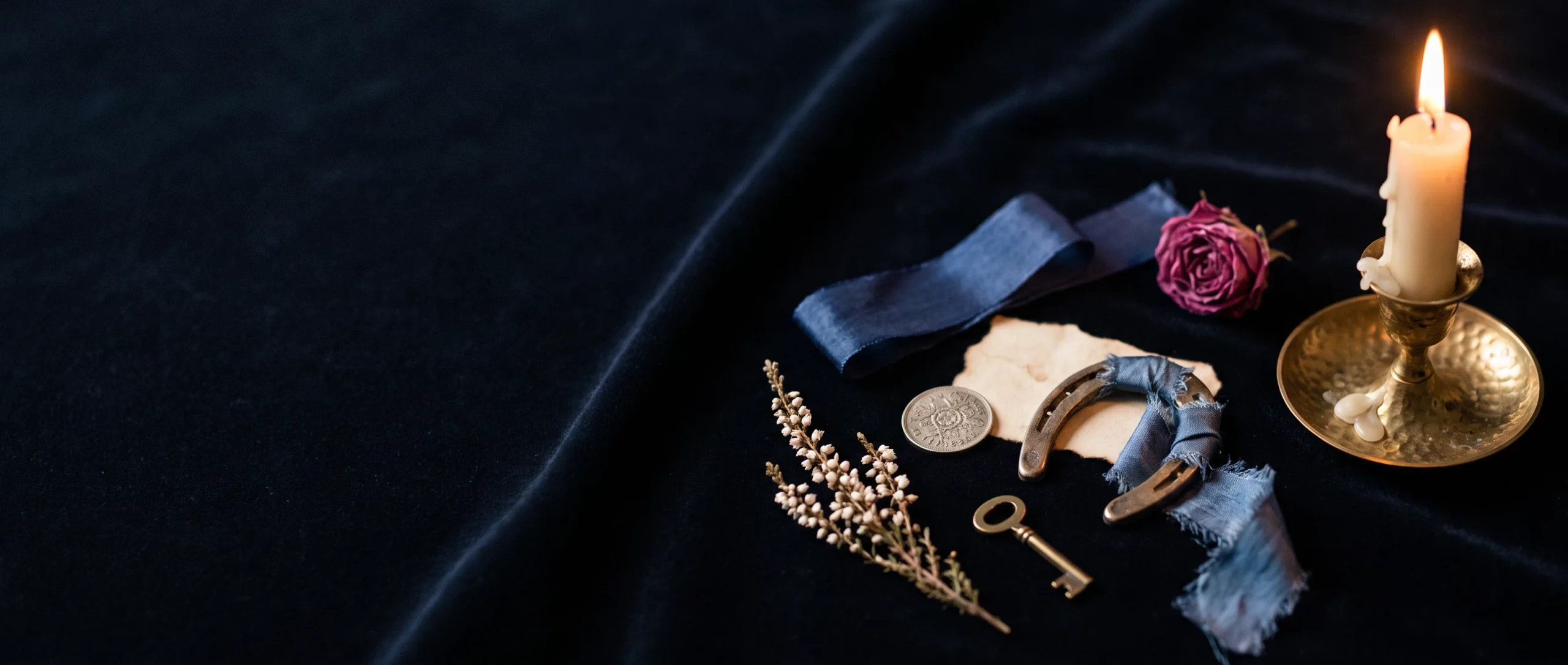
Wedding superstitions are the small rituals of luck and protection that surround a wedding day — carrying something blue, not letting your partner see the dress, hoping for (or dreading) rain. Most are folklore repurposed over centuries: charms against bad luck, blessings for fertility and prosperity, and rituals meant to protect a couple during a moment believed to be spiritually exposed.
Here are the most common ones, where they come from, and which still show up at real weddings.
Superstitions About the Bride and the Dress
“Something old, something new, something borrowed, something blue” (and a sixpence in her shoe). An English rhyme from the 1800s. Old = continuity with family; new = optimism for the future; borrowed = borrowed luck from a happily married friend; blue = fidelity and love; the sixpence = prosperity. Most brides keep at least the first four. (Full breakdown in “Something Blue” Meaning.)
The partner shouldn’t see the dress before the ceremony. This comes from the era of arranged marriages, when a meeting before the ceremony risked one party backing out. It survives now purely for the emotional payoff of the first look.
The bride shouldn’t see her full reflection in the mirror once fully dressed. Some traditions say leave off one item — a glove, an earring — until the last moment, so the “finished” bride first appears at the ceremony.
Tears on the wedding day are lucky. Especially the bride’s. Folklore holds that crying at the wedding means you’ve shed all your tears and won’t cry during the marriage.
Superstitions About Luck and Weather
Rain on your wedding day is good luck. A knot that gets wet is harder to untie — so a wet wedding knot symbolizes a bond that holds. (Fuller version in Rain on Your Wedding Day.)
Sun means happiness; wind carries change; a rainbow is a blessing. Cross-cultural weather folklore assigns a meaning to nearly every sky. Even fog has one — a soft, private start.
A spider found on the wedding dress is good luck. An English superstition tying spiders to money and good fortune (“if you wish to live and thrive, let the spider run alive”).
Finding a bird — especially a dove or a robin — on the wedding morning is a blessing. Doves for partnership, robins for a happy home.
Superstitions About the Ceremony and the Day
The bride enters the church on her right foot. Stepping in “right foot first” was believed to start the marriage on the correct footing, literally.
Carrying the bride over the threshold. Roman-era: the threshold was a vulnerable spot where malicious spirits gathered, so the bride was lifted across it.
Knives and sharp objects as gifts are unlucky unless the recipient gives a coin in return — the coin turns a “cutting” gift into a purchase and cancels the bad luck.
Wedding cake: save the top tier. Originally saved for the christening of the first child, now usually eaten on the first anniversary. Sleeping with a slice of cake under your pillow was said to make you dream of your future spouse.
The bouquet and garter toss. Descended from a much older tradition of guests trying to tear a piece of the bride’s dress for luck — the toss was invented to protect the dress.
Superstitions About the Date
- Wednesday is the “best day to wed” in an old English rhyme (“Monday for wealth, Tuesday for health, Wednesday the best day of all”). Saturday, now the most popular day, was traditionally considered the unluckiest.
- Marrying in a leap year was considered bold or unlucky in parts of Europe; in Ireland and Scotland it flipped the script and let women propose.
- Odd-numbered years and the month of May carried old warnings (“marry in May, rue the day”) tied to the Roman festival of the dead.
Almost no one plans around these anymore — but they’re fun to know if your date happens to line up.
A Few More From Around the World
- Italian: the groom carries a piece of iron (toccaferro) in his pocket to ward off the evil eye.
- Swedish: the bride carries a silver coin from her father and a gold coin from her mother in her shoes, so she’ll never go without.
- Greek: an unmarried friend writes her name on the sole of the bride’s shoe; the names still legible at the end of the night are the next to marry.
- Filipino: the couple releases a pair of doves (one male, one female) to symbolise a harmonious life together.
- Chinese: the bride’s family may not sweep the floor on the wedding day, to avoid “sweeping away” the good luck.
Which Superstitions Do Brides Actually Keep?
In practice, the survivors are the ones with an emotional payoff, not a fear: something blue, the first look, saving the top tier, tears being lucky, and rain being reframed as a blessing. The protective ones (thresholds, sharp gifts, entering right-foot-first) mostly live on as trivia.
See what folklore says about your specific wedding day with the free Wedding Day Blessing Decoder — enter your date and the expected weather, and it returns the cross-cultural omens and blessings tied to it, framed as charm rather than warning.
Frequently Asked Questions
What are the most common wedding superstitions?
Something old/new/borrowed/blue, not seeing the dress before the ceremony, rain being good luck, saving the top tier of the cake, and tears on the day being lucky are the five you’ll encounter most.
Is it bad luck to see the wedding dress before the wedding?
It’s a superstition, not a rule. The tradition dates to arranged marriages; today many couples do a “first look” photo session before the ceremony and report it calms nerves rather than causing bad luck.
Why is rain on your wedding day considered good luck?
Because a wet knot is harder to untie — a metaphor for a marriage bond that holds. Several cultures also read rain as cleansing, or as a blessing of fertility and abundance.
What day of the week is unlucky to get married?
In the old English rhyme, Saturday — now the most popular wedding day — was the unluckiest, and Wednesday was the best. Very few couples plan around this today.
What wedding gifts are considered bad luck?
Knives and other sharp objects, in some traditions, unless the recipient gives a small coin in return to “buy” the gift and break the association.
Are wedding superstitions bad luck to ignore?
No — that’s the point of keeping them light. They were never meant as threats; they were small rituals of protection at a threshold. Skipping all of them causes no “bad luck,” and cherry-picking the ones you like (a blue garter, a saved cake tier) is exactly how most couples treat them.
Where does the bouquet toss actually come from?
From a medieval belief that a piece of the bride carried luck, which led guests to grab at her dress and flowers. Tossing the bouquet (and later the garter) was a way to give the crowd something to catch instead of the dress.
Folklore, Not Fear
The point of wedding superstitions was never to frighten a couple — it was to hand them small rituals of protection and blessing at a threshold moment. Kept in that spirit, they’re charming: a reason to wear a specific stone, to save a slice of cake, to smile when it rains.
Decode the omens tied to your own date with the free Wedding Day Blessing Decoder.
Related Reading
- Rain on Your Wedding Day: What It Means (and Why It’s Lucky)
- “Something Blue” Meaning: The Full Rhyme, Explained
- Wedding Blessings for the Ceremony: Irish, Celtic, and Short Readings
- More in Wedding Meaning & Folklore