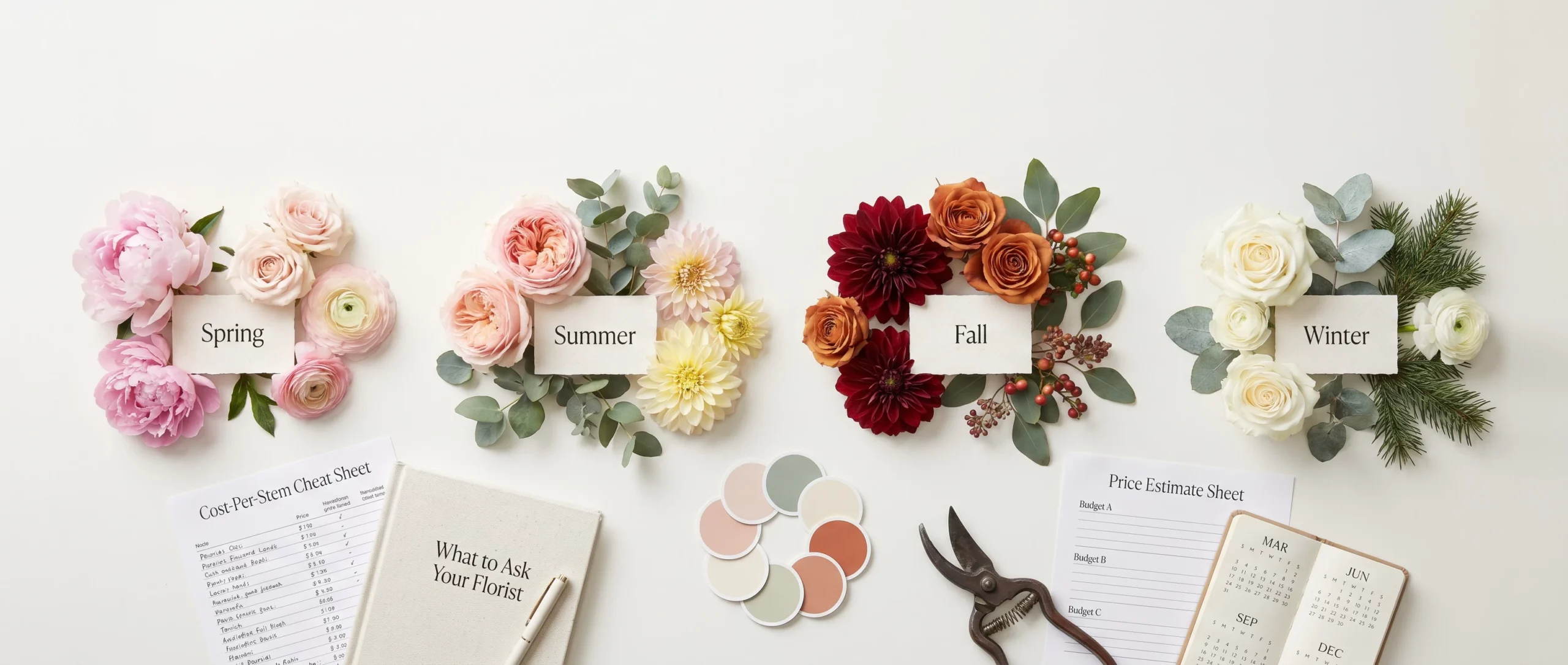
Wedding flowers shape the entire visual experience of your day — the bouquet in every portrait, the ceremony backdrop, the centerpieces guests sit beside for hours. Wedding flowers are also one of the easiest line items to overspend on without noticing, because a florist quote is hard to sanity-check if you don’t know what drives the price. This guide covers the popular blooms, real 2026 cost ranges, what’s in season month by month, traditional flower meanings, and the exact questions to ask before you sign a contract.
The most popular wedding flowers (and why)
Certain flowers dominate weddings because they photograph well, hold up out of water for hours, and come in the soft, romantic palettes most couples want.
| Flower | Peak season | Notes |
|---|---|---|
| Roses | Year-round (greenhouse) | The workhorse — every color, every budget, reliably available |
| Peonies | Late spring (Apr–Jun) | The most requested “lush” bloom; scarce and expensive outside spring |
| Ranunculus | Winter–spring | Rose-like layers at a lower price point |
| Hydrangea | Summer–early fall | Cheap volume — fills space fast, but wilts in heat |
| Dahlias | Late summer–fall | Dramatic, textural, a fall favorite |
| Garden roses | Spring–fall | The “expensive rose” look — ruffled, fragrant |
| Anemones | Winter–spring | High-contrast dark centers; a modern, editorial choice |
| Baby’s breath | Year-round | The budget volume filler, back in style as a standalone |
| Eucalyptus / greenery | Year-round | Not a flower, but the backbone of most 2026 arrangements |
| Lisianthus | Year-round | A rose-and-peony stand-in that lasts and travels well |
If your must-have flower isn’t in season for your date, a skilled florist can usually get close with a substitute — the look matters more than the exact stem.
What wedding flowers actually cost
Floral pricing is driven by three things: the flowers themselves, the labor to design and install them, and delivery/setup/breakdown. Labor is usually 40–60% of the total, which is why a “simple” arrangement of pricey stems can cost less than an elaborate one of cheap ones.
Typical ranges (2026, US)
| Item | Budget | Mid-range | High-end |
|---|---|---|---|
| Bridal bouquet | $150–$250 | $250–$400 | $400–$700+ |
| Bridesmaid bouquet (each) | $55–$85 | $85–$150 | $150–$250 |
| Boutonnière (each) | $15–$25 | $25–$40 | $40–$65 |
| Ceremony arch / installation | $300–$800 | $800–$2,500 | $2,500–$8,000+ |
| Centerpiece (each, low) | $50–$100 | $100–$200 | $200–$400 |
| Centerpiece (each, tall/lush) | $150–$250 | $250–$450 | $450–$900 |
| Total floral budget | $1,500–$3,500 | $3,500–$8,000 | $8,000–$25,000+ |
Most US couples spend somewhere between 8% and 12% of their total wedding budget on flowers. If your quote is well above that, the usual culprits are large installations, out-of-season signature blooms, or a high centerpiece count on a big guest list.
How to control cost without it looking “cheap”
- Repurpose ceremony flowers at the reception — have someone move arch pieces and aisle arrangements to the head table or bar during cocktail hour.
- Go tall or lush, not both — a few dramatic tall centerpieces plus simple bud vases reads as intentional and costs far less than lush arrangements on every table.
- Lean on greenery and candlelight — eucalyptus runners with taper candles are one of the highest-impact, lowest-cost table looks available.
- Pick one signature flower, in season — then let the florist fill around it with cheaper complementary stems.
- Cut the flower count, not the quality — five beautiful arrangements beat fifteen sparse ones.
- Run the numbers first with the free Wedding Floral Budget Estimator so you walk into the consultation with a figure in mind.
Wedding flowers by season
Buying in season is the single biggest lever on both cost and freshness. A rough guide:
- Spring (Mar–May): peonies, ranunculus, tulips, lilac, sweet pea, anemone, cherry blossom, daffodil
- Summer (Jun–Aug): garden roses, dahlias, hydrangea, zinnia, sunflower, lisianthus, stock, delphinium
- Fall (Sep–Nov): dahlias, chrysanthemum, amaranthus, marigold, celosia, dried grasses, berries
- Winter (Dec–Feb): amaryllis, anemone, ranunculus, hellebore, evergreen, cotton, tulip (forced)
- Year-round (greenhouse/imported): roses, carnations, orchids, baby’s breath, alstroemeria, greenery
Check your exact month against the free Wedding Flower Season Checker — it flags which of your picks will need to be imported at 2–3× the price.
Bouquet styles, briefly
- Round / posy — compact, structured, classic; hides stems, easy to hold
- Nosegay — smaller round bouquet, good for bridesmaids and city-hall weddings
- Cascade / trailing — dramatic downward flow; the most expensive to build
- Hand-tied / garden — loose, organic, asymmetrical; the dominant 2026 look
- Composite / “glamelia” — many petals wired into one oversized “flower”; a specialty, priced accordingly
- Single stem or small cluster — increasingly popular for a minimalist, editorial feel
Bouquet size should suit your frame — a large cascade can overwhelm a petite bride in photos, and a tiny posy can disappear against a full ballgown.
What wedding flowers traditionally mean
Floriography — the “language of flowers” — assigned meanings to blooms in the Victorian era, and plenty of couples still choose flowers partly for what they symbolize:
| Flower | Traditional meaning |
|---|---|
| Rose (red) | Love, passion |
| Rose (white) | Unity, new beginnings |
| Peony | Happy marriage, prosperity, good fortune |
| Ranunculus | “You are radiant” |
| Lily of the valley | Return of happiness, humility |
| Stephanotis | Marital happiness |
| Ivy | Fidelity, lasting attachment |
| Myrtle | Love and marriage (traditionally in royal bouquets) |
| Forget-me-not | True love, remembrance |
If the symbolism matters to you, the free Bouquet Intentions tool builds a flower list around the meanings you want to carry down the aisle. For a deeper dive, see our guide to the language of flowers and birth flower by month.
Questions to ask your florist before booking
- Have you worked at my venue? Setup logistics, load-in times, and what the space needs vary enormously.
- What’s included — delivery, setup, breakdown, and rentals? Vases, arches, candelabra, and pickup are often line items, not assumptions.
- What happens if my signature flower isn’t available that week? You want a florist who substitutes confidently, not one who panics.
- Can we repurpose ceremony pieces at the reception, and is there a fee for the move?
- How many weddings are you doing my weekend? Affects attention and setup timing.
- What does the deposit and cancellation policy look like?
- Can I see a full proposal with quantities and per-item pricing, not just a lump sum?
Walk in prepared with the free Wedding Florist Consultation Checklist.
Florals and your venue
- Ballrooms and blank spaces reward height and volume — they can absorb large installations without looking cluttered.
- Gardens and vineyards often need very little; the setting does the work.
- Historic or ornate venues can compete with busy arrangements — simpler, monochrome florals usually photograph better there.
- Outdoor ceremonies need heat-hardy flowers (roses, orchids, lisianthus) — hydrangea and dahlias can collapse by the time you say “I do.”
Frequently asked questions
How much should I budget for wedding flowers?
Most US couples spend 8–12% of their total wedding budget on flowers — commonly $3,000–$8,000 for a mid-range wedding. Bouquets, boutonnières, and a few statement pieces are the essentials; centerpiece count and large installations are where budgets balloon.
What are the cheapest wedding flowers that still look good?
Baby’s breath, carnations (used en masse, not sparsely), alstroemeria, chrysanthemums, and greenery like eucalyptus. Pairing inexpensive volume flowers with one nicer signature bloom per arrangement keeps the look elevated.
Which wedding flowers are the most expensive?
Peonies out of season, garden roses, orchids, lily of the valley, and anemones. Large hanging or arch installations are expensive regardless of flower choice because of the labor and structure involved.
Do wedding flowers need to match my colors exactly?
No — florists work in palettes, not exact matches. Give them 2–3 reference images and your non-negotiables (e.g. “no orange,” “must include white”) and let them build within that.
How far in advance should I book a wedding florist?
Six to nine months for popular dates; sought-after florists in major markets book 12+ months out. You’ll need a rough color direction and guest count, not final details, to lock the date.
Can I DIY my wedding flowers?
For a small wedding, bouquets and simple centerpieces are doable with a wholesale order and a day of prep — but it’s more work and stress than most couples expect, and installations should be left to a professional.
Bringing it together
Wedding flowers come down to three decisions: a palette and one or two signature blooms, a realistic budget expressed as a percentage of your total, and a florist who’s honest about substitutions and itemized pricing. Get those right and the rest is detail.
Start with the free Wedding Flower Season Checker to see what’s in season for your date, then price it with the Wedding Floral Budget Estimator. For the meaning behind your blooms, the free Bouquet Intentions tool builds a list around what you want the flowers to represent.
Related reading
- Rustic Wedding Ideas: Venues, Decor, Food, and Style
- Outdoor Wedding Ideas: Planning a Beautiful Ceremony and Reception Outside
- 2026 Cake Trend: Small, Sculptural, and Stress-Free Alternatives to the Giant Tiered Cake
- Birth Flower by Month: The Full List and What Each One Means
- The Language of Flowers: Floriography Meanings, Explained
- More in Vendors
- The Vendor Vault Blessing