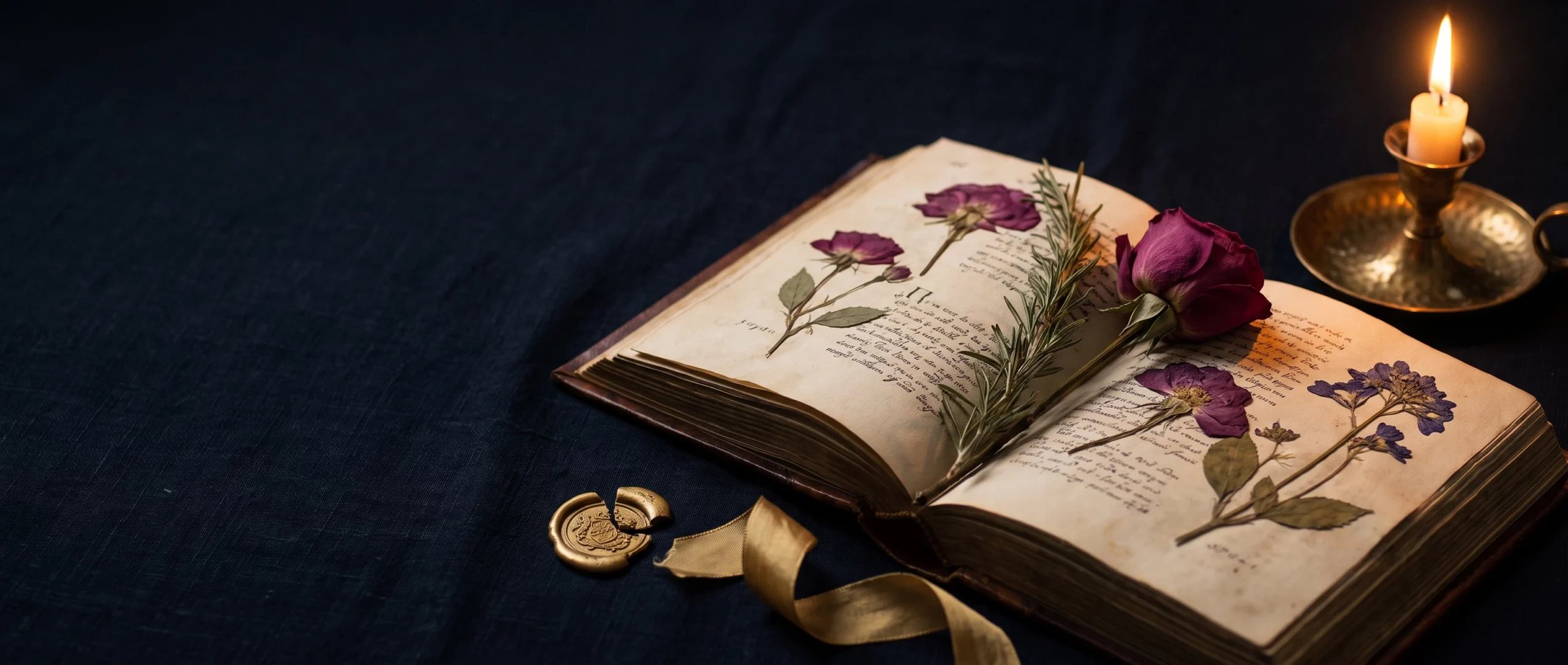
The language of flowers — floriography — is a system that assigns a specific meaning to each flower, and often to its color, so that a bouquet becomes a message. A red rose says passionate love; a yellow one, historically, said jealousy or a fading feeling. Rosemary means remembrance. Ivy means fidelity. Sent together, they form a sentence.
This guide covers where floriography came from, the meanings that matter most for weddings, and how to assemble flowers into an intention rather than just an arrangement.
What Floriography Is, and Where It Came From
Floriography is the practice of communicating through flower selection and arrangement. It has roots in Ottoman court culture and spread through Europe in the late 1700s, but it peaked in the Victorian era, roughly 1837–1901, when strict social codes made a coded bouquet genuinely useful. Dozens of “flower dictionaries” were published — and they didn’t always agree, which is why the same flower can carry slightly different meanings depending on the source.
A Victorian bouquet (a tussie-mussie or nosegay) could be read like a paragraph: the central flower was the main message, surrounding flowers modified it, and how it was presented — upright, inverted, given with the right or left hand — changed the meaning again. A flower worn in the hair meant one thing; the same flower over the heart meant another.
Flowers of Love
| Flower | Meaning |
|---|---|
| Red rose | Passionate, romantic love |
| Red tulip | A declaration of love |
| Peony | A happy marriage, prosperity, bashfulness |
| Jasmine | Sensuality, sweet love, attachment |
| Gardenia | Secret love, “you’re lovely” |
| Forget-me-not | True love, faithful memory |
| Honeysuckle | Devoted, bonded affection |
| Myrtle | Love in marriage — the traditional royal bridal flower |
Myrtle is worth knowing: since Queen Victoria, British royal brides have carried a sprig of myrtle grown from a cutting of Victoria’s own bush. It’s the floriography flower most specifically tied to married love rather than courtship — which is why some non-royal brides deliberately tuck a sprig into the bouquet.
Flowers of Luck, Protection, and Blessing
| Flower | Meaning |
|---|---|
| Heather (white) | Protection, wishes will come true |
| Sage | Wisdom, domestic virtue, warding |
| Bay laurel | Glory, protection from harm |
| Clover (four-leaf) | Luck, “be mine” |
| Marigold | Warmth, sacred protection, devotion |
| Snapdragon | Grace under pressure, protection from deception |
Flowers of New Beginnings
| Flower | Meaning |
|---|---|
| Daffodil | New beginnings, rebirth |
| Lily of the valley | Return of happiness, a fresh start |
| Apple blossom | Promise, better things to come |
| Crocus | Youthful gladness, cheer after hardship |
Flowers of Remembrance
| Flower | Meaning |
|---|---|
| Rosemary | Remembrance, fidelity (“rosemary for remembrance”) |
| Forget-me-not | Faithful memory of someone absent |
| Poppy | Remembrance, consolation, eternal sleep |
| White chrysanthemum | Grief and honor (especially in Europe and East Asia) |
| Statice | Remembrance, lasting beauty |
Color Changes the Meaning
The same flower shifts message by color. Roses are the clearest example:
- Red — love, passion
- White — purity, new beginnings, “I am worthy of you”
- Pink — gratitude, admiration, gentleness
- Yellow — friendship and joy today (historically: jealousy or a waning love)
- Orange — fascination, enthusiasm
- Lavender — enchantment, love at first sight
If you’re building a meaningful bouquet, decide the color and the flower — they’re two separate words.
How to Say Something With Flowers
Modern couples use floriography for the bouquet, the boutonnière, the centerpieces, and increasingly for a “hidden message” element only the couple knows about — a single stem of forget-me-not for a grandparent who isn’t there, a sprig of rosemary tucked into the ribbon.
A simple method: pick two or three intentions (say, devoted love, protection, a nod to someone we’ve lost), then choose one flower for each. That’s a readable sentence, and it constrains your florist choices in a helpful way.
A worked example
A couple wants their flowers to say steady married love, protected, and holding memory of both their fathers. They choose myrtle (married love), white heather (protection, wishes granted), and rosemary (remembrance) — the myrtle and heather woven through the bride’s bouquet, the rosemary in both the bouquet ribbon and the groom’s boutonnière so it’s literally on both of them. Three intentions, three flowers, one sentence.
Turn your intentions into a flower list with the free Bouquet Intentions — select what you want your flowers to carry and it returns specific blooms with their floriography meaning, so your bouquet reads the way you mean it to.
Frequently Asked Questions
What is the language of flowers called?
Floriography. The term combines “flora” with “-graphy” (writing), and it describes both the Victorian practice and the modern revival of assigning meanings to flowers.
What flower means true love?
The forget-me-not is the clearest single answer for faithful, true love. For love within marriage specifically, myrtle is the traditional choice; for passionate romantic love, the red rose.
Do florists still use floriography?
Many bridal florists do, at least loosely — it’s a common way to make selections feel personal. Full Victorian-style coded bouquets are rare, but choosing flowers “for what they mean” is standard practice in wedding design now.
Why do yellow roses have a negative meaning?
In strict Victorian dictionaries, yellow roses signaled jealousy or a dying affection. That meaning has largely faded — today yellow roses read as friendship, warmth, and joy — but you’ll still see the old meaning cited.
What flowers should you avoid in a wedding bouquet?
It depends on the meaning you want. Some couples avoid white chrysanthemums (funeral associations in many cultures), yellow carnations (disdain, in old dictionaries), or striped carnations (“I cannot be with you”). Your florist can flag anything that reads oddly for your guests.
Where can I look up a flower’s floriography meaning?
The Victorian flower dictionaries are freely available online (Kate Greenaway’s 1884 Language of Flowers is the best-known), and modern florists’ guides collate them. Where sources disagree, pick the meaning you like — that’s genuinely how it worked in the 1800s too.
Can I use floriography if the flower I love has a “bad” meaning?
Yes. Floriography is a tool for adding intention, not a set of rules to be trapped by. If you love a flower whose old meaning doesn’t fit, use it anyway — or pair it with a stem whose meaning corrects the sentence.
Every Bouquet Is Already Saying Something
Whether or not you plan it, the flowers you choose carry meaning — floriography just lets you choose the meaning on purpose. Pick your intentions, pick a flower for each, and the bouquet becomes a sentence you’ll remember.
Open the free Bouquet Intentions to build yours.