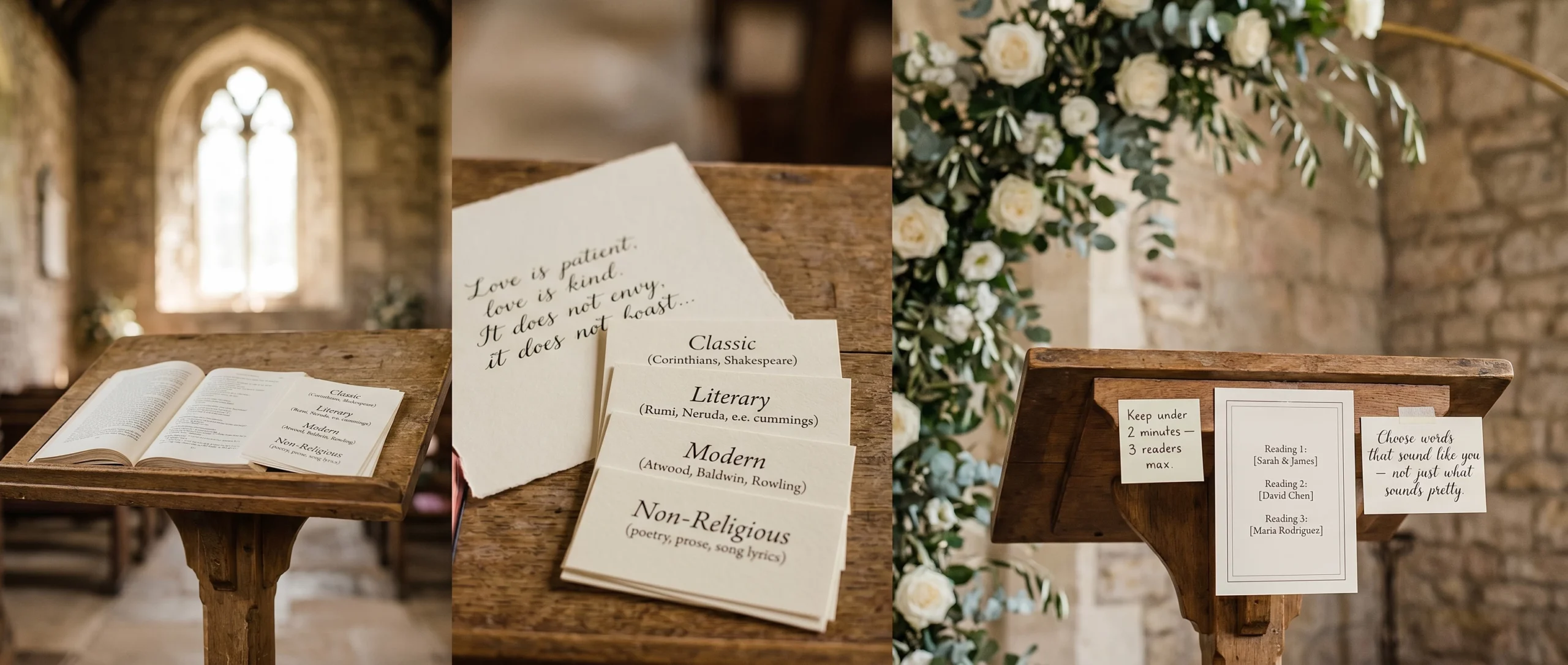
A well-chosen reading gives the ceremony a moment of stillness — a pause in the ritual where something true is said about love, partnership, or the commitment being made.
The best wedding ceremony readings sound like they were chosen specifically for the two of you. Here’s a guide to the most enduring options, how to choose one, and how to use it well.
How to Choose a Wedding Reading
Before searching for specific texts, answer these:
- What is the ceremony’s tone? A secular humanist ceremony has different space for a reading than a traditional religious service. Know which kind of language belongs.
- How long should it be? A reading that lands is typically 1–3 minutes read aloud. Most ceremonies include one or two; a single strong reading beats two weaker ones.
- Who is reading? The reader’s voice, relationship to you, and comfort with public speaking all affect how it lands. Choose someone who can hold themselves together emotionally and has read it aloud at least once beforehand.
Classic Literary Readings
“On Marriage” from The Prophet by Kahlil Gibran
One of the most requested wedding readings of the last 50 years. The central idea — that two people should stand together but not too near, that love should not possess but liberate — is as resonant as it was in 1923. The full passage runs about 2–3 minutes at a measured pace.
Sonnet 116 by William Shakespeare
“Let me not to the marriage of true minds / Admit impediments…” Shakespeare’s most famous poem on love addresses constancy specifically — that true love does not alter when circumstances change. Short (14 lines), dignified, and universally recognised. Public domain.
“i carry your heart with me” by e.e. cummings
“i carry your heart with me (i carry it in / my heart)…” One of the most frequently chosen contemporary-feeling poems for ceremonies. Brief (12 lines), intimate, and accessible without being sentimental. Public domain.
“The Passionate Shepherd to His Love” by Christopher Marlowe
A romantic pastoral poem that reads with warmth and imagery. Works particularly well for outdoor ceremonies. Public domain.
Non-Religious / Secular Options
Excerpt from Captain Corelli’s Mandolin by Louis de Bernières
The passage beginning “Love is a temporary madness…” has appeared in thousands of ceremonies since 1994. It frames love not as a permanent feeling but as a commitment that carries a couple through the inevitable changes in feeling. Very effective read well. (Copyright held by the author; for private, non-commercial ceremony use this is generally considered acceptable — verify your situation.)
“The Art of Marriage” (attributed, most often to Wilferd Arlan Peterson)
A prose poem offering specific wishes and observations about what makes a marriage work. Warm, accessible, and appropriate for mixed audiences. Attribution is contested; widely used freely.
“Union” by Robert Fulghum
A prose reflection on the meaning of choosing a partner — practical in voice, meaningful in substance. Often used in humanist ceremonies for its grounded, non-abstract language.
An excerpt from a book meaningful to you both
The most personal option of all: a paragraph from a novel you both love, a passage from a favourite poet, or a few lines from a song read as text. If it says something true about love and it belongs to your relationship, it will land.
“The Life That I Have” by Leo Marks
A short, spare wartime poem (12 lines) that has become a wedding favourite for its plainness: “The life that I have is all that I have / And the life that I have is yours.” Public domain in most contexts; verify for your country.
A letter written to your future selves
Some couples have a friend or parent read aloud a short passage the couple wrote earlier — a paragraph each, addressed to the person they’re marrying, sealed until the ceremony. It’s the most personal reading possible and needs no attribution.
Religious Readings
1 Corinthians 13:4–7 (Christian)
“Love is patient, love is kind…” The most commonly requested biblical passage for Christian wedding ceremonies. Brief, clear, and deeply familiar to most guests at a Christian ceremony.
Ruth 1:16–17 (Christian / Jewish)
“Where you go I will go, and where you stay I will stay…” Ruth’s vow to Naomi, adapted for a wedding, speaks to lifelong fidelity and accompaniment. Moving in its simplicity.
Ecclesiastes 4:9–12 (Christian / Jewish)
“Two are better than one… a cord of three strands is not quickly broken.” Short, concrete, and works in both religious and lightly spiritual ceremonies.
How to Use a Reading in the Ceremony
- Placement: readings typically come after the officiant’s opening words and before the vows. One reading before vows works well; a second can follow the ring exchange.
- Introduction: the officiant briefly introduces the reader and the text. The reader should not introduce themselves.
- Practice: the reader should rehearse at least twice aloud, from a large-font printed card — not a phone.
- Timing: 1–2 minutes is usually ideal. If the text you love runs longer, ask the reader to use a selected portion.
Frequently Asked Questions
How many readings should we have?
One or two, depending on ceremony length. A 20-minute ceremony usually has room for one; a 45-minute ceremony can hold two.
Can a reading be funny?
Yes, if the ceremony’s tone allows it. A warm, humorous reading from a children’s book or a piece of writing that’s meaningful to you both can work well, particularly in informal ceremonies.
Who should do the reading?
Someone who can read clearly and calmly under emotional pressure. Consider their voice, their relationship to you, and whether they’ll hold together. Brief them fully on timing and expectations.
Can we write our own reading?
Yes. A short piece of original prose, or a selected excerpt from something meaningful to your relationship, is often the most personal option.
Is it OK to use a reading someone else used at their wedding?
Absolutely. Popular readings become popular because they’re genuinely moving. There’s no originality requirement.
What about copyright?
For private, non-commercial ceremonies, brief readings from copyright-protected works are generally not enforced. If you’re recording and distributing the ceremony or publishing the programme commercially, check the rights more carefully.
How to Brief Your Reader
Give your reader the text at least two weeks out, printed in 16–18pt font on a single card, with any tricky names spelled phonetically. Ask them to read it aloud to someone once before the day. Tell them where they’ll stand, how the officiant will hand off to them (“Our first reading is…”), and where to go afterward. And give them explicit permission to pause if they get emotional — the room will wait, and a reader who knows that in advance is far less likely to rush.
A Reading Should Sound Like the Two of You Chose It
The test for any wedding reading: does it say something true about love, and does it sound like something you would choose? If yes to both, it’s the right reading. See our wedding ceremony order of events guide for where readings sit in the ceremony, and wedding processional songs for the music around them.