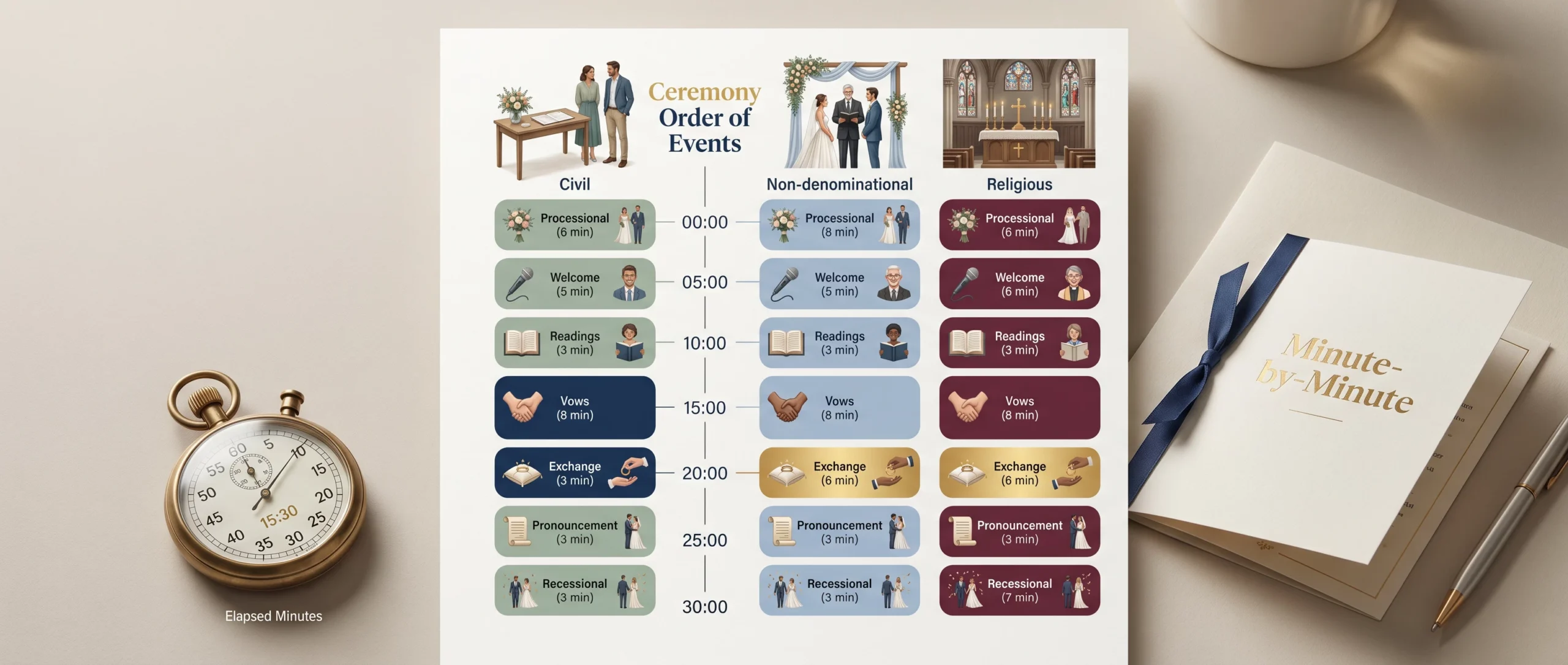
Most couples spend months on how their ceremony will feel and almost no time on what will literally happen, in what order, and how long each part takes. But the wedding ceremony order of events drives your program design, your music cues, where the photographer stands, and whether guests are seated comfortably or shifting in the sun for 40 minutes. This guide lays out the standard sequence, realistic timings, the processional order, and the most common religious and cultural variations.
Before the ceremony begins
- 30–45 min before: guests arrive; prelude music plays; ushers seat people (bride’s side traditionally left, groom’s right — increasingly ignored for “sit anywhere”).
- 10 min before: immediate family and any reserved rows are seated.
- 5 min before: officiant and the partner waiting at the altar take their positions; grandparents are seated.
- 2 min before: parents of the couple are seated (mother of the bride last — traditionally her seating signals the ceremony is about to start).
The standard non-denominational order
| # | Segment | Typical length | Notes |
|---|---|---|---|
| 1 | Processional | 3–5 min | Wedding party, then the person being “given away,” enters to music |
| 2 | Welcome / opening words | 2–4 min | Officiant greets guests, frames the day, may include a moment for those absent |
| 3 | Reading(s) | 1–3 min each | 1–2 readings, done by friends or family |
| 4 | Address to the couple | 3–6 min | The officiant’s remarks — the couple’s story, thoughts on marriage |
| 5 | Vows | 2–5 min | Repeated after the officiant, or personal vows read aloud |
| 6 | Ring exchange | 2–3 min | Rings given with a short spoken line each |
| 7 | Unity ritual (optional) | 2–4 min | Handfasting, candle, sand, wine, a family or cultural tradition |
| 8 | Pronouncement | 1 min | “I now pronounce you…” |
| 9 | The kiss | — | |
| 10 | Presentation & recessional | 2–3 min | Couple introduced by married name/title, then exits with the wedding party |
Total: roughly 20–30 minutes for a non-religious ceremony with one reading and a unity ritual. Estimate yours precisely with the free Wedding Ceremony Length Estimator.
The processional order
The most-searched piece of this. Standard Western order, front to back:
- Officiant (often already in place)
- The partner being met at the altar, sometimes with their parents
- Grandparents (if not pre-seated)
- Parents of the entering partner
- Best person / groomsmen (may enter from the side instead)
- Bridesmaids, single file or paired
- Maid/matron of honor
- Ring bearer
- Flower person
- The entering partner, with whoever is walking them
Variations that are now common: both partners process (from opposite sides, or together); the wedding party is already standing at the front; children are skipped or seated with a parent; couples with two aisles use both.
Ceremony length by type
| Ceremony type | Typical length |
|---|---|
| Civil / courthouse | 5–15 min |
| Non-denominational / celebrant-led | 20–30 min |
| Protestant Christian | 20–40 min |
| Catholic (without Mass) | 30–45 min |
| Catholic Nuptial Mass | 60–90 min |
| Jewish | 30–45 min |
| Hindu | 90 min–3 hrs (often multi-part) |
| Interfaith / blended | 30–50 min |
Build in the real number when you set your reception start time and photography timeline — a ceremony that runs long compresses everything after it.
Religious and cultural variations
- Catholic Nuptial Mass adds the Liturgy of the Word, the Rite of Marriage, the Liturgy of the Eucharist, and Communion — hence the length.
- Jewish ceremonies include the bedeken (veiling), the chuppah, seven blessings (sheva brachot), and breaking the glass.
- Hindu ceremonies center on the saptapadi (seven steps) around a sacred fire and can include the baraat, kanyadaan, and mangalsutra.
- Many cultures add a tea ceremony, a coin or arras exchange, a rice or petal toss, or a family blessing — some before the ceremony, some woven in.
Placing a cultural or personal ritual well matters: a unity ritual usually sits after the ring exchange, a family blessing near the opening, and anything requiring guest participation before the pronouncement so the recessional stays celebratory. If a personal ritual appeals but you’re undecided, the free The Rune of Union tool is a short reflective practice some couples use while choosing one.
Building your ceremony program
The printed (or displayed) program should mirror this order exactly, so guests can follow along:
- Names of the couple, date, venue
- Officiant and wedding party names with roles
- The order of events (segment names, not timings)
- Reading titles and who’s reading them
- A note on any cultural ritual guests will witness
- A thank-you or memorial line, if you want one
Keep segment names guest-friendly (“A Blessing,” “The Exchange of Vows”) rather than internal shorthand. Time your readings first with the free Wedding Reading Length Calculator so the program reflects reality, and see our guide to wedding ceremony readings for options.
Frequently asked questions
What is the correct order of a wedding ceremony?
Processional, welcome, reading(s), the officiant’s address, vows, ring exchange, an optional unity ritual, the pronouncement, the kiss, and the recessional. Religious ceremonies add liturgical elements within that frame.
Who walks first in the wedding processional?
After the officiant and the partner waiting at the altar, grandparents and parents enter, then the wedding party (groomsmen, bridesmaids, maid of honor), then any children, then the entering partner with their escort.
How long should a wedding ceremony be?
A non-religious ceremony typically runs 20–30 minutes. Civil ceremonies are 5–15 minutes; a Catholic Nuptial Mass runs 60–90 minutes. Plan your reception timeline around the real figure for your ceremony type.
Do readings come before or after the vows?
Before. Readings usually follow the welcome and precede the officiant’s address and the vows, giving the ceremony a reflective build toward the central moment.
Where does a unity ceremony go in the order?
Almost always right after the ring exchange and before the pronouncement — it’s framed as the couple’s first joint act, immediately before they’re pronounced married.
Can both partners walk down the aisle?
Yes, and it’s increasingly common — either processing from opposite sides to meet in the middle, walking in together, or each being walked by their own parents. There is no rule requiring one partner to already be at the altar.
The heart of your day
Your ceremony is the shortest and most important part of the wedding. Nail the order, time it honestly, and give your officiant, musicians, and photographer a written version, and it will feel unhurried instead of rushed.
Estimate your exact runtime with the free Wedding Ceremony Length Estimator, then slot it into your full wedding day timeline.
Related reading
- Wedding Ceremony Readings: Classic, Modern, and Non-Religious Options
- How Many Songs Do You Need for a Wedding? Reception Playlist Math
- Father Daughter Dance Songs: 50 Picks From Timeless to Modern
- How Long Is a Wedding Ceremony? (By Type + Ready-to-Use Program Outline)
- Wedding Day Emergency Kit: The Complete List (Print and Pack)
- More in Ceremony