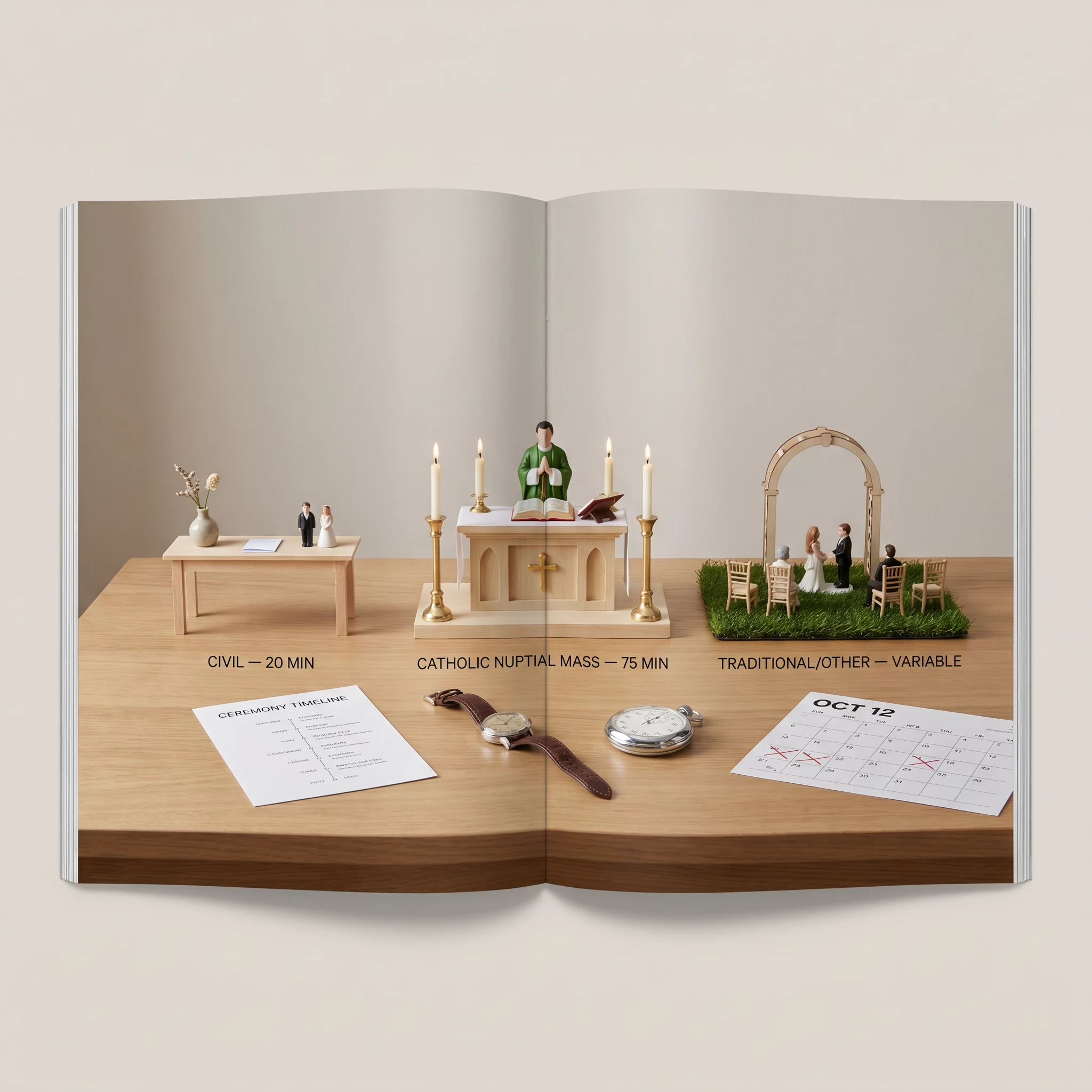
If you’ve asked yourself how long your ceremony will actually run, you’re not alone — it’s one of the first logistical questions vendors, family, and guests all want answered. The answer depends almost entirely on the type of ceremony you’re having.
A civil ceremony with two personal vows can be done in 15 minutes. A Catholic nuptial mass with a full homily runs over an hour. Everything else falls somewhere in between.
This guide breaks down average ceremony lengths by type, the elements that push timing longer or shorter, and a program outline you can use to map your own ceremony from start to finish.
Ceremony Length by Type: Quick Reference
| Ceremony Type | Typical Duration |
|---|---|
| Courthouse / civil registry | 10–20 minutes |
| Civil ceremony (officiant, no mass) | 20–35 minutes |
| Non-denominational / secular | 25–45 minutes |
| Protestant Christian | 30–50 minutes |
| Jewish (Reform or Conservative) | 30–60 minutes |
| Catholic (without nuptial mass) | 30–50 minutes |
| Catholic (with nuptial mass) | 60–90 minutes |
| Eastern Orthodox | 60–90 minutes |
| Hindu | 60–120 minutes |
| Jewish (Orthodox) | 45–75 minutes |
The standard planning window vendors use is 30 minutes for the ceremony itself, plus 15–20 minutes of pre-ceremony seating and 15 minutes of transition buffer at the close. That gives you a 60-minute block to hand vendors when coordinating.
→ Use the Wedding Ceremony Length Estimator to calculate your specific ceremony timing based on the exact elements you’ve chosen.
What Makes a Ceremony Run Long (or Short)
The ceremony type is the baseline. These variables move the needle:
Number of Readings
Each reading adds 2–5 minutes depending on length. Two scripture readings plus a secular poem adds roughly 10–12 minutes to any ceremony. If you have three readers, budget 15 minutes for readings alone.
Personal Vows vs. Traditional Vows
Traditional repeated vows: 2–3 minutes total. Personal vows (both partners): 4–10 minutes depending on how much each person writes. Couples who write longer vows often haven’t practiced reading them at real pace — add 20% buffer when calculating.
Musical Performances
A live musical piece performed during the ceremony (not background processional music) adds 3–6 minutes per song. Two songs equals 6–12 extra minutes.
Ceremonies Within the Ceremony
Unity candles, sand ceremonies, handfasting, wine ceremonies, ring warming — each adds 3–7 minutes. Beautiful and meaningful; just account for it in your timeline.
Size of the Wedding Party
A larger wedding party means a longer processional. Eight bridesmaids walking one at a time, with music and spacing, can take 6–10 minutes for the processional alone. A smaller party of two or three: 2–4 minutes.
Number of Guests
Guest count doesn’t affect the ceremony itself but does extend the pre-ceremony seating window. Two hundred or more guests need 30 minutes of seating time. Fifty guests need 10.
Homily Length
This is the biggest variable in religious ceremonies. A 5-minute homily is short. A 20-minute homily is not unusual. If you have a religious officiant, ask specifically how long their typical message runs — then add 5 minutes.
The “Sweet Spot” Most Couples Land On
After accounting for all elements, most non-religious ceremonies run 25–35 minutes when they include:
- A processional (3–5 min)
- A welcome and introduction (2–3 min)
- 1–2 readings (4–8 min)
- Personal vows (4–6 min)
- Ring exchange (2–3 min)
- Pronouncement and first kiss (1 min)
- Recessional (2–3 min)
That’s 18–29 minutes of scripted content, plus natural pauses, music transitions, and the recessional — which lands squarely in the 30-minute window most guests expect.
Guests begin to feel restless around 45 minutes in a non-religious ceremony. Religious traditions carry a different expectation — your congregation will know what they’re in for.
Program Outline Template
Use this as a starting framework and fill in your specific readers, songs, and officiant name:
PRELUDE (20–30 min before ceremony start)
 → Guests seated; instrumental music plays

PROCESSIONAL
 → Grandparents + parents (if walking in)
 → Wedding party (bridesmaids, groomsmen, flower girl, ring bearer)
 → Bride

WELCOME (officiant)
 → 1–2 minutes

READING #1 (optional)
 → Reader name + reading title

MUSICAL INTERLUDE (optional)
 → Performer name + song title

READING #2 (optional)

OFFICIANT'S ADDRESS
 → 5–20 min depending on ceremony type

VOWS
 → Groom speaks
 → Bride speaks

RING EXCHANGE

UNITY CEREMONY (optional)
 → Sand / candle / handfasting / wine

PRONOUNCEMENT

FIRST KISS

RECESSIONAL
 → Couple exits first
 → Wedding party exits
 → Guests exit by row
Once you’ve filled this in, it becomes your printed program — and it gives your day-of coordinator an accurate working timeline.
Ceremony Timing and Your Vendor Day
Your ceremony length directly affects every vendor’s clock for the day. Photographers, caterers, DJs, and venue coordinators are all working backward from a ceremony end time. A ceremony that runs 20 minutes long doesn’t stay a ceremony problem — it cascades into a shortened cocktail hour, rushed dinner service, and a DJ who loses dance floor time.
Share your completed program outline with your coordinator and review it together before the wedding. If anything looks long on paper, trim it before the day rather than apologize for it after.
Your ceremony florals also need to match the atmosphere and duration — arrangements designed for an intimate 30-minute ceremony look and feel different from those set for a 90-minute mass. For more on setting the right floral mood, see our wedding ceremony floral arrangements guide.
Planning the Rest of Your Day Around the Ceremony
The ceremony is the centerpiece — everything else builds outward from it.
| Day-of segment | Typical duration |
|---|---|
| Bride getting ready | 3–5 hours before ceremony |
| Groom getting ready | 1.5–2 hours before ceremony |
| First look (if included) | 30–45 min before ceremony |
| Ceremony | Per your estimate above |
| Cocktail hour | 60–90 min after ceremony ends |
| Reception | 3–5 hours |
Use a detailed wedding planning timeline to map every block, not just the ceremony itself. When vendors know the ceremony duration, they can build their own timelines accurately — and that’s when the day actually runs smoothly.
FAQ: How Long Is a Wedding Ceremony?
How long is a courthouse ceremony? A courthouse or civil registry ceremony is typically 10–20 minutes. It covers the legal requirements — reading of the marriage declaration, exchange of vows, signing of the license — and nothing more unless you’ve arranged otherwise.
How long is a non-denominational wedding ceremony? Non-denominational ceremonies typically run 25–40 minutes. They’re flexible in content, so length depends almost entirely on what you include: readings, music, personal vows, unity rituals, and the officiant’s remarks.
How long is a Catholic wedding ceremony without a mass? Without a nuptial mass, a Catholic ceremony typically runs 30–50 minutes. With the full nuptial mass, expect 60–90 minutes.
How long should personal vows be? Most couples aim for 1–3 minutes per person when speaking aloud. Written on paper, that’s roughly 150–300 words. Practice reading them at a slow, clear pace — most people naturally read faster when nervous.
What’s a reasonable buffer to build into the vendor timeline? Add 15 minutes before and 15 minutes after the ceremony in your working timeline. If the ceremony runs to time, the buffer gives you a natural transition. If it runs long, the buffer absorbs most of it without affecting the next event.
Should I tell guests if the ceremony will be long? If your ceremony type is unfamiliar to most guests — a full mass, a traditional Hindu ceremony, an Orthodox ceremony — it’s a courtesy to mention the expected duration on your wedding website or in personal conversation with guests who may have accessibility concerns.
How do I estimate my exact ceremony length? Use the Wedding Ceremony Length Estimator — it lets you select your ceremony elements one by one and calculates your estimated running time, including natural pauses and transitions.
Your Ceremony Should Feel Unhurried, Not Unending
The best ceremonies feel completely present — guests are moved, not watching the clock.
If you’re in the early stages of planning and ceremony logistics feel like a lot to manage alongside everything else, the free wedding planning tools at weddingserenity.com/tools cover ceremony timing, music, checklists, and 17 other planning areas — all free, no signup required.
For someone who wants a guided weekly planning system built around calm progress and expert support, the Wedding Serenity Club is available as a gift starting at $50, delivered instantly.