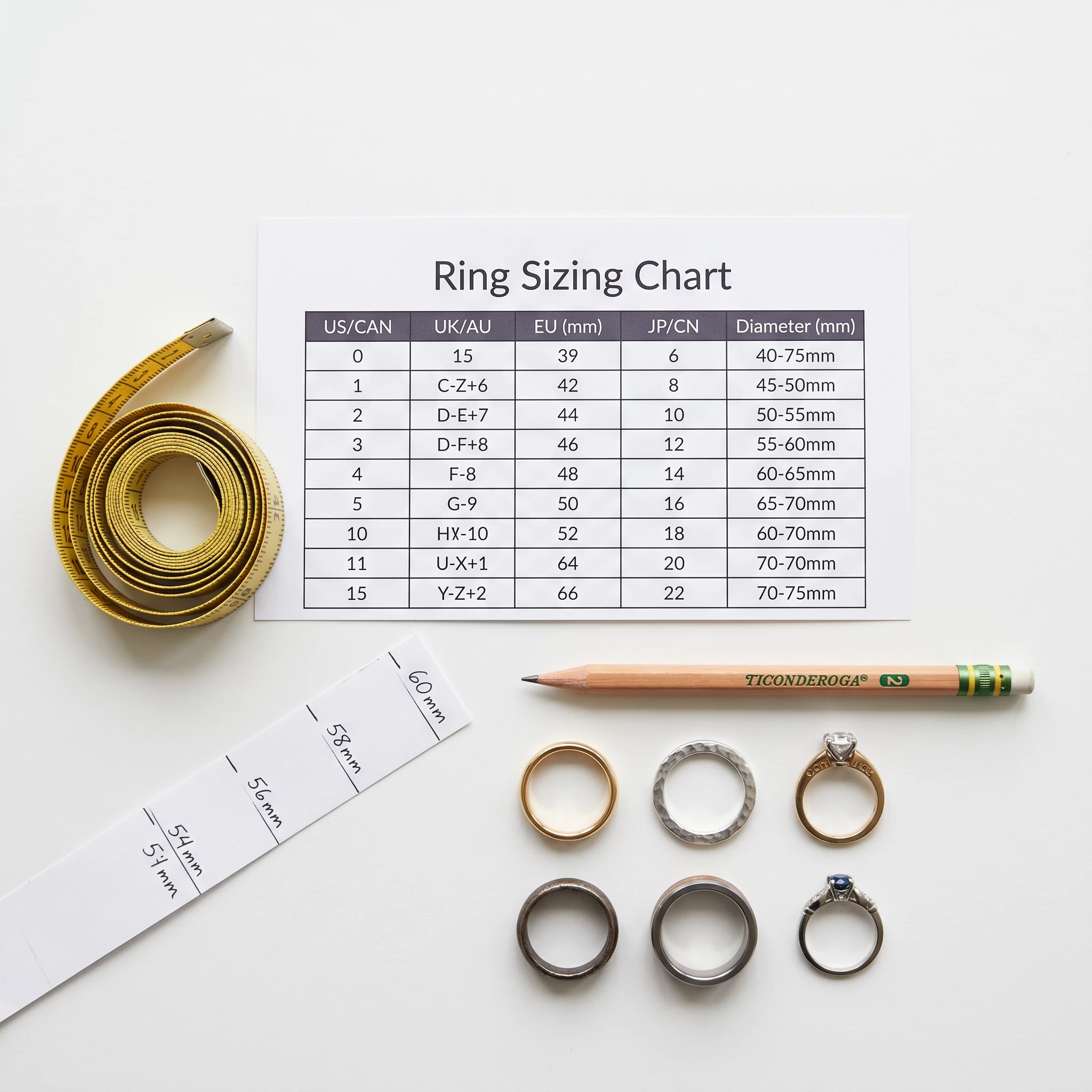
Ring sizes sound simple until you realize your US size 6 means something completely different to a jeweler in London, Tokyo, or Paris.
Whether you’re ordering an engagement ring online, shopping from an international brand, or trying to figure out your size before your partner proposes — this guide gives you everything in one place: a complete ring size conversion chart, three reliable at-home measuring methods, and a free tool to check your size across five sizing systems in seconds.
No jeweler appointment needed.
Quick answer: measure the inside of a ring that fits (or wrap a strip of paper around your finger) and match it to the chart below. A US size 7, for example, is about 17.3 mm across on the inside and 54.4 mm around.
Complete Ring Size Conversion Chart: US, UK, EU, Australian & Japanese
This table covers US sizes 3 to 13, which takes in most women’s and men’s ring sizes. US and Canadian sizes use the same scale. Australian and New Zealand sizes follow the UK alphabetical system.
| US / Canada | UK / AU / NZ | EU (ISO) | Japan | Inner Diameter (mm) | Inner Circumference (mm) |
|---|---|---|---|---|---|
| 3 | F | 44 | 4 | 14.1 | 44.2 |
| 3.5 | G | 45.5 | 6 | 14.5 | 45.5 |
| 4 | H | 46.5 | 7 | 14.8 | 46.5 |
| 4.5 | I | 48 | 8 | 15.3 | 48.0 |
| 5 | J | 49 | 9 | 15.7 | 49.3 |
| 5.5 | K | 50.5 | 10 | 16.1 | 50.6 |
| 6 | L | 51.5 | 12 | 16.5 | 51.8 |
| 6.5 | M | 53 | 13 | 16.9 | 53.1 |
| 7 | N | 54 | 14 | 17.3 | 54.4 |
| 7.5 | O | 55.5 | 15 | 17.7 | 55.7 |
| 8 | P | 57 | 16 | 18.2 | 57.0 |
| 8.5 | Q | 58 | 17 | 18.5 | 58.3 |
| 9 | R | 59.5 | 18 | 18.9 | 59.5 |
| 9.5 | S | 61 | 19 | 19.4 | 61.0 |
| 10 | T | 62 | 20 | 19.8 | 62.1 |
| 10.5 | U | 63 | 21 | 20.2 | 63.4 |
| 11 | V | 64.5 | 22 | 20.6 | 64.7 |
| 11.5 | W | 66 | 23 | 21.0 | 65.9 |
| 12 | X | 67 | 24 | 21.4 | 67.2 |
| 12.5 | Y | 68.5 | 25 | 21.8 | 68.5 |
| 13 | Z | 69.5 | 26 | 22.2 | 69.7 |
Letters (UK, Australia, New Zealand) and Japanese sizes are the closest standard equivalents. Jewelers’ charts can differ by up to one size, so use the millimeter columns as the tie-breaker.
Prefer the math? If you know the inner diameter in millimeters, the US size is approximately (diameter − 11.63) ÷ 0.8128. A 16.5 mm ring works out to size 6; a 17.3 mm ring to size 7. The EU size is simply the inner circumference in millimeters, rounded to the nearest half.
Quick check: Use our free Ring Size Converter to instantly convert between any of these systems — enter a size in one column and see the equivalent across all five.
What Is the Average Ring Size for Women?
Commonly cited averages for women in the US and Canada fall between size 6 and size 7. Exact figures vary by source and sample, so treat any average as a rough starting point.
Ring size varies from person to person, and one finger can change with age, weight, and temperature. The only reliable number is your number, measured properly.
If you’re trying to guess a partner’s size without asking, a measurement beats a guess every time (see Method 2 below). Many jewelers offer free or low-cost resizing for a limited time after purchase, so ask about the policy before you buy.
How to Measure Your Ring Size at Home (3 Methods)
You don’t need a ring sizer kit or a jewelry store visit. Any of these three methods will get you within half a size — which is accurate enough for ordering.
Method 1: String or Paper Strip (Most Accurate)
What you need: a thin strip of paper or a piece of string, a pen, and a ruler.
- Cut a strip of paper about 10mm wide and 10cm long (or use a piece of string).
- Wrap it snugly around the base of the finger you’re sizing — the knuckle should pass through comfortably without the ring slipping off.
- Mark or pinch where the paper overlaps.
- Measure the length in millimeters — this is your inner circumference.
- Match that measurement to the Inner Circumference (mm) column in the chart above.
Pro tip: Fingers swell throughout the day. Measure in the late afternoon or evening for the most accurate fit — not first thing in the morning when hands tend to be slightly slimmer.
Method 2: Trace an Existing Ring
If you have a ring that already fits the correct finger, this is the fastest method.
- Place the ring flat on a piece of white paper.
- Trace the inside of the ring with a pen as precisely as possible.
- Measure the diameter of the traced circle in millimeters.
- Match that measurement to the Inner Diameter (mm) column in the chart above.
Best for: finding a partner’s size without asking. Borrow a ring they already wear on the finger the new ring will go on, trace it, and put it back before they notice.
Method 3: Use the Free Ring Size Converter Tool
If you’re buying from a brand that uses a different sizing system, the easiest option is our free tool:
→ Use the Ring Size Converter — convert between US, UK, EU, Australian & Japanese sizes
Enter your size in any system and get the equivalent across all five. No math, no guessing.
UK to US Ring Size: Quick Conversion Reference
If you’re ordering from a UK brand or shopping internationally, here are the most common women’s sizes side-by-side:
| US Size | UK Size | EU Size |
|---|---|---|
| 5 | J | 49 |
| 5.5 | K | 50.5 |
| 6 | L | 51.5 |
| 6.5 | M | 53 |
| 7 | N | 54 |
| 7.5 | O | 55.5 |
| 8 | P | 57 |
The UK system uses letters; the US system uses numbers. There’s no direct mathematical formula between them — you match them by inner circumference, which is why the full chart above is more reliable than any conversion shortcut.
4 Common Ring Sizing Mistakes (and How to Avoid Them)
Even with a chart in hand, these are the mistakes that lead to rings that don’t fit:
1. Measuring when hands are cold. Cold fingers are smaller. A ring sized on a cold morning can be a size too tight by summer afternoon. Always measure at room temperature or slightly warm.
2. Confusing which finger to measure. An engagement ring typically sits on the left ring finger (fourth finger, left hand). That finger may be a different size than your right ring finger — sometimes by a full size.
3. Forgetting about the knuckle. If your knuckle is significantly wider than the base of your finger, you may need to size up and use a ring adjuster or sizing spring to keep it from spinning.
4. Assuming all ring widths fit the same. Wider rings (over 6mm) tend to feel tighter than narrow rings at the same size. If you’re ordering a wide band, go up half a size from your measured size.
Does Band Width Change Your Ring Size?
Yes. A wider band covers more of your finger and usually feels snugger than a thin one in the same size. These are general rules of thumb that many jewelers use; ask yours about a specific style:
- Up to about 4 mm: usually true to your measured size.
- About 5–6 mm: many people go up a quarter to a half size.
- 7 mm and wider: often a half size up or more, especially if your knuckle is large.
- Comfort-fit bands (rounded on the inside) tend to fit more loosely than flat interiors.
Why Do Different Countries Use Different Ring Size Systems?
The UK adopted an alphabetical system in the early 20th century. The US system uses fractional numbers. The EU follows the ISO 8653 standard, which is based on the ring’s inner circumference in millimeters. Japan uses a numbered system based on a similar measurement but with a different starting point.
There’s no single international standard, which is why an EU size 54 doesn’t intuitively translate to anything without a conversion chart. The good news: inner circumference in millimeters is the universal measurement that underlies all of them — which is why it’s the most useful column in the chart above.
FAQ: Ring Size Questions
What is the most common ring size for women in the US? Commonly cited averages for women fall between size 6 and size 7. This varies widely, though; the only accurate size is one measured on your actual finger using one of the methods above.
Can I get my ring resized if it doesn’t fit? Yes. Most jewelers resize rings within a size or two for a fee that commonly runs from about $20 to $80 or more, depending on the metal and the jeweler. Gold and silver resize easily; platinum and tungsten are harder to adjust. Ask your jeweler before ordering if resizing is included.
What if I’m between ring sizes? Go up half a size rather than down. A slightly loose ring is easier to wear and easier to resize than one that’s too tight to remove comfortably.
Is a US ring size 7 the same as an EU size 7? No. EU ring sizes are based on inner circumference in millimeters, so EU 54 = US 7. They use completely different scales. Always use a conversion chart — never assume the numbers match.
How do I find a partner’s ring size without asking? The most reliable method: borrow a ring they already wear on the right finger, trace the inside on paper, measure the diameter in mm, and match it to the chart above. If you can’t get a measurement, a size in the 6–7 range is a common starting guess for women’s rings, but it is only a guess; resizing is usually possible.
How do I convert a UK ring size to US? Find your letter in the UK / AU / NZ column of the chart and read the US size from the same row. Letters and numbers don’t convert by a formula, so the chart (or the free Ring Size Converter) is the reliable way.
How do I measure my ring size without a ring sizer? Use the paper-strip or trace-a-ring method above, then match your circumference or diameter to the chart. If you know the diameter in millimeters, the formula under the chart gives the US size directly.
Is my ring size the same on both hands? Often not. Your dominant hand is frequently a little larger, and the difference can be half a size or more. Measure the exact finger the ring will be worn on.
Does ring size change over time? Yes. Fingers can change size due to weight changes, pregnancy, temperature, and age. It’s worth re-measuring if you haven’t checked your size in a few years or if significant life changes have happened.
Once You Have Your Number: Choosing the Ring
With your size sorted, the fun part is choosing the ring itself. A few free tools to help:
- Engagement Ring Style Quiz: eight questions that point you toward a style, from solitaire to vintage to modern.
- Engagement Ring Metal Guide: platinum, white, yellow, or rose gold, matched to your lifestyle and skin tone.
- Ring Size Converter: check your size across all five systems in seconds.
For the buying side, see our guides to engagement ring styles and lab-grown vs. natural diamonds.
And for a little symbolism, the free Gemstone Soulmate Match pairs birthstone meanings with a stone suggestion by zodiac sign. It’s for fun rather than gemology, but it makes a nice conversation starter.