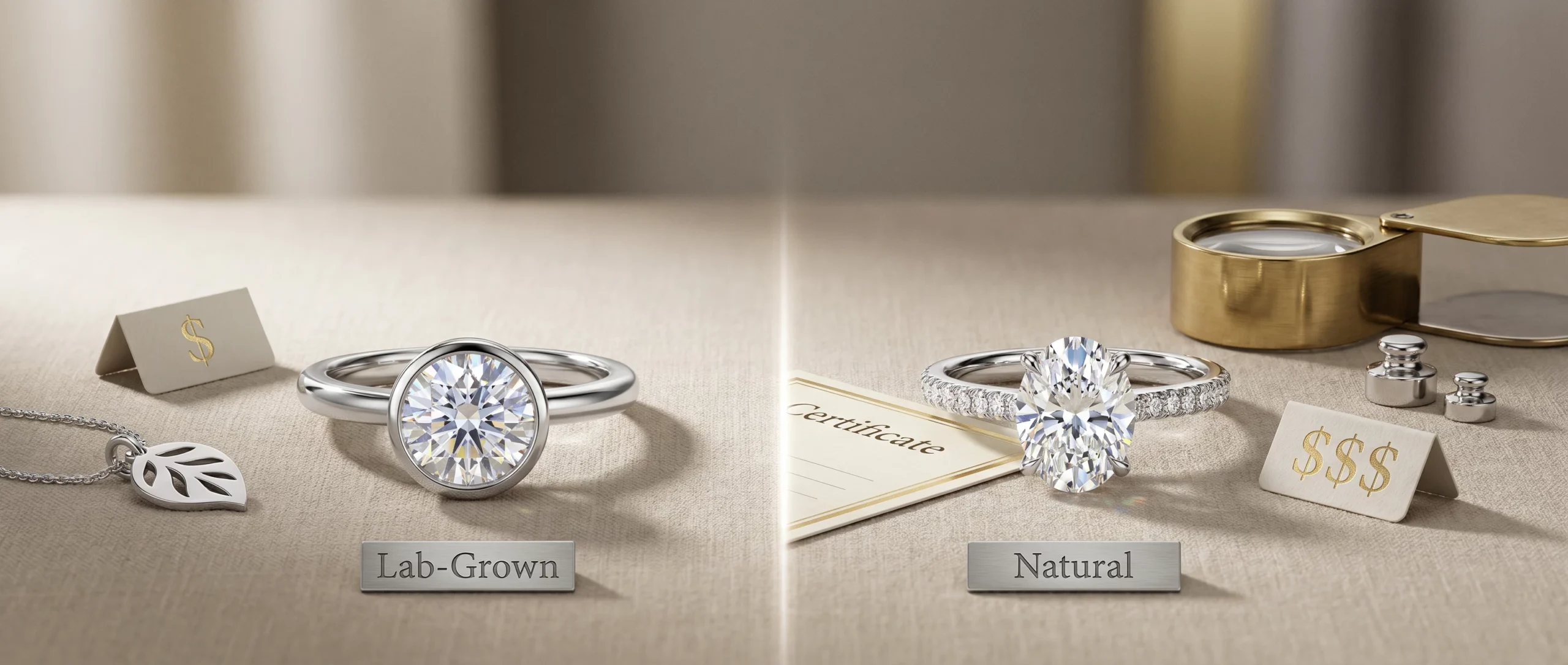
Lab grown diamonds now make up a large and growing share of the US engagement ring market. Some couples choose one without hesitation; others are certain they want mined; most are in the middle, trying to tell a genuine difference from marketing noise. Here’s the honest lab grown diamond vs natural comparison — what’s actually the same, what’s actually different, and how to decide.
First, the thing that confuses everyone: lab grown diamonds are real diamonds
A lab grown diamond is not a “fake” or a simulant. It is carbon arranged in the same crystal structure as a mined diamond, with the same hardness (10 on the Mohs scale), the same optical properties, the same fire and brilliance. A jeweler’s diamond tester reads it as a diamond because it is one. The only difference is origin: one formed in the earth over roughly one to three billion years; the other formed in a machine over a few weeks.
Two production methods:
- HPHT (High Pressure High Temperature) — mimics the earth’s conditions
- CVD (Chemical Vapor Deposition) — grows the crystal layer by layer from carbon-rich gas
Both produce gem-quality stones. Only specialized lab equipment (not the naked eye, not a standard jeweler’s loupe, not a diamond tester) can distinguish a lab grown diamond from a mined one — usually by tiny differences in trace elements or growth patterns.
The 4 Cs: same standards, same grading
Lab grown diamonds are graded on the identical scale — cut, color, clarity, carat — by the same labs (GIA, IGI). A G-color, VS1, excellent-cut lab diamond looks exactly like a mined stone with those specs, because the grading measures the stone, not its history. Use the free Diamond Cut Comparison Tool to see how cut grade affects sparkle regardless of origin.
Price: the biggest practical difference
This is why most people are here. A lab grown diamond typically costs 60–85% less than a mined diamond of the same specs — and the gap has widened as lab production has scaled.
| Specs | Mined (approx.) | Lab grown (approx.) |
|---|---|---|
| 1.0 ct, G, VS1, excellent cut | $5,500–$7,500 | $900–$1,800 |
| 1.5 ct, F, VS2, excellent cut | $10,000–$14,000 | $1,600–$3,000 |
| 2.0 ct, G, VS1, excellent cut | $18,000–$28,000 | $2,500–$5,000 |
Prices vary by shape, exact grade, retailer, and month — treat these as ballparks, not quotes.
Practically, the same budget buys a noticeably larger or higher-quality stone if you go lab grown — or the same stone for a fraction of the cost, freeing budget for the setting, the band, or the wedding itself. Model the tradeoff with the free Wedding Jewelry Budget Calculator.
Resale value: the honest answer
Neither type is a good investment, and this is where couples deserve straight talk.
- Mined diamonds typically resell for 20–40% of retail — the “diamonds hold value” idea is largely a myth at the consumer level, because retail markup is steep and the resale market is buyer-favorable.
- Lab grown diamonds currently have a weaker and less established resale market — often 10–30% of purchase price, sometimes less, partly because new lab stones keep getting cheaper.
If resale or heirloom trade-in value is genuinely important to you, that’s a point for mined. If you view the ring as a keepsake you’ll never sell — which describes most people — the resale gap is close to irrelevant, and the money saved upfront is real and immediate.
Ethics and sustainability: nuanced, not simple
Neither option is unambiguously “the ethical choice.”
Lab grown avoids mining’s land disruption and the risk of conflict diamonds, but it’s energy-intensive to produce; the environmental footprint depends heavily on whether the lab runs on renewable or fossil-fuel power, which most brands don’t disclose.
Mined has a real history of human-rights and environmental harm, but the modern Kimberley Process and traceable-origin programs (Canadian, Botswanan, and others) have improved conditions significantly, and diamond mining is a major source of income and infrastructure in several countries whose economies depend on it.
If ethics is your deciding factor, look for specifics — a lab brand that publishes its energy source, or a mined stone with documented country-of-origin — rather than a blanket claim from either side.
How to choose
Choose lab grown if:
- Getting the most size or quality for your budget matters most
- You want to keep the ring budget modest without compromising on the look
- Resale/heirloom value isn’t a consideration
- Avoiding mining impact is a priority and you’ll research the brand’s energy source
Choose mined if:
- The multi-billion-year natural origin has real romantic or symbolic meaning for you
- You want the (limited) resale and trade-in market that exists for natural stones
- You’re buying a stone specifically as a potential heirloom with trade-in value
- A documented-origin mined stone fits your ethical framing better than an undisclosed-energy lab
There is no wrong answer. A lab grown and a mined diamond of the same specs are visually identical on your hand and in every photo — the difference is what the origin means to you.
Always buy certified
Whichever you choose, insist on an independent grading report (GIA or IGI) for any diamond over ~0.3 ct, and confirm lab grown stones are laser-inscribed on the girdle with their report number and “lab grown.” This protects you at purchase, at appraisal, and at insurance time. Then choose a setting with the free Engagement Ring Metal Guide, and if gemstone symbolism appeals, the free Gemstone Soulmate Match tool reads stone meanings by sign. See also our guide to engagement ring styles.
Frequently asked questions
Are lab grown diamonds real diamonds?
Yes. They are chemically, physically, and optically identical to mined diamonds — the same carbon crystal structure, the same hardness, the same sparkle. They are graded on the same 4 Cs scale by the same labs. The only difference is that they’re grown in weeks rather than formed over billions of years.
Will a lab grown diamond pass a diamond tester?
Yes — a standard diamond tester reads thermal or electrical conductivity, and lab grown diamonds have the same properties as mined ones, so they test as genuine diamonds. Distinguishing the two requires specialized lab equipment.
How much cheaper are lab grown diamonds?
Typically 60–85% less than a mined diamond of the same cut, color, clarity, and carat, and the gap has been widening as production scales.
Do lab grown diamonds hold their value?
Not well — the resale market is newer and weaker than for mined stones, often 10–30% of purchase price. Mined diamonds also resell poorly (20–40% of retail), so neither is a sound financial investment.
Are lab grown diamonds more ethical than mined?
It’s not clear-cut. Lab grown avoids mining impact and conflict-diamond risk but is energy-intensive, and few brands disclose their power source. Modern mined diamonds with documented origin (Canada, Botswana) have improved dramatically. Look for specifics from whichever side you lean toward.
Can jewelers tell the difference between lab grown and natural?
Not by eye or with a standard loupe or tester. Identification requires specialized instruments that detect trace-element and growth-pattern differences, which is why reputable lab grown stones are laser-inscribed on the girdle.
The decision is yours
The practical facts: same look, same durability, same certification. Lab grown saves you a lot of money now; mined retains a small resale market and, for some people, a meaningful natural origin. Everything else is preference.
Compare cut grades with the free Diamond Cut Comparison Tool, and set your total with the Wedding Jewelry Budget Calculator.
Related reading
- Engagement Ring Styles 2026: Every Cut, Setting, and Metal Guide
- Ring Size Chart: US, UK, EU, Australian & Japanese Sizes (+ How to Measure at Home)
- Engagement Photo Ideas: 50+ Locations, Outfits, and Poses to Inspire Your Session
- Wedding Photography Styles Explained: Which One Is Right for You?
- More in Engagement Rings