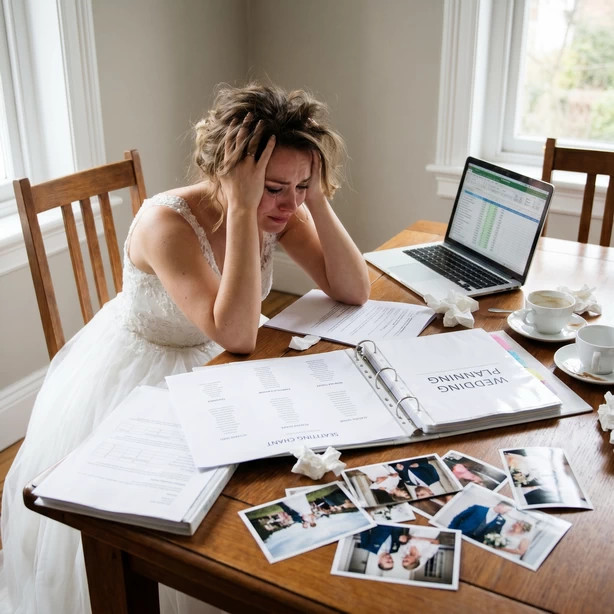
Are you excited about your engagement but already feeling weirdly… heavy about wedding planning?
Like, you’re happy. You love your person. You want the day.
But your brain is also doing that thing where it wakes you up at 3:12 a.m. like, “Did you book a photographer?” and then immediately follows it up with, “Wait, how much does a photographer cost?” and then, “Are we secretly ruining our families?” and then, “Should we elope?”
If that’s you. Yes. It’s normal.
Also, it’s more common than people admit. Most brides don’t post the messy parts. They post the ring selfie, the venue champagne pic, the cute “I said yes” sign. Not the crying-in-the-car after a “helpful” phone call with a relative. Not the spreadsheet spiral. Not the moment where you realize you’ve spent 45 minutes debating napkin colors and now you want to lie down forever.
So let’s say it out loud.
Wedding planning can be stressful enough to trigger what feels like a mental breakdown. And it doesn’t mean you’re ungrateful. It doesn’t mean you’re dramatic. It means you’re trying to plan a major life event, with money, emotions, expectations, and time pressure… often with zero training and a whole lot of opinions flying at you.
This article from Wedding Serenity is here to make you feel less alone and more in control. It covers practical advice but also addresses the emotional aspects of wedding planning because both matter.
If you’re considering unique ways to celebrate your love amidst all this stress, perhaps exploring some roots of love traditions could provide some inspiration. Remember, it’s important to stay grounded and focused on what truly matters during this journey – your love for each other.
First, a quick reality check: wedding planning is a lot
In the U.S., weddings are basically a full project management job layered on top of your normal life.
You’re coordinating vendors, making a budget, handling contracts, building a timeline, making decisions that feel permanent (even when they aren’t), and trying to keep relationships intact. You’re also supposed to enjoy being engaged. And keep up at work. And maybe exercise. And maybe sleep.
It’s no wonder so many brides hit a wall.
And here’s the tricky part.
Wedding stress doesn’t always look like “I’m stressed.” Sometimes it looks like:
- snapping at your partner over something tiny
- doom scrolling wedding TikTok and feeling worse
- avoiding planning altogether, then panicking about avoidance
- crying during perfectly normal tasks like addressing invites
- feeling guilty for not enjoying it “enough”
- overthinking every decision, then getting mad at yourself for overthinking
If any of that landed, you’re not broken. You’re overloaded.
The 5 biggest reasons brides spiral (and what to do instead)
Let’s get specific, because vague reassurance only goes so far when you have 14 tabs open and your mom is texting “Did you pick a venue yet?”
1. Budget overruns and money anxiety
This is a big one. For a lot of couples, the budget is the first fight, the first stressor, and the first source of shame.
You start with a number that sounds okay.
Then you price out venues. Then catering. Then you realize the “pretty” things add up fast. Florals, rentals, hair and makeup, alterations, stationery, tips. It’s not just one bill. It’s a thousand small decisions that quietly drain the account.
What helps: a budget that’s actually built for real life.
Not just a number. A plan.
- Start with your true ceiling (not the dream number, the real number).
- Build category ranges (not exacts) early, then tighten later.
- Track deposits and payment dates so you’re not surprised in month six.
- Decide in advance what you’ll splurge on and what you won’t.
Also, gentle reminder. A budget is not a moral test. It’s just a tool. You can have a beautiful wedding at many price points. The stress comes when the plan is fuzzy and every decision feels like a guess.
For many couples facing these challenges, seeking professional help can be beneficial. Services like those offered by Wedding Serenity can provide much-needed support in managing various aspects of wedding planning such as budgeting or vendor coordination which can significantly reduce stress levels.
Additionally, it’s important to remember that you’re not alone in this journey; numerous brides have experienced similar feelings of overwhelm during their wedding planning process. However, with effective strategies in place—like those mentioned above—this overwhelming task can be transformed into an enjoyable experience rather than an exhausting chore.
If you’re finding it particularly challenging to navigate through this phase of your life without succumbing to stress or anxiety, consider reaching out for help through resources such as Wedding Serenity. They offer expert advice and assistance tailored specifically for brides-to-be who are struggling with the pressures of wedding planning.
2. Vendor overwhelm (too many options, too much pressure)
The internet makes it seem like you should “shop around.” Which is true, but also… exhausting.
You look up photographers and there are 200. You start emailing. Half don’t respond. Some respond with pricing that makes your stomach drop. You finally get on a call with someone and you’re trying to sound calm while your brain screams, “I HAVE NO IDEA WHAT I’M DOING.”
What helps: a simple step by step vendor process.
Try this:
- Pick your top 3 priorities (what matters most for your day).
- For each vendor category, define what “good enough” looks like.
- Shortlist 3 to 5 vendors, max.
- Ask the same questions to each, so you can compare cleanly.
- Choose, book, move on. No endless second guessing.
The trap is thinking you need the “best.” You don’t. You need the best fit for you.
3. Family opinions and conflict
This is the part nobody puts on Pinterest.
Family dynamics get louder during weddings. Sometimes it’s because people care. Sometimes it’s because money is involved. Sometimes it’s because weddings stir up old roles and expectations.
You might hear things like:
- “We have to invite your second cousins.”
- “This isn’t how we do it in our family.”
- “If you don’t do a church wedding, your grandmother will be heartbroken.”
- “Why are you spending money on that?”
Even when it’s said nicely, it can feel like you’re being pulled away from your own wedding.
What helps: clear boundaries and a united front.
A few scripts that work (and don’t start World War III):
- “We’re keeping the guest list tight so we can stay within budget.”
- “We’re still deciding, but we’ll let you know once it’s finalized.”
- “We hear you. We’re making the choice that works best for us.”
- “If you’d like to contribute to that, we’re open to it. If not, we’re going another direction.”
And here’s a big one: You and your partner are a team now. Wedding planning is basically practice for future team stuff. So if family pressure is hitting you hard, pull your partner closer, not away.
Speaking of teamwork in wedding planning, consider incorporating unique traditions into your ceremony such as sweeping away bad luck with a Caribbean wedding ritual. This could serve as a beautiful metaphor for starting your new life together while also providing an opportunity to set clear boundaries with family about the direction of your wedding plans.
4. Decision fatigue (the hidden stress monster)
This is where the mental breakdowns really come from. Not one big thing. Just… too many things.
Because weddings require decisions on:
- guest list
- venue
- date
- photographer
- color palette
- dresses
- suits
- shoes
- signage
- favors (do people even want favors?)
- seating chart (why is this a puzzle from hell?)
- ceremony details
- reception flow
- music choices
- food choices
- bar choices
After a while, even simple questions feel impossible. You stop trusting yourself. You start asking six people for opinions. You get more confused.
What helps: decision rules.
Try these:
- If it doesn’t affect the guest experience, it gets 10 minutes.
- If you can’t tell the difference between option A and B, pick the cheaper one.
- If it’s not one of your top 3 priorities, choose “simple” on purpose.
- If you’re stuck, ask: “Will I care about this in a year?”
Also, consider setting “planning hours.” Like, Tuesday and Thursday 7 to 8 p.m. That’s it. No constant wedding brain. You get your life back.
5. The emotional pressure to make it “the best day ever”
This one is sneaky.
The messaging around weddings is intense. It’s supposed to be magical. Flawless. Worthy of photos that will live forever. A reflection of your love, your taste, your family, your entire personality.
That is… a lot to put on one Saturday.
What helps: redefining success.
A successful wedding is not a perfect production.
A successful wedding feels like you.
It’s a day where you marry your person, people feel welcomed, and you don’t spend the whole time managing chaos.
You’re allowed to want it to be beautiful. Of course. But perfection is a stress machine. And the weird truth is, letting go of perfection usually makes the day feel better anyway.
When it comes to choosing the right venue, Florida wedding venues offer some stunning options that can help reduce stress and allow for a more enjoyable planning experience.
What a structured, guided approach actually changes
If wedding planning has been feeling like chaos, structure can feel like someone finally turned the lights on.
Not structure in a rigid, controlling way. More like… a calm path. A checklist that actually makes sense. A system that tells you what to do now, what can wait, and what you can ignore.
Here’s what guided wedding planning tends to help with the most.
You stop carrying it all in your head
When you have a clear roadmap, you don’t have to constantly mentally juggle.
You know:
- what month you should book what
- what decisions matter first
- what contracts to look out for
- how to track payments and deadlines
- how to build a timeline that doesn’t feel rushed
And once it’s on paper, it’s not spinning in your brain at night.
You make smarter budget decisions (without panic spending)
A step by step plan helps you allocate money based on real priorities, not fear.
Because panic spending is a thing. You get stressed, you feel behind, you throw money at the problem. Or you book something too quickly because you’re scared it’ll disappear.
A calm plan reduces that.
You protect your relationship
This matters more than people admit.
Wedding planning can turn into a cycle where every conversation becomes logistics. Or worse, an argument. Not because you’re incompatible, but because you’re tired.
Structure helps you split tasks clearly, set check in times, and avoid constant low grade conflict.
And it creates space for the fun parts again. The ones you actually want to remember.
You get your time back
Most brides don’t need more motivation. They need fewer rabbit holes.
A guided approach cuts down on:
- endless research
- second guessing
- redoing decisions
- trying to “figure out what’s next”
You do the next right thing. Then you go live your life.
You feel supported, not judged
This is huge, especially if you’re the first in your friend group to get married, or you don’t have family support, or you just don’t want to dump every stress on your bridesmaids.
A supportive planning space means you can ask “Is this normal?” and not feel silly.
Because it is normal. A lot of this is normal. You just haven’t done it before.
A calmer way to plan (a simple framework you can steal)
If you’re overwhelmed, don’t try to fix everything today. Start with this.
Step 1: Choose your top 3 priorities
Examples:
- great photos
- great food
- packed dance floor
- intimate vibe
- low stress day
- meaningful ceremony
Write them down. This becomes your filter for decisions.
Step 2: Set a budget range and a guest count range
Not exact. Range.
Because “We think 120 to 150 guests” is more useful than pretending it’s exactly 132.
Same with budget. A range gives you breathing room.
Step 3: Lock in the big 3 (venue, date, key vendors)
Most timelines depend on these. Everything gets easier once they’re handled.
Step 4: Make planning boring on purpose
That sounds strange, but it works.
Put planning into a weekly routine, use checklists, track decisions in one place. Reduce drama. Reduce chaos.
Step 5: Create a boundary plan for family input
Decide:
- who gets a vote
- who gets an opinion
- who gets a polite update afterward
This alone can lower stress fast.
When it’s more than stress (and you should take it seriously)
Sometimes “wedding planning breakdown” is a sign you’re running on empty in general.
If you’re having panic attacks, not sleeping, not eating well, or feeling depressed, it’s okay to get support outside of wedding planning too. Talk to your doctor or a therapist if you can. Lean on trusted friends. Ask your partner to step in more.
You don’t get extra points for suffering quietly.
And you definitely don’t need to earn calm. You’re allowed to create it.
Where something like Wedding Serenity Club fits in (without making it a big dramatic decision)
Some brides want a full service planner, and that’s great.
Other brides want something more approachable. A guided program. A clear system. A place to get support and stop feeling like they’re guessing.
That’s where a step by step membership style approach, like the Wedding Serenity Club, can be genuinely helpful. Not because you can’t plan your own wedding. You can.
But because planning is easier when you’re not doing it alone, and when you’re not reinventing the wheel at midnight.
Think of it like having a calm planning guide in your corner. Helping you stay organized, make smart decisions, and actually enjoy your engagement again. Less scrambling. More steady progress.
Not perfection. Just… steadier.
Also, if you’re considering floral arrangements for your wedding ceremony that will truly wow your guests, be sure to explore some stunning ideas here: Wedding Ceremony Floral Arrangements That Wow.
A quick reminder before you go
If you’ve been feeling overwhelmed, behind, or like you’re “bad at wedding planning,” you’re not.
You’re a normal person planning a big event in a world that makes weddings feel like a performance.
Take a breath. Choose the next small step. Put the rest down for today.
And if you want support and a clearer path, it’s okay to seek that out. The goal isn’t to prove you can do it the hard way.
The goal is to get married feeling present, loved, and like yourself.
FAQs (Frequently Asked Questions)
Why do I feel overwhelmed and stressed during wedding planning even though I’m excited about my engagement?
Feeling overwhelmed during wedding planning is completely normal. While you’re happy and in love, the process involves managing numerous decisions, budgets, expectations, and emotions all at once. This mental load can trigger stress responses like overthinking, crying unexpectedly, or snapping at loved ones. Remember, it’s not a sign of being ungrateful or dramatic; it’s simply the reality of planning a major life event often without prior experience.
How can I manage budget anxiety and avoid overspending on my wedding?
Budget overruns are one of the biggest stressors for brides. To manage this, start with your true financial ceiling—not just a dream number—and create category ranges for expenses early on. Track deposits and payment deadlines carefully to avoid surprises. Decide in advance which elements you want to splurge on and where you can save. Remember, a budget is a tool to help you plan realistically, not a moral test. Seeking professional help from services like Wedding Serenity can also provide valuable support.
What are some signs that wedding stress is affecting me even if I don’t openly admit it?
Wedding stress doesn’t always look like obvious anxiety. It might show up as snapping at your partner over small things, doom scrolling wedding content and feeling worse, procrastinating on planning then panicking later, crying during routine tasks like addressing invites, feeling guilty for not enjoying the process enough, or overthinking every decision and then getting frustrated with yourself. Recognizing these signs means you’re overloaded and need to take steps to manage your stress.
How can I stay grounded and focused on what truly matters during the hectic wedding planning process?
It’s important to remember that your wedding day is ultimately about celebrating your love for each other. Exploring meaningful traditions—like roots of love ceremonies celebrated by Amazonian tribes—can inspire unique ways to honor your relationship amidst the chaos. Prioritize what brings you joy and connection rather than getting lost in endless details. Taking breaks, setting boundaries with family opinions, and seeking support when needed can help keep you centered.
Is it common to feel conflicted about big decisions like whether to elope or have a large wedding?
Yes, many couples experience conflicting feelings such as questioning whether to elope versus hosting a big celebration. These thoughts often arise from stress and pressure surrounding logistics, costs, and family dynamics. It’s normal to weigh different options carefully; what’s most important is choosing what feels right for you both without guilt or external pressure.
Where can I find practical advice and emotional support for managing wedding planning stress?
Resources like Wedding Serenity offer comprehensive guidance that addresses both the practical aspects—like budgeting and vendor coordination—and the emotional challenges of wedding planning. Their blog provides helpful articles while their services offer personalized support tailored to brides facing overwhelm. Utilizing such expert help can make the entire process more manageable and enjoyable.