The honeymoon sits in an unusual position in wedding budgeting: it’s the trip couples look forward to most, but the one most likely to be planned without a clear budget in place.
The result is often sticker shock — a trip that costs far more than expected — or a honeymoon that feels constrained because funds were depleted by the wedding itself. This guide covers the average honeymoon cost in 2026, real budget ranges by destination type, what drives the price at each tier, and how to build a number that reflects both what you want and what you actually have.
Figures are 2026 planning estimates for two people travelling together, not financial advice. Airfare and seasonality move them significantly — treat them as a starting point for your own research.
What the Average Honeymoon Costs
The US average honeymoon spend is roughly $4,500–$5,500 per couple for a week-long trip, according to recent bridal-industry surveys. That figure includes accommodation, flights, food, excursions and incidentals.
The Knot 2026 Real Weddings Study puts the average honeymoon at $5,500, and The Knot’s honeymoon research found that 69% of couples planned a honeymoon in 2024, with trips lasting about seven days on average.
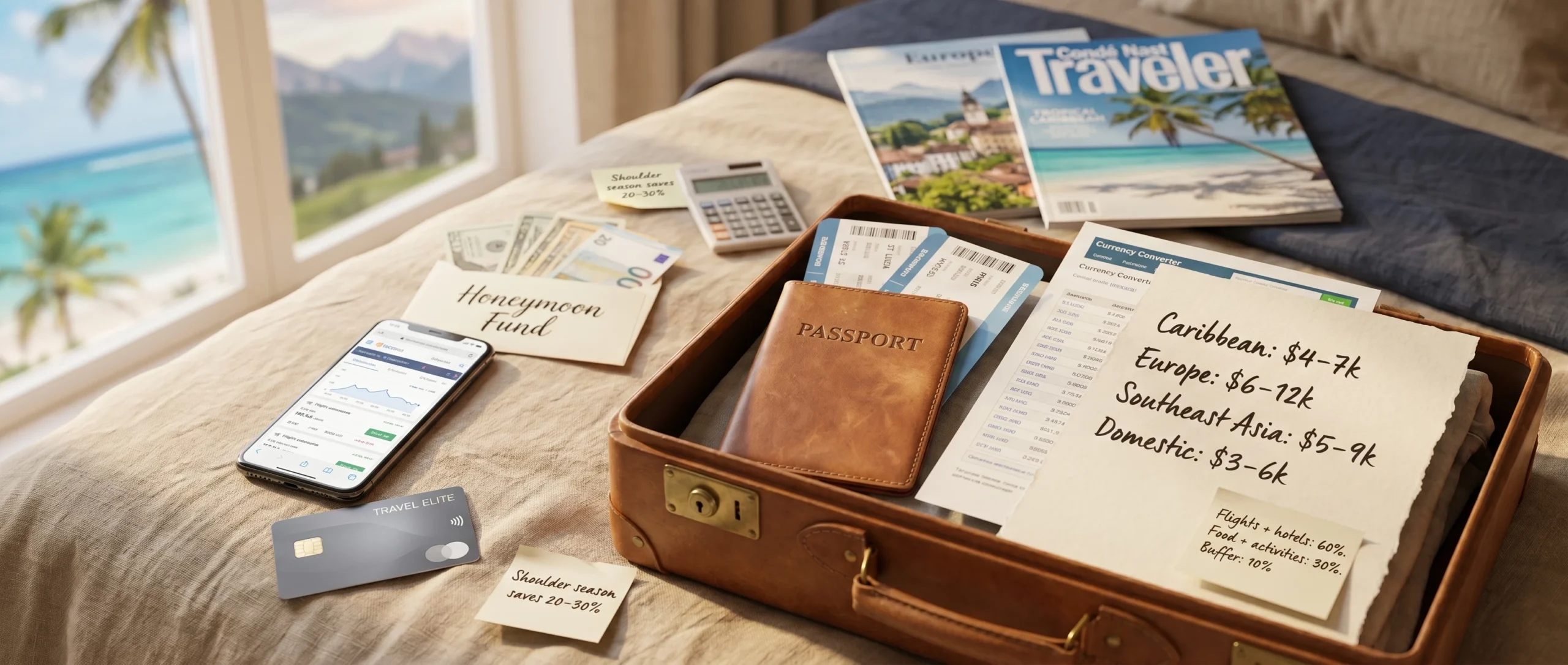
What the average hides is that the range is enormous. A long weekend in a nearby city can cost $1,500. A two-week European trip with boutique hotels runs $10,000–$20,000. Both are honeymoons. The more useful question isn’t “what’s average?” — it’s “what does our specific honeymoon actually cost, and how does that compare to what we can spend without starting married life on a credit-card balance?”
Cost Ranges by Destination Type
| Destination type | Budget range (per couple) | Typical trip length |
|---|---|---|
| Caribbean all-inclusive | $3,500–$8,000 | 7 nights |
| Domestic US road trip / national parks | $2,500–$6,000 | 7–10 nights |
| Southeast Asia (Thailand, Bali, Vietnam) | $3,000–$8,000 | 10–14 nights |
| Hawaii | $5,000–$14,000 | 7–10 nights |
| Europe (Paris, Amalfi, Santorini, Portugal) | $7,000–$20,000 | 10–14 nights |
| Maldives / overwater luxury | $8,000–$25,000+ | 7 nights |
Caribbean all-inclusive
All-inclusive resorts in Jamaica, the Dominican Republic and Mexico (Cancún, Riviera Maya) bundle accommodation, meals, drinks and most activities into one price, which makes budgeting predictable. Cost drivers: resort tier, room category (suite vs. standard), time of year, and flight distance. Peak season (December–April) runs 20–40% higher than shoulder season (May–June, November). Typically extra: spa services, premium excursions like catamaran tours or scuba certification, restaurant upgrades within the resort, and airport transfers.
Hawaii
Hawaii combines long-haul domestic flights from most US cities with accommodation that runs from $250–$700/night for a solid hotel to $600–$1,500/night for a resort or luxury property. Maui and Kauai are generally more expensive than the Big Island; Oahu is the most accessible and usually the most affordable per night. Food costs run above US mainland averages — budget $150–$250/day for two at mid-range restaurants.
Europe
European honeymoons vary dramatically by country and season. Portugal (Lisbon, the Algarve) runs significantly cheaper than Italy (Amalfi, Positano) or Greece (Santorini, Mykonos); Paris sits in the middle. Primary costs: transatlantic flights ($800–$2,000 per person depending on seat class and timing), accommodation ($200–$600/night for a quality hotel), and daily expenses ($200–$400/day for food, transport and activities). Santorini specifically is iconic but expensive — $500–$1,200/night for a cliffside cave hotel in July–August. Shoulder season (May, September, October) reduces costs sharply and is often a better experience.
Southeast Asia
Southeast Asia offers the best value in honeymoon travel. Bali is the most popular destination in this category — beautiful, well-developed for tourism, and far more affordable than comparable luxury in Europe or the Caribbean. Flights are the primary cost ($1,200–$2,500 per person depending on routing and class). Once there, a luxury villa in Bali runs $200–$500/night, and food and transport are low-cost. Thailand offers similar value with more variety across Bangkok, Chiang Mai and the islands.
Domestic road trip / national parks
A domestic trip — the Pacific Coast Highway, Rocky Mountain parks, the American Southwest, New England in autumn — eliminates international airfare entirely. Primary costs: car rental ($60–$120/day), accommodation ($150–$400/night depending on style), fuel, food and park fees. National park lodges inside Yellowstone, Zion and Grand Canyon book up 12+ months in advance and are typically modestly priced; private rentals near park gates offer more space at competitive rates.
Maldives / overwater luxury
The premium tier: overwater bungalows, full-board pricing, and long-haul flights from the US or Europe. All-inclusive pricing typically runs $800–$2,000/night per couple, with the property covering all meals and most non-motorised water activities. Bora Bora, Fiji and private-island resorts follow a similar structure.
The Cost Breakdown by Category
| Category | Approximate share of total |
|---|---|
| Flights | 25–35% |
| Accommodation | 35–45% |
| Food & dining | 10–20% |
| Activities & excursions | 8–15% |
| Local transport | 3–7% |
| Incidentals & shopping | 5–10% |
Flights and accommodation together typically represent 60–80% of total trip cost. These are the two levers that most affect your budget — shifting your dates by two weeks to land in shoulder season, or choosing a destination one flight-tier closer, changes the total more than economising on meals ever will.
Timing the Honeymoon
Many couples don’t take their honeymoon immediately after the wedding, and that’s entirely normal and often practical. A delay of one to six months allows better flight prices (booked further ahead), off-peak timing at the destination, recovery from wedding expenses, and more time to plan a trip you’ll actually enjoy rather than one thrown together in the exhausted week after the wedding. Telling hotels and airlines “this is our honeymoon” sometimes unlocks a room upgrade or a small welcome touch — it doesn’t always work, but it costs nothing to mention.
A Worked Example
A couple with a $6,000 honeymoon budget and a preference for beach-and-relaxation has two realistic paths. A 7-night Caribbean all-inclusive at a mid-tier resort in shoulder season: roughly $1,000 flights, $3,800 resort, $600 excursions and spa, $600 incidentals — about $6,000, fully covered, with everything prepaid. Or a 12-night Bali trip: $2,800 flights, $2,400 villa, $500 food and transport, $300 activities — about $6,000 for nearly twice the length, but with more planning and a longer flight. Neither is “better”; the all-inclusive trades length for predictability, and Bali trades a long-haul flight for time and value.
Frequently Asked Questions
How do we fit the honeymoon into an already stretched wedding budget?
Set the honeymoon budget before you start the wedding budget, not after. Treating it as a fixed line item from the start prevents it from getting quietly squeezed every time the wedding runs over.
Is a honeymoon registry a good idea?
For many couples, yes. A honeymoon registry — where guests contribute toward specific experiences, a night at a hotel, or a dinner — often receives strong participation because guests feel they’re funding a memory rather than an object. It works especially well for couples who already share a home and don’t need traditional registry items.
When should we book?
For peak-season travel (summer Europe, the Caribbean December–March), 8–12 months out is not too early for flights and key accommodation. For shoulder season or more flexible destinations, 4–6 months typically suffices.
What’s the most common honeymoon budgeting mistake?
Underestimating food and incidentals. Couples plan flights and hotels carefully, then discover the daily spend — meals, excursions, tips, local transport, a few souvenirs — runs $100–$200/day more than they pictured.
Should we fly business class?
Worth considering for long-haul flights (10+ hours) where seat class meaningfully affects how you arrive. For trips under 8 hours, the premium is harder to justify. If you upgrade one direction, make it the overnight outbound so you arrive rested.
How do we decide between nearby-affordable and far-away bucket-list?
Neither is wrong. An accessible trip that leaves you financially comfortable for the first year of marriage is often better than an extraordinary trip that creates stress afterward. Decide together, based on what genuinely matters most to both of you rather than what photographs best.
Book the Honeymoon You Can Enjoy Without Stress
The best honeymoon is one you can fully enjoy — which means not thinking about the bill while you’re on it. A trip scaled to your actual budget, wherever that lands, beats the “perfect” trip that overshoots what you have. Project a cost range for your specific destination, trip length and accommodation style with the free Honeymoon Budget Calculator, and keep the honeymoon as its own protected line in your wedding budget breakdown.
Related reading
A note on the numbers: where a figure above links to a source, it comes from that source. The remaining ranges in this guide are planning rules of thumb and vendor-reported estimates rather than survey results, so confirm them against quotes in your own market.