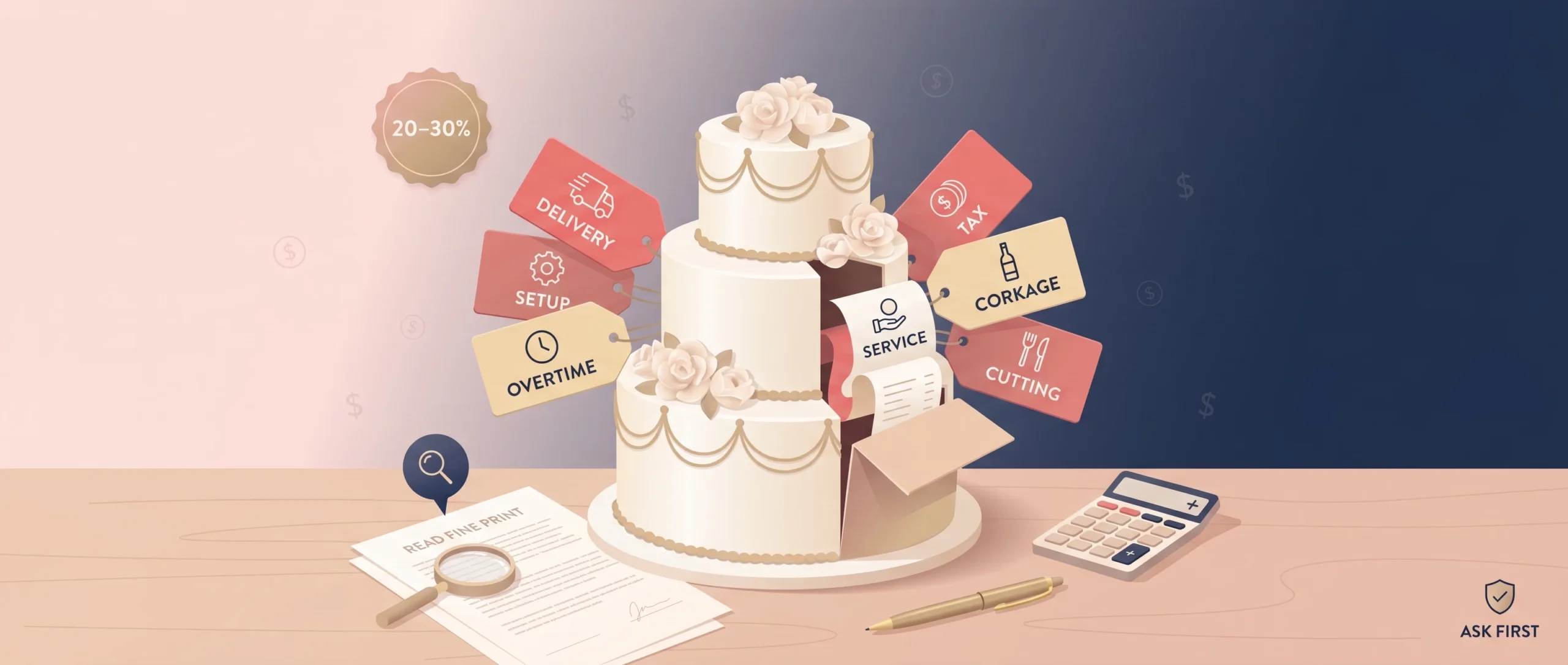
Most couples walk into venue meetings with a budget in mind. Most walk out having signed something that doesn’t quite match it.
The average wedding ends up costing 20–30% more than the couple’s original plan — not because of careless decisions, but because the wedding industry presents prices in a way that makes the full cost difficult to see until you’re well into the booking process. A $12,000 venue quote becomes $16,500 by the time the contract is final, and nobody set out to overspend. This guide covers the hidden wedding costs that consistently catch couples off guard, where they show up in the planning timeline, and exactly what to ask before you commit to anything.
Figures below are 2026 US planning estimates, not financial advice — prices vary by market, season and guest count. Use them to know what questions to ask, then replace them with your own written quotes.
The Venue: Where Hidden Costs Begin
Venue pricing is the most common source of budget surprises. The headline number — the room rental fee — rarely reflects the real cost of the space once catering, staffing and required add-ons are attached.
Service charges
Most catering contracts include a service charge of 18–24%, applied to the entire catering bill: food, beverage, and sometimes the rental itself. This is not a gratuity that goes to your servers — it’s a revenue line for the venue or catering company. Gratuity for the serving staff is typically additional, and many contracts state this explicitly in a line most couples skim past.
On a $15,000 catering order, a 22% service charge adds $3,300 before you’ve tipped anyone. On a $25,000 order it’s $5,500. This single line is the most common reason a catering quote and a catering invoice don’t match.
Add-ons and mandatory minimums
Many venues require a food-and-beverage minimum — a guaranteed amount you’ll spend on catering regardless of your final headcount. If your guest count drops from 130 to 105 after RSVPs, you’re still paying the minimum built for 130. Ask what the minimum is and whether it’s negotiable for off-peak dates.
Common charges that appear after the initial quote:
- Cake-cutting fee — $3–$5 per person when you bring an outside cake (for 120 guests, $360–$600)
- Corkage fee for bringing your own wine
- Parking, valet, or a shuttle requirement
- Coat check
- Security requirements for evening events
- Setup and breakdown fees
- Overtime charges if your event runs past the contracted end time
- A “plating fee” for desserts brought in from an outside baker
Ask for the full cost breakdown — including every mandatory add-on and standard fee — in writing, before you sign anything.
The events that aren’t in the reception quote
Many venues quote the reception only. A more elaborate cocktail hour than the standard package, a welcome reception, or a day-after brunch for out-of-town guests all appear separately — sometimes from different vendors entirely, sometimes at a higher per-head rate because they fall outside the main booking.
Catering and Bar: The Details That Add Up
Vendor meals
Catering is quoted per person, but the number of “persons” can be larger than your guest list. Many catering contracts charge vendor meals at the full per-head rate — your photographer, videographer, second shooter, DJ and officiant can add four to six full covers without appearing on your guest count. At $120 per head, that’s $480–$720. Some caterers offer a discounted vendor-meal rate; you have to ask for it and get it in writing.
Bar packages and timing
Open-bar packages are quoted for a set number of hours. A ceremony at 4pm and a reception ending at midnight is eight hours; many bar packages cover four or five. The additional hours bill at a separate — often higher — rate. Late-night beverage service, specialty cocktails and a Champagne toast are frequently quoted separately from the main reception package.
Linen, china and rental upgrades
Standard venue packages often include only basic white linens and standard china. The chargers, coloured linens, chairs, table numbers and centrepiece vessels shown in the venue’s marketing photos may all be rentals at additional cost — often several dollars per place setting, which adds up fast across 15 tables.
Photography, Flowers, and Music
Photography
- Travel and location fees — photographers include travel within a certain radius of their studio. Destination travel, ferry crossings, tolls and remote-location fees bill additionally.
- Overtime — if the timeline slips (a late ceremony, extended portraits), overtime applies, typically $250–$500 per hour beyond the contracted time.
- Second shooter — the portfolio photos you’re comparing were often taken with two-photographer coverage. Confirm whether a second shooter is included or a $300–$800 add-on.
- Print rights — most modern contracts include full-resolution files with personal printing rights, but some restrict printing to prints purchased through the photographer. Read the clause.
Flowers and décor
Your floral quote covers the flowers. Delivery, on-site setup, and end-of-night breakdown are separate charges in many florist contracts — typically 15–25% of the floral order total. Rented items (arches, votives, certain vessels) come with a minimum order and a late-return fee if they aren’t collected the next morning. Out-of-season blooms substituted at the last minute cost more than planned-for alternatives, so confirm what’s genuinely in season for your month.
Music
DJ contracts specify a number of hours; overtime applies if the dance floor is still full when the contracted time ends. Many DJs also charge an early-setup fee for arriving well before the event. A reception DJ or band contract typically does not include ceremony music — ceremony musicians are a separate booking. Uplighting, dance-floor lighting and effects are usually quoted separately, adding $500–$2,000.
Paper, Postage, and Stationery
Wedding invitation suites often exceed a standard letter’s weight. An invitation with an inner envelope, an RSVP card and a decorative liner can cost $1.40–$1.75 per envelope to mail rather than the standard first-class rate — and if you include a pre-stamped RSVP return envelope, you’re paying that twice. For 150 invitations, the difference between planned and actual postage can be $200 or more. Hand-weigh a completed suite at the post office before buying stamps, and use the invitation postage calculator to check. Day-of stationery — menus, escort cards, table numbers, programs — is almost always separate from the invitation suite and routinely left out of the initial stationery budget.
The Costs at the End: Gratuities and Final Payments
Vendor gratuities
Tips are not included in any vendor contract. For a 100-person wedding with a full vendor team, total gratuities typically run $500–$1,500+ across all vendors combined. Knowing who to tip, how much, and when is one of the most common last-minute panic moments — our wedding vendor tipping guide has amounts by role and a plan for handing out envelopes.
Final-payment cash flow
Most vendors require final payment 30 days before the wedding. With eight to ten vendors, you may need to move $15,000–$30,000 within a single 30-day window — on top of gratuities and any last-minute additions. Many couples don’t account for that concentration when they set up a payment plan, and end up scrambling in the month they can least afford the stress.
How to Find Hidden Costs Before You Sign
- Ask for an itemised all-in quote — service charge, tax, delivery, setup, breakdown and every mandatory fee in writing, before you compare vendors against each other. A “cheaper” vendor with a 24% service charge and separate breakdown fees can cost more than a “pricier” all-inclusive one.
- Read the full contract — specifically the sections on overtime, cancellation, force majeure, and what’s excluded. Most contracts are straightforward once you know what you’re looking for.
- Budget 10% contingency — before you allocate any category, set aside 10% of your total as an unallocated buffer. Hidden costs will use it.
- Ask vendors what prior couples wished they’d known. Most will tell you honestly — they’ve watched the surprises happen before.
Frequently Asked Questions
What percentage should I add to my budget for hidden costs?
10–15% is the planning standard. Couples with complex weddings — many vendors, destination elements, large guest counts — should use 15%. This is separate from the money you allocate to named categories; it’s an unallocated buffer.
Are service charges the same as gratuity?
No. A service charge goes to the venue or catering company as revenue. Gratuity goes to the individual staff who served your event. Many contracts include a service charge and explicitly state it is not distributed to servers — meaning a separate staff tip is still appropriate.
Do all vendors charge overtime fees?
Most do. Photographers typically charge $250–$500 per hour; venues often have flat overtime minimums that can be steep. Know your contracted end time for every vendor and build buffer time into the day’s schedule so a 20-minute delay early doesn’t cascade into paid overtime at the end.
Is the cake-cutting fee negotiable?
Sometimes — it’s worth asking, especially if you’re booking the venue for a larger event or an off-peak date. Some venues waive it; others won’t. Get the answer in writing before your final invoice so it isn’t a surprise line.
What’s the most common budget overage?
Catering — specifically the service charge, vendor meals and bar overtime — followed by décor rentals and stationery postage. If you pressure-test only one category for hidden costs, make it catering.
When do hidden costs typically surface?
Early-stage costs (add-ons, minimums, rental upgrades) appear at contract review. Late-stage costs (gratuity, overtime, final-payment timing) appear in the last month before the wedding. Planning for both phases is what keeps surprises manageable.
Read the Quote, Not Just the Number
Every vendor quote you receive is a starting point, not a final price. Your job is to turn every quoted number into an all-in number before you sign — because most hidden costs aren’t hidden by intent, they’re just not automatically included in what vendors present upfront. Run your venue and catering quotes through the free Wedding Hidden Fee Detector to flag the surcharges couples miss most, and keep your overall total visible with the wedding budget breakdown framework and the average wedding cost in 2026.
Related reading
- Wedding Invitation Postage Guide: US and Canada
- How Much Does a Rehearsal Dinner Cost in 2026? (Real Ranges by Format)
- How Much Food Do You Need for a Wedding? (Per-Person Quantities by Format)
- Wedding Photographer Cost 2026: What You're Actually Paying For
- How Much Does a Wedding Venue Cost in 2026? (By Region + Hidden Fees Exposed)
- Wedding Photography Styles Explained: Which One Is Right for You?
- Wedding Dress Sizing Guide: Why Bridal Sizes Run Small + Brand-by-Brand Chart
- Wedding DIY Mistakes That Cost More Than They Save
- More in Wedding Budget
- The Swinging Truth