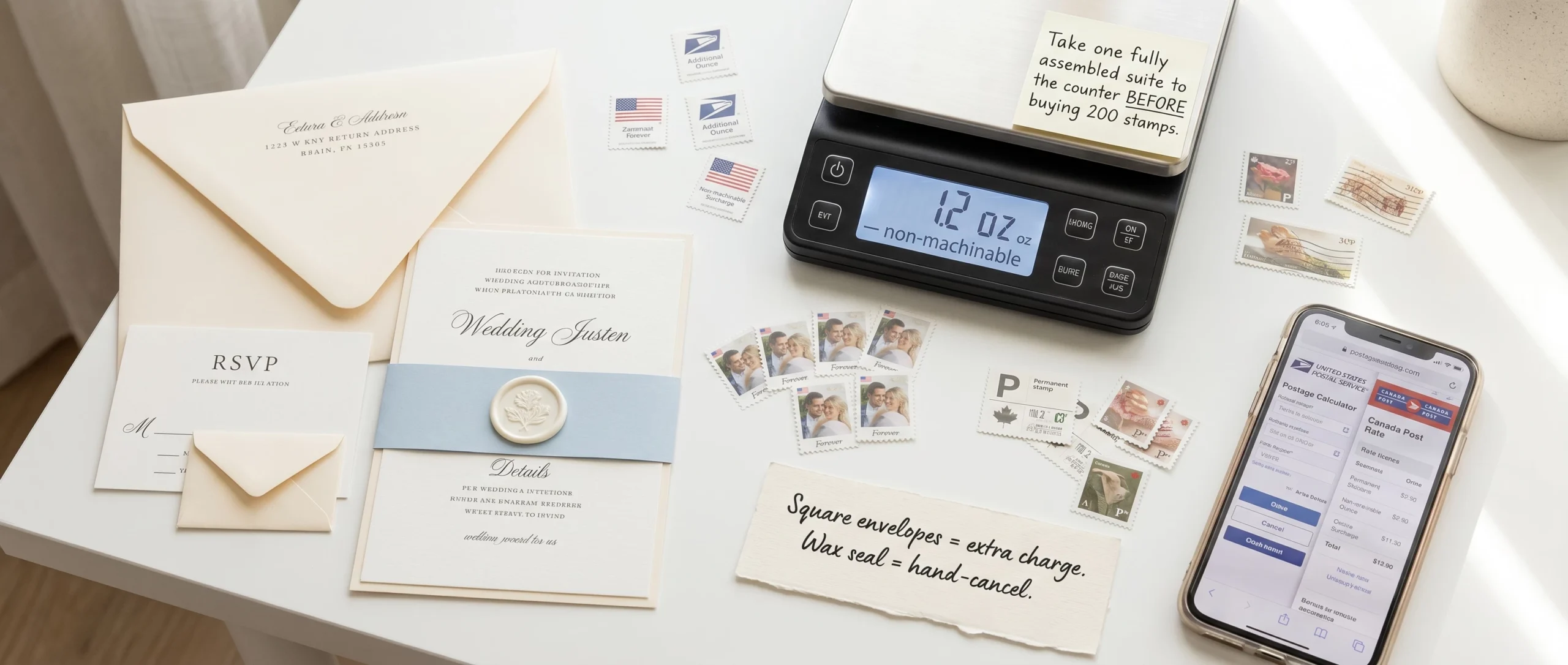
Wedding invitation postage is one of the most overlooked logistics in the mailing process — until 200 envelopes come back undeliverable, or you discover at the post office that you’ve bought the wrong stamps.
The core issue: most wedding invitations don’t qualify for a standard first-class letter stamp. They’re heavier, sometimes larger, and often irregularly shaped. Paying standard postage on a non-standard suite means a meaningful percentage will be returned or arrive “postage due.” This guide covers how to calculate the right wedding invitation postage for US and Canadian invitations before you buy a single stamp.
Why Wedding Invitations Usually Need Extra Postage
A standard first-class letter in the US (under 1 oz, standard rectangular size) costs $0.73 as of early 2026. Most wedding invitation suites exceed that threshold because of:
- Weight. A typical suite — outer envelope, invitation card, inner envelope, RSVP card and RSVP envelope — weighs 1.5 to 3 oz. Every additional ounce above 1 oz adds $0.24 in US postage.
- Size. Non-standard envelopes (square, oversized, unusually shaped) trigger a USPS non-machineable surcharge, currently $0.40 per piece. Square invitations almost always trigger this.
- Thickness and rigidity. Very rigid envelopes — with acrylic, vellum or board inserts — may be classified non-machineable regardless of size.
- Wax seals. A wax seal adds thickness and can jam postal machinery. Many couples hand-cancel wax-sealed envelopes at the post office to avoid damage; this is typically free if you bring them in unsealed and ask.
USPS Postage Rates for Wedding Invitations (2026)
| Weight | Standard rectangular | Non-standard / square |
|---|---|---|
| Up to 1 oz | $0.73 | $1.13 |
| Up to 2 oz | $0.97 | $1.37 |
| Up to 3 oz | $1.21 | $1.61 |
| Up to 3.5 oz | $1.45 | $1.85 |
These rates are for first-class mail and are updated periodically — verify current rates at usps.com before buying stamps. Most wedding invitations fall in the 2–3 oz range; if your suite includes a square envelope, budget for the non-standard surcharge on every piece.
How to Calculate Your Actual Postage
- Assemble one complete suite exactly as it will be mailed — every insert, the inner envelope, the RSVP card and the RSVP return envelope.
- Weigh it at a post office. Postal scales are more accurate than a kitchen scale, and the counter can give you the exact rate on the spot. Bring the suite assembled but unsealed.
- Note the envelope dimensions. Measure the outer envelope. If it exceeds 11.5″ × 6.125″, or is square, you’ll pay the non-standard surcharge.
- Multiply by quantity plus a buffer. Add 10–15 to your planned count for addressing errors, late additions and damaged envelopes.
The free Wedding Invitation Postage Calculator walks through this with your specific weight, size and quantity and gives you a total in one step.
A worked example
Say you’re sending 130 invitations. Your suite is an outer envelope, a 5″ × 7″ invitation card, an inner envelope, an RSVP card and an RSVP return envelope, and it weighs 2.4 oz assembled. The outer envelope is a standard rectangle, so you’re in the “up to 3 oz, standard” column: $1.21 per piece. That’s $157.30 for the outgoing invitations. Add 130 RSVP return stamps at $0.73 = $94.90. Buy 15 extra of each for errors and late additions: about $22 more. Total postage: roughly $275 — a line item most couples never see coming, and one that lands right when final vendor payments are also due.
Now change one thing: make the outer envelope square. Every piece jumps to the non-standard column at $1.61, adding $52 to the outgoing total for the same invitations. The envelope shape is worth deciding with the postage cost in view.
Addressing and Assembly Notes That Affect Postage
- Assemble before you weigh, not after. The inner envelope, tissue liners and any belly band all add weight. Weigh the finished article.
- Calligraphy and wax add negligible weight but real bulk. A thick calligraphy nib doesn’t change the ounce, but a raised wax seal can push a borderline envelope into non-machineable territory.
- Overseas guests need their own calculation. International letter rates are charged per piece and are significantly higher; mail these 2–3 weeks earlier than domestic.
- Keep 5–10 unstamped spares. If an address changes after you’ve mailed, you want a spare suite you can stamp for the exact new rate rather than guessing.
Don’t Forget Return Postage
Every RSVP card needs a pre-stamped return envelope if you expect guests to use it. The RSVP envelope is usually smaller and lighter, typically qualifying for a standard first-class stamp at $0.73. For 150 invitations, RSVP return postage alone is roughly $110 at current rates — add it to your postage budget before you shop for stamps.
Canada Post Rates (2026)
| Weight | Domestic rate |
|---|---|
| Up to 30g (about 1 oz) | $1.15 |
| Up to 50g (about 1.75 oz) | $1.94 |
| Up to 100g (about 3.5 oz) | $2.71 |
Non-standard sizes may also attract surcharges — check canadapost-postescanada.ca for current rates and size requirements. For invitations mailed across the US–Canada border (common for cross-border guest lists), use the relevant international letter rate, which is significantly higher per piece.
Beautiful Postage Options
Many couples want their postage to match the aesthetic of the suite. A few options: USPS custom photo stamps through an approved vendor program (real postage printed with your image); vintage or collectible stamps sold at face value through USPS and Canada Post philatelic programs, or by estate-sale and philatelic vendors — using multiple small-denomination stamps to reach the correct total is entirely valid and often beautiful; and hand-cancelling, a free service you request so machine cancellation doesn’t obscure the stamp design.
Mailing Timeline
- 6–8 weeks before: save-the-date cards, if using them, go out well ahead of formal invitations.
- 8–12 weeks before: formal invitations mailed. For destination weddings or events requiring significant travel, 12 weeks is the minimum.
- RSVP deadline: set it 3–4 weeks before the wedding — enough time to finalise catering numbers and seating.
Allow 5–7 business days for domestic delivery in the US and Canada; mail international addresses 2–3 weeks earlier.
Frequently Asked Questions
Can I just use two regular stamps?
For a 2 oz invite in a standard rectangular envelope, two Forever stamps slightly overpay but work. The problem is a square envelope or anything that triggers the non-machineable surcharge — two Forever stamps won’t cover it.
What happens if I underpay postage?
The post office returns the envelope to you, or delivers it “postage due” so the recipient must pay to receive it. Neither is a good outcome for a wedding invitation.
Can I buy stamps online instead of going to the post office?
Yes, at usps.com or canadapost-postescanada.ca. But to weigh your assembled suite and confirm the exact rate, one post-office visit for the test run is worth the trip.
What if different guests get different inserts?
Weigh each version separately. Guests receiving accommodation cards or additional enclosures get a heavier suite that may need different postage.
Should I put a stamp on the RSVP envelope?
Yes, if you want a strong response rate. Guests who have to find and affix a stamp RSVP at significantly lower rates than guests with a pre-stamped envelope.
Test One Before You Buy a Hundred
The single most important piece of advice: bring one complete, assembled suite to the post office before buying stamps for all of them. A 15-minute visit tells you exactly what rate applies and what stamps to buy. Buying 200 stamps before confirming the rate is the most common — and most avoidable — invitation postage mistake. It’s also one of the hidden wedding costs that catches couples off guard.