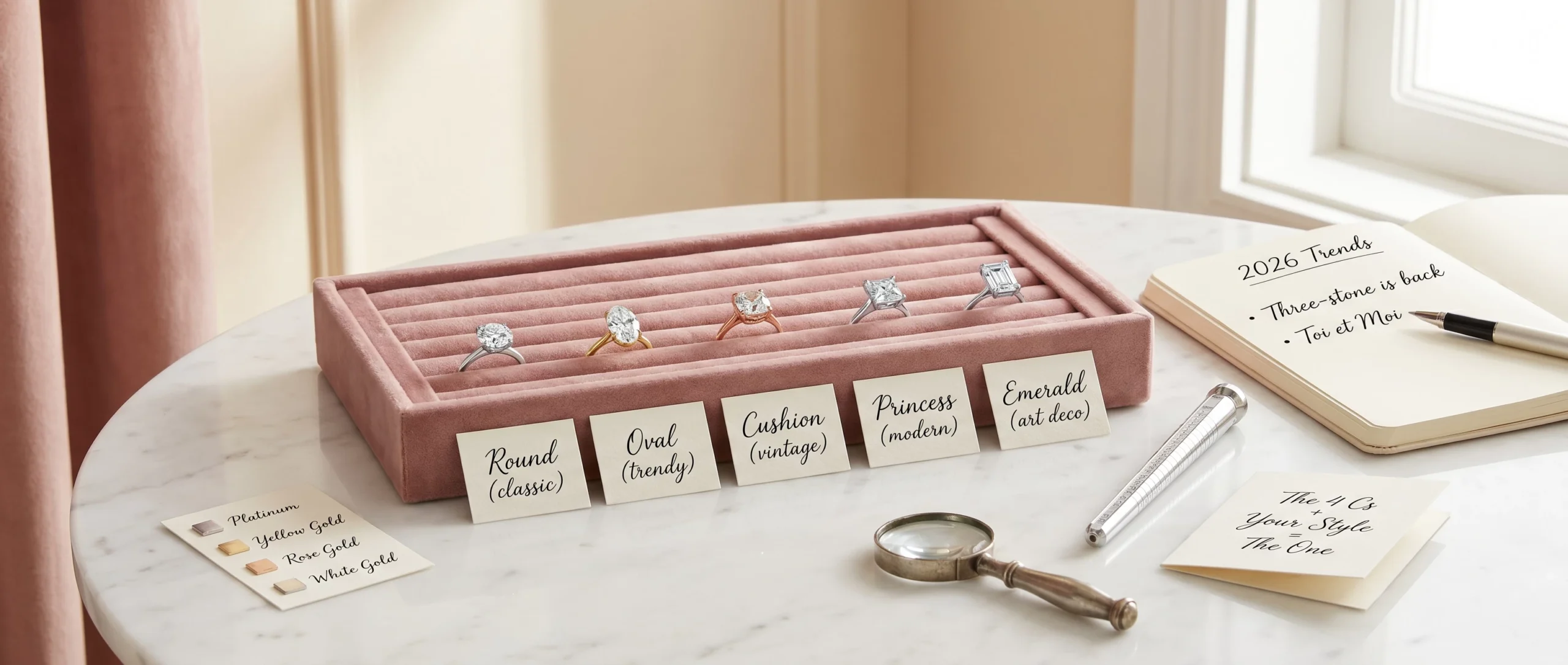
Choosing an engagement ring is one of the most personal purchases in a relationship — and one of the most confusing if you haven’t bought diamonds before. The terminology is dense, the options are vast, and the price difference between similar-looking rings can be enormous.
This guide breaks down every major component of engagement ring styles: diamond cuts, ring settings, and metals. Understanding each helps you decide based on what you actually want, not what the person behind the counter recommends.
Diamond and Stone Cuts
The “cut” refers to the shape of the stone — the most visually defining characteristic of a ring.
Round Brilliant
The most popular cut, roughly 60% of all engagement rings sold. It maximises light return, giving more sparkle than almost any other shape. The safest choice for someone unsure what they want, and it holds resale value better than fancy shapes. The trade-off: round brilliants command a significant price premium over comparably sized fancy shapes.
Oval
The fastest-growing cut in recent years. Ovals offer the brilliance of a round in an elongated shape that visually lengthens the finger, and a well-cut oval looks larger than a round of the same carat weight. Watch for the “bowtie effect” — a dark shadow across the centre of poorly cut ovals. View the stone in person or via high-quality video before buying.
Cushion
A square or rectangular cut with rounded corners, combining a vintage aesthetic with excellent light performance. Cushions look romantic and slightly softer than rounds. Two sub-styles: standard cushion (wider light pattern, slightly less sparkle) and cushion modified brilliant (more similar to round).
Emerald
A rectangular step-cut with long parallel facets, producing a distinctive “hall of mirrors” effect rather than bright sparkle. Elegant and elongating, but it shows inclusions more readily — making clarity a more important factor in stone selection.
Pear
A hybrid between oval and round, worn with the point toward the fingertip to elongate the finger. The asymmetry requires careful prong placement to protect the point.
Marquise
An elongated cut with pointed ends at both sides. It maximises visible carat weight, appearing significantly larger than a round of the same weight. Requires secure prongs at both points. Polarising but increasingly reappearing in fashion-forward styles.
Princess
A square cut with strong brilliance. Popular in the 2000s and 2010s, now somewhat less dominant but still a clean, geometric choice. The four corners require protective prongs.
Radiant
A rectangular or square brilliant cut — essentially the sparkle of a round in a more geometric shape. One of the more versatile fancy shapes.
Asscher
A square step-cut similar to the emerald but with a higher crown and deeper facets, producing a windmill-like reflection and a strongly Art Deco aesthetic. Works best when it’s genuinely your style.
Rose Cut
A vintage-inspired cut with a domed, faceted top and flat bottom. Less sparkle than modern brilliant cuts — more of a subtle glow. Popular in vintage-style and non-traditional rings.
Ring Settings
The setting describes how the stone is held and largely determines the overall aesthetic.
- Solitaire — one stone, minimal band, maximum focus on the diamond. The most classic and enduring; works with any cut; rarely goes out of style.
- Halo — a central stone surrounded by a circle of smaller diamonds, making the centre stone appear larger and adding sparkle. Very popular in the 2010s; still common but slightly less dominant now.
- Pavé — small diamonds set along the band’s surface for sparkle throughout. Often combined with a solitaire or halo.
- Vintage / milgrain — settings that reference historical styles (Art Deco, Victorian, Edwardian). Milgrain is a beaded edge detail that creates an antique appearance.
- Three-stone — a central stone flanked by two side stones, traditionally symbolic of past, present and future.
- Bezel — the stone encircled by a thin metal collar rather than prongs. Secure and modern-looking; a good choice for active people.
- Cathedral — the band arches up on both sides to meet the stone, creating height and a more dramatic profile.
- Tension — the stone appears suspended between the two ends of the band, held by the tension of the metal. Bold and architectural; polarising.
Metal Choices
- Platinum — the most durable precious metal for engagement rings. Dense, naturally white, hypoallergenic, and it displaces rather than removes when scratched. Typically costs 20–40% more than comparable gold, and shows a fine-scratch “patina” that many wearers come to prefer.
- White gold — gold alloyed with white metals and plated with rhodium for a bright white appearance. More affordable than platinum and nearly identical immediately after plating. The rhodium wears off over 1–3 years, revealing a slightly warmer tone; re-plating is a routine, inexpensive service.
- Yellow gold — the most traditional metal, seeing a strong resurgence. Pairs well with warm-toned stones and vintage-inspired settings. 14k is harder and more scratch-resistant; 18k has a richer colour but dents more easily.
- Rose gold — gold alloyed with copper for a warm pink tone. Durable (copper adds hardness) and particularly flattering against warm skin tones.
2026 Engagement Ring Trends
- Elongated stones (oval, pear, marquise) continue to dominate interest
- Yellow and rose gold are maintaining the comeback that started in the late 2010s
- Vintage-inspired settings (milgrain, Art Deco geometric) are increasing alongside non-round cuts
- East-West settings — the stone mounted horizontally rather than vertically — especially for emerald and marquise cuts
- Coloured centre stones — sapphire, morganite, green tourmaline — growing as alternatives to white diamonds
- Low-profile bezels in yellow gold — minimal, modern, practical for active wearers
- Lab-grown diamonds — now mainstream, typically 50–70% less expensive than natural for equivalent size and quality (see our lab-grown vs. natural diamond guide)
Frequently Asked Questions
Which diamond cut is most popular?
Round brilliant is still the most purchased cut globally, but oval has closed the gap significantly in the last five years.
Which cut looks biggest for the budget?
Oval, pear and marquise cuts appear larger than rounds of the same carat weight due to their elongated surface area. Emerald and Asscher cuts often appear slightly smaller.
Does the setting affect the price significantly?
Yes. A halo setting can add hundreds to a few thousand dollars depending on the metal and the size of the halo diamonds. A plain solitaire with a simple band is typically the most affordable setting for any given centre stone.
Is platinum worth the premium?
For someone who wants low-maintenance durability and is sensitive to metals, yes. For someone budget-conscious who’s comfortable with periodic re-plating, white gold achieves a very similar appearance at lower cost.
Are lab-grown diamonds a good choice?
If size and quality per dollar matter more than rarity and resale value, yes. They’re chemically identical to natural diamonds and visually indistinguishable. They carry less resale value, which rarely matters for most buyers.
How do I know what she wants?
Have the conversation — most couples discuss ring preferences before a proposal. If it needs to be a surprise, her closest friend, sister or mother usually knows.
Know What You Want Before You Walk In
Understanding cuts, settings and metals turns the jeweller consultation from a confusing sales experience into a productive decision. Go in knowing your preferred shape, setting direction, metal preference and budget. Start with the free Engagement Ring Style Quiz to identify which cuts and settings match your aesthetic, and the Ring Size Converter for sizing across standards.