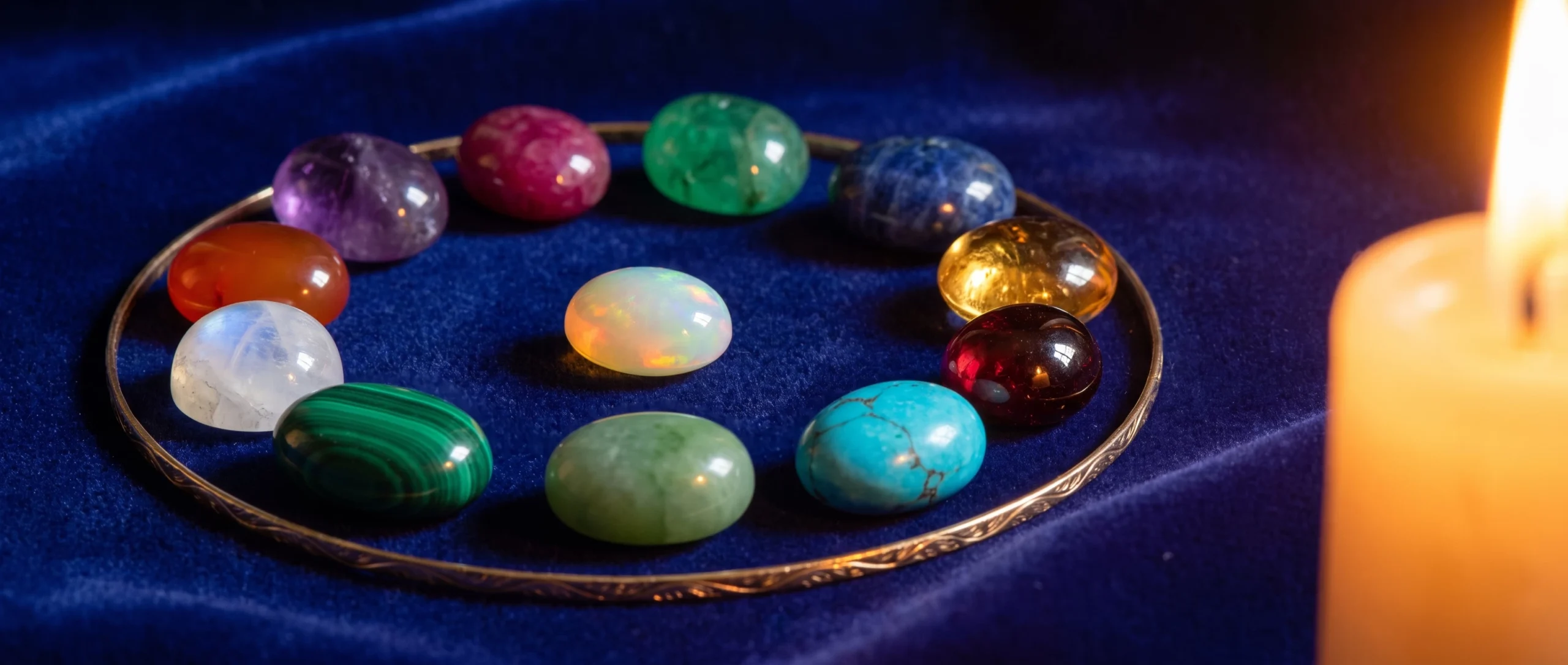
Your birthstone by month is the gem traditionally tied to your birth month — one stone (sometimes two or three) with its own color and its own symbolism. January is garnet, a deep protective red. April is diamond. September is a velvet-blue sapphire. December gives you a choice of blue-green stones, including turquoise and tanzanite.
Here is the full list, what each stone is believed to mean, and the part most charts skip: how a bride can wear a primary birthstone and a bridal stone at the same time, so the jewelry she carries down the aisle actually says something.
The full birthstone chart by month
The modern list below is the one standardized by the jewelry trade (the American Gem Society and the Gemological Institute of America both publish versions of it). Where a month has more than one stone, the first is the most common.
| Month | Birthstone(s) | Color | Traditionally symbolizes |
|---|---|---|---|
| January | Garnet | Deep red | Protection, loyalty, steady devotion |
| February | Amethyst | Purple | Clarity, calm, sincerity |
| March | Aquamarine (also bloodstone) | Pale sea-blue | Serenity, safe passage, courage |
| April | Diamond | Colorless | Enduring love, strength, clarity |
| May | Emerald | Green | Rebirth, fidelity, deep love |
| June | Pearl, moonstone, alexandrite | Cream / glowing white / color-shift | Purity, intuition, adaptability |
| July | Ruby | Vivid red | Passion, vitality, the “king of gems” |
| August | Peridot (also spinel, sardonyx) | Olive-green | Strength, warmth, good fortune |
| September | Sapphire | Royal blue | Wisdom, loyalty, faithfulness |
| October | Opal, tourmaline | Iridescent / pink-green | Hope, creativity, imagination |
| November | Topaz, citrine | Golden yellow | Joy, warmth, abundance |
| December | Turquoise, tanzanite, zircon, blue topaz | Blue to violet | Friendship, good fortune, protection |
Traditional vs. modern: a few months differ between the older “traditional” list and the modern one — March was once bloodstone, June was once only pearl, and November was once only topaz. If a family heirloom uses a different stone than the chart above, it’s likely following the traditional list.
What your birthstone is believed to mean
Birthstone meaning is folklore layered over centuries — the practice traces to the twelve stones on the breastplate of Aaron described in the Book of Exodus, reinterpreted through Roman, medieval European, and Victorian jewelry traditions. The month-by-month assignments most people know today were formalized by the National Association of Jewelers (now Jewelers of America) in 1912.
The meanings cluster into a few themes:
- Protection stones — garnet, turquoise, and December’s blue stones were carried by travelers.
- Love and fidelity stones — emerald, ruby, sapphire, and diamond all show up in engagement and anniversary tradition for exactly this reason.
- Clarity and calm stones — amethyst and aquamarine.
- Abundance and joy stones — citrine and topaz.
None of this is a prediction. It’s a language — a way of choosing a stone because of what you want it to stand for on a particular day, not just because of when you were born.
Birthstone by zodiac sign
There’s a parallel system that assigns stones to zodiac signs rather than calendar months, which matters if your birthday lands near a sign cusp:
| Sign | Zodiac stone |
|---|---|
| Aries | Bloodstone / diamond |
| Taurus | Sapphire / emerald |
| Gemini | Agate / pearl |
| Cancer | Emerald / moonstone |
| Leo | Onyx / ruby |
| Virgo | Carnelian / sapphire |
| Libra | Peridot / opal |
| Scorpio | Beryl / topaz |
| Sagittarius | Topaz / turquoise |
| Capricorn | Ruby / garnet |
| Aquarius | Garnet / amethyst |
| Pisces | Amethyst / aquamarine |
Many people wear both — the calendar stone and the sign stone — and read the pairing as a fuller portrait.
For brides: the primary stone and the “bridal” stone
Here’s the piece a jeweler’s chart won’t tell you. A bride is rarely wearing just one meaningful stone on her wedding day. There’s usually a small stack:
- Her primary birthstone — hers, by birth month.
- Her partner’s birthstone — often set into a band, a locket, or a hidden charm on the bouquet stem.
- A “bridal” stone — chosen for the marriage itself, not for either person. Sapphire (loyalty), emerald (fidelity), and moonstone (new beginnings) are the classic picks.
- Something borrowed and blue — frequently a stone: a grandmother’s aquamarine, a sapphire pin.
Where each one sits has meaning too. Traditionally: protective stones close to the body (a charm on the bouquet, a pin inside the dress), love stones on the hands, and the “new beginning” stone somewhere visible — earrings, a pendant.
Get your bridal stone stack in under a minute with the free Bride’s Birthstone Story — enter your birth month and your partner’s, and it maps your primary stone, your secondary, a bridal stone chosen for the marriage, and where tradition says to wear each.
How to actually use your birthstone
- In the engagement ring. Birthstone engagement rings are having a real moment — a sapphire or emerald center with diamond accents costs far less than an all-diamond ring and carries a story.
- As “something blue.” March’s aquamarine, September’s sapphire, and December’s turquoise all cover the blue tradition and the birthstone tradition at once.
- As a bridal party gift. A tiny birthstone charm for each bridesmaid, keyed to her own month, is a low-cost gift that doesn’t feel generic.
- In the bouquet. A birthstone charm wired to the bouquet stem — yours, your partner’s, or a late loved one’s — is a quiet, private inclusion.
Frequently asked questions
What is my birthstone? It’s the stone assigned to your birth month on the chart above — for example, a May birthday is emerald, an October birthday is opal or tourmaline. If your birthday is near the start or end of a month and you also follow astrology, you may want to look at your zodiac stone as well.
Why do some months have more than one birthstone? The jewelry trade added alternatives over the last century, usually to give people a more affordable or more available option. June (pearl, moonstone, alexandrite), August (peridot, spinel, sardonyx), and December (turquoise, tanzanite, zircon, blue topaz) each have three official stones.
What’s the difference between traditional and modern birthstones? Modern birthstones are the 1912 standardized list still used by most jewelers. Traditional birthstones are older European assignments — a few months differ, most notably March (bloodstone), June (pearl only), and November (topaz only).
What is the rarest birthstone? Alexandrite (June) is among the rarest — a color-change stone that looks green in daylight and red under warm light. Fine natural alexandrite is rarer and more valuable than diamond by carat.
Can I wear a birthstone that isn’t mine? Yes. Many people choose a stone for its meaning rather than their month — a bride might wear moonstone for new beginnings regardless of when she was born. Birthstones are a language of intention, not a rule.
Your stone is a small, wearable story
A birthstone chart tells you which gem belongs to which month. What it doesn’t tell you is that on your wedding day you get to layer several of them — yours, your partner’s, one for the marriage itself — and that where you place each stone is part of the meaning.
Map your full bridal stone stack with the free Bride’s Birthstone Story. It takes about a minute and gives you a primary stone, a secondary, a bridal stone chosen for the union, and a where-to-wear-it guide you can screenshot and send to whoever’s helping you get ready.
Related reading
- “Something Blue” Meaning: The Full Rhyme, Explained
- Birth Flower by Month: The Full List and What Each One Means
- Wedding Superstitions: 20 Traditions and What They Mean
- More in Wedding Meaning & Folklore