Couples plan their wedding in terms of events — the ceremony, the first dance, the send-off. What gets missed is the connective tissue: how long hair and makeup really takes, when the photographer needs you, how long it takes 120 guests to move from ceremony to cocktail hour. A realistic wedding day timeline is the difference between a day that flows and a day that scrambles from behind all afternoon.
The core principle: work backward from your ceremony
Your ceremony start time is the fixed point. Everything before it is calculated backward; everything after it is calculated forward.
Backward from the ceremony:
- Guests should be seated 15 minutes before — so guest arrival music starts 30 minutes before.
- You need to be hidden and ready 30 minutes before (or done with a first look 90 minutes before).
- Photographer arrives for “getting ready” shots 2–3 hours before.
- Hair and makeup finishes 60–90 minutes before the photographer needs you (buffer for touch-ups and dressing).
- Hair and makeup starts: count 45 minutes per person for hair, 45 for makeup, running two stylists in parallel, plus 30 minutes of setup. For a bride plus 4 bridesmaids, that’s roughly a 4-hour window.
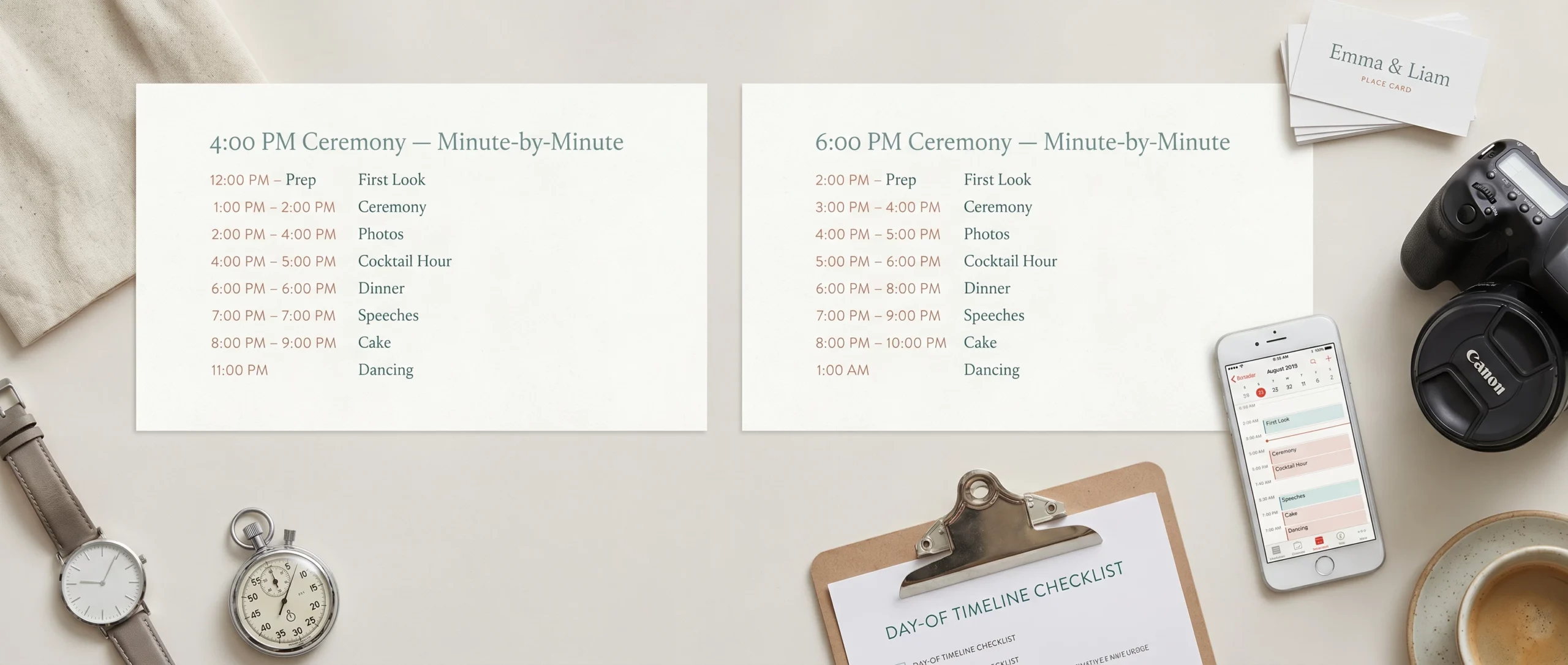
Sample timeline: 4:00 pm ceremony (no first look)
| Time | What’s happening |
|---|---|
| 9:00 am | Hair & makeup team arrives, sets up |
| 9:30 am | Getting-ready begins (bridesmaids first, bride’s makeup last) |
| 12:30 pm | Photographer & videographer arrive; detail shots (dress, rings, invites, shoes) |
| 1:15 pm | Bride’s hair & makeup finishing; bridesmaids dressed |
| 1:45 pm | Bride gets into dress; “first look with dad” or bridesmaids |
| 2:15 pm | Bridal party photos (getting-ready location) |
| 2:45 pm | Travel to venue / move to ceremony area; hide the couple |
| 3:15 pm | Photographer shoots the empty ceremony space, then guests arriving |
| 3:30 pm | Guest arrival music; ushers seating |
| 4:00 pm | Ceremony |
| 4:30 pm | Ceremony ends; cocktail hour begins |
| 4:35 pm | Family formals (list of 8–12 groupings, ~3 min each) |
| 5:00 pm | Wedding party + couple portraits |
| 5:40 pm | Couple gets 15 min alone / joins the tail of cocktail hour |
| 5:55 pm | Guests moved into the reception space |
| 6:00 pm | Grand entrance → first dance → welcome toast |
| 6:20 pm | Dinner served |
| 7:15 pm | Toasts (2–4, kept to 3–4 min each) |
| 7:40 pm | Parent dances |
| 7:50 pm | Dance floor opens |
| 8:30 pm | Cake cutting (quiet moment, doesn’t stop dancing) |
| 9:45 pm | Last dance / private moment |
| 10:00 pm | Send-off; vendors break down |
Sample timeline: 6:00 pm ceremony (with a first look)
A later ceremony plus a first look front-loads the photography and leaves the whole evening for guests.
| Time | What’s happening |
|---|---|
| 12:00 pm | Hair & makeup begins |
| 3:00 pm | Photographer arrives; details |
| 3:30 pm | Bride dresses |
| 4:00 pm | First look + couple portraits (45 min) |
| 4:45 pm | Wedding party photos |
| 5:15 pm | Family formals |
| 5:40 pm | Everyone hidden; guests arrive |
| 6:00 pm | Ceremony |
| 6:25 pm | Cocktail hour (couple joins after ~15 min of golden-hour photos) |
| 7:15 pm | Grand entrance, first dance, dinner |
| 8:15 pm | Toasts, parent dances |
| 8:40 pm | Open dancing |
| 10:30 pm | Send-off |
First look: it changes the whole day
Choosing a first look — a private, staged moment where the couple sees each other before the ceremony — is the single biggest structural decision for your timeline.
With a first look: most portraits (couple, wedding party, and often family) happen before the ceremony. You attend most of your own cocktail hour, dinner starts sooner, and the evening is unhurried.
Without a first look: you preserve the aisle moment, but 60–90 minutes of photos happen during cocktail hour, and you’ll likely miss most of it. Build a longer cocktail hour (75–90 min) and a tight, pre-planned family shot list to protect the schedule.
Neither is wrong — but decide early, because vendors build their timelines around it.
Build buffer time in everywhere
The most common timeline failure is chaining tasks with zero slack. Rules that hold up:
- Add 15 minutes to every hair/makeup estimate.
- Add 15–20 minutes for every location change (people move slower than you think in formalwear).
- Family formals always run long — shorten the list, not the time. Assign a bridesmaid or coordinator to round people up by name.
- A 4:30 ceremony end doesn’t mean a 4:31 cocktail hour — guests trickle.
- Leave one genuinely empty 15-minute block in the afternoon as a shock absorber.
Build and stress-test yours with the free Wedding Day Timeline Builder, and plan the morning separately with the Wedding Morning Schedule Builder.
Who gets a copy of the timeline
- Every vendor — photographer, videographer, DJ/band, florist, caterer, planner, officiant, transportation. Send it 2 weeks out; confirm 48 hours before.
- The wedding party — a simplified version with only their call times and locations.
- Both sets of parents — so they know when family photos happen and aren’t wandering off.
- Your point person — the coordinator or the one organized friend who runs the day so you don’t have to.
Frequently asked questions
What time should a wedding ceremony start?
Most work backward from sunset for photos. A 4:00–5:00 pm ceremony in most US seasons gives good light for portraits and a natural flow into an evening reception. Church or venue rules, and dinner timing, adjust this.
How long does a wedding day actually last for the couple?
From the first hair appointment to the send-off, plan for 10–13 hours. That’s why building in rest, food, and a few quiet minutes matters.
How much time do I need for wedding photos?
Roughly: 30–45 min for couple portraits, 30 min for wedding party, 30–45 min for family formals. A first look lets most of this happen before the ceremony instead of during cocktail hour.
How long should cocktail hour be?
60 minutes with a first look (photos are done); 75–90 minutes without one, so you have time for portraits and still greet some guests.
When should hair and makeup start on the wedding day?
Count ~45 minutes per person per service with two artists working in parallel, plus 30 minutes setup, and finish 60–90 minutes before the photographer needs you. For a bride plus 4 attendants, start around 4–4.5 hours before that finish time.
Do I need a day-of coordinator to run the timeline?
Not strictly, but someone other than the couple has to own it — a hired coordinator, a venue captain, or a trusted, organized friend who is not in the wedding party and not expected to also enjoy the day as a guest.
Build it early, share it widely
Draft your timeline as soon as your ceremony time and photographer are booked — it will change five times, and that’s fine. The goal is that on the day itself, nobody is asking “what’s next?” because it’s written down and everyone who needs it has a copy.
Start with the free Wedding Day Timeline Builder, and coordinate outfit changes with the Wedding Day Outfit Timeline Planner. Pair it with your wedding ceremony order of events and a packed wedding day emergency kit.
Related reading
- Wedding Day Emergency Kit: The Complete List (Print and Pack)
- How Many Songs Do You Need for a Wedding? Reception Playlist Math
- Father Daughter Dance Songs: 50 Picks From Timeless to Modern
- Wedding Ceremony Readings: Classic, Modern, and Non-Religious Options
- How Long Is a Wedding Ceremony? (By Type + Ready-to-Use Program Outline)
- Best Honeymoon Destinations 2026: By Budget, Vibe, and Travel Style
- Bridal Fitness Timeline