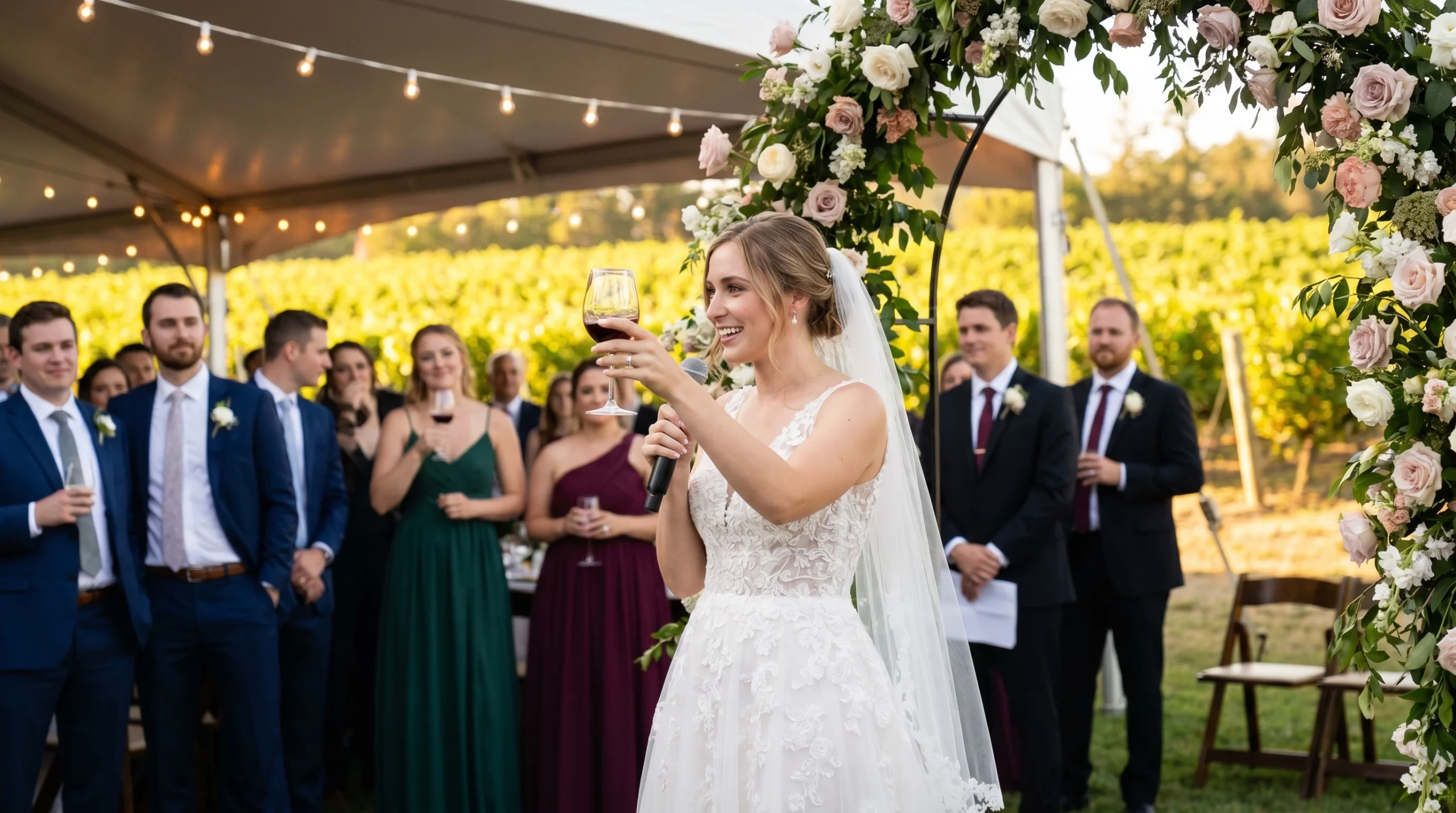
If you volunteered to give a wedding toast and now you’re thinking, “why did I do that?”, you’re not alone.
Wedding toasts are sweet, short, public, emotional. This exact combo makes a lot of people cry mid-sentence or go completely blank while holding a champagne flute like it weighs fifty pounds.
The good news is this: you do not need to become a “great public speaker” to give a great wedding toast. You just need a plan that keeps you steady, centers the couple, and gives your nerves fewer places to hijack you.
This guide is built for the real moment. The mic squeaks. Everyone is looking. The couple is glowing. Your throat tightens. You still get through it.
What people really mean when they search “wedding toast without crying or freezing”
Usually, it is one of these:
- “I cry any time I talk about love or family and I do not want to sob into the mic.”
- “I get stage fright and my mind goes blank.”
- “I want it to be heartfelt but not rambly.”
- “I’m terrified I will embarrass myself or the couple.”
So we are going to cover all of it: writing, structure, practice, what to do with your hands, and emergency steps if you start crying or freezing anyway.
Start with the goal. Not perfection
A wedding toast is not a TED Talk; it is a small gift.
Your goal is:
- Honor the couple
- Share one or two true, specific moments
- Offer a warm wish for their life together
- Get out before people start checking the bread basket
If you do that, you win.
For more tips on making your wedding experience memorable beyond just the toast, consider exploring Wedding Serenity’s blog, which offers a wealth of information on various aspects of weddings. From wedding ceremony floral arrangements that wow to unique Caribbean wedding rituals that sweep away bad luck, there’s something valuable for everyone planning a wedding on this site.
However, if your fear of public speaking feels overwhelming, remember that it’s possible to face such fears with the right mindset and preparation. For instance, one could develop strategies similar to those used by individuals who have successfully confronted their own fears. They found ways to channel their anxiety into positive energy for their speeches. This concept can be further explored in an insightful article about facing fears, which might provide useful strategies for managing your nerves during this important moment.
The simplest structure that almost always works (and keeps you from spiraling)
When nerves hit, structure is oxygen. Use a template so your brain does not have to invent anything live. If you’re struggling with public speaking anxiety, consider exploring these 5 techniques to overcome your fear of public speaking.
Here is a calm, reliable wedding toast outline that you can refer to for guidance:
- Quick hello and who you are
- How you know the couple (or one of them)
- One short story that shows who they are
- What you admire about them together
- A simple wish and the toast
That is it. Five parts. You can fit it in 60 to 120 seconds.
A fill in the blanks version (steal this)
Hi everyone, I’m [Name], [relationship to couple].
I’ve known [Partner A] since [how/when], and I met [Partner B] [how/when].
One thing I’ll always remember is [short specific story].
Seeing them together, what stands out is [quality: steadiness, kindness, fun, teamwork].
So here’s to [Couple] and a life full of [three good things]. Cheers.
If you want to write a wedding toast without freezing, this is the fastest path. You are not staring at a blank page, and you are not relying on “vibes” in the moment.
The #1 reason people cry during a toast (and how to prevent it)
Most people cry because they start with the emotional part first. They open with “I just love you both so much” and their throat closes immediately.
Instead, start with something grounding and simple. Facts. Context. A light line. Not a roast, not a stand up routine. Just gentle.
For more detailed examples, check out these sample wedding toast ideas, or explore our services for personalized assistance in crafting your perfect toast.
Better openers if you are prone to tears
- “Hi everyone, I’m Alex. I’m Maya’s older brother, and yes, I’m trying to keep it together.”
- “Good evening everyone. I’m Sam, Jordan’s best friend since seventh grade.”
- “I promised myself I’d keep this short, and I promised the couple I’d keep it sincere. So here we go.”
These start you in your speaking voice. You can get emotional later, when you already have momentum.
Keep it short on purpose (short = safer)
Long toasts increase the chances of crying, freezing, rambling, or accidentally saying something weird.
A very solid length is:
- 60 to 90 seconds if you are nervous
- 90 to 120 seconds if you are comfortable
- Over 2 minutes only if you are genuinely skilled and the couple asked for it
Here is a quick timing guide.
|
Toast length |
Word count (approx) |
Best for |
|
1 minute |
130 to 160 words |
Nervous speakers, simple toasts |
|
90 seconds |
170 to 220 words |
Most best man and maid of honor toasts |
|
2 minutes |
230 to 300 words |
Confident speakers with a clear story |
If you are worried about freezing. Aim for 170 to 200 words. It is enough to feel meaningful, not so much that you get lost.
How to write a wedding toast that feels personal (without oversharing)
A lot of people panic and default to generic lines. The way out is specificity.
Personal does not mean private. It means clear and real.
Use this “one story, one meaning” method
- Pick one moment you witnessed
- Describe it in two or three sentences
- Explain what it shows about the couple in one sentence
Example:
“Last winter, I watched Chris show up at 6 a.m. to help Taylor move apartments, and Taylor had coffee waiting and a playlist ready. It wasn’t a big dramatic thing. It was just teamwork, quietly. And that’s what I love about them. They make life lighter for each other.”
That kind of story is almost impossible to fake. It lands. And it is less likely to trigger tears than a heavy childhood montage.
If you do not want to cry, avoid these emotional traps
Some topics are basically tear buttons. If you know you are sensitive, do not build your toast around them.
Common tear triggers:
- talking about parents, grandparents, or anyone who has passed
- describing the bride or groom as a child
- “I remember the day we met” love story retellings (they are sweet but intense)
- “you deserve this happiness after everything” (even if true, it opens a floodgate)
You can still be heartfelt without going there.
Swap “big feelings” for “steady admiration.”
Instead of: “You’ve been through so much.”
Try: “I’ve watched you grow into someone who shows up with so much steadiness and care.”
Notes, phone, or memorized. What actually works best?
You might think memorizing prevents freezing. For most people it does the opposite. One missed line and your brain goes white.
Here is the safest approach:
- Write it out fully once.
- Then create a short speaking version on a note card or phone.
- Practice enough that you know the flow, not every exact word.
Quick comparison
|
Method |
Pros |
Cons |
Best choice if you freeze? |
|
Memorized |
Looks polished |
Easy to blank |
Not usually |
|
Reading word for word |
Reliable |
Can sound flat |
Sometimes, if you read well |
|
Bullet notes |
Natural, flexible |
Requires basic comfort |
Yes, for most people |
If you are a freezer, bullet notes are usually best. If you are a crier, reading a short script can keep you steady because you are following text, not feelings.
Practice in a way that actually reduces freezing (not just “read it in your head”)
Reading silently is not practice. Your mouth, breath, and pace matter. So does hearing your own voice.
Try this simple practice plan:
- Read it out loud once and time it.
- Underline the places you speed up or choke up.
- Add breathing marks (literally write “breathe”).
- Practice standing up, holding something in your hand.
- Do three runs total the day before. Not twenty. Over practicing can make you tense.
A tiny trick that helps a lot
Record a voice note on your phone and listen back once. You will catch the parts that are unclear, too long, or too emotional.
And you will also realize you sound more normal than you think.
What to do with your hands, your body, and the microphone
This is where freezing often shows up. Not in your words, in your body.
Here is the easiest setup:
- Hold the mic in one hand (if handheld)
- Hold your notes in the other
- Plant both feet about hip width apart
- Soft bend in the knees, not locked
- Look at the couple most of the time, then glance at guests
If there is a mic stand, adjust it before you start. Do not hunch down to meet it. Take ten seconds. Nobody minds.
Also, remember that gestures can significantly enhance your presentation. Use them to emphasize points and engage with your audience more effectively.
What to do with your glass
If you are holding a glass and notes and a mic, it becomes a circus. Set the glass down before you begin.
It also reduces shaking. Simple.
A calm “anti cry” breathing strategy you can do at the table
Crying often starts with breath getting stuck high in your chest.
Before you stand up, do this quietly:
- inhale through your nose for 4
- exhale slowly for 6
- repeat three times
Longer exhale tells your nervous system, we are safe.
If you want something even more subtle, press your tongue gently to the roof of your mouth and relax your jaw. It sounds silly. It works.
How to deliver a wedding toast without freezing in the moment
Let’s talk about the blank mind moment. It happens fast.
Your brain is like: Everyone is looking. Danger. And then it deletes your lines.
Here is what helps.
1. Start slower than you think you should
Most nervous speakers rush. Rushing creates more panic because you cannot catch your breath.
Speak at about 80 percent speed for the first two sentences.
2. Use “anchors” you can always return to
Anchors are short phrases that guide you back if you get lost. Write two of these into your notes before you speak.
- “One thing I love about them is…”
- “And that brings me to…”
- “What I’ve learned from them is…”
3. Look at one friendly face
If staring at the whole room makes you freeze, choose one person who feels safe. A sibling, a friend, a kind aunt. Deliver your first lines to them, then widen your gaze.
4. Give yourself permission to pause
A pause feels like an eternity to you. It sounds like confidence to everyone else.
If you freeze: pause, breathe, glance at your notes, continue.
If you start crying anyway, do this (it is not a disaster)
Crying during a wedding toast is common. It does not mean you failed. It means you care.
Here is a graceful rescue plan:
- Stop speaking.
- Smile if you can.
- Take one slow breath.
- Say a simple line to buy yourself a moment. Good options: “Give me one second.” — “I’m okay, just a lot of love here.” — “Hold on, I promised I’d get through this.”
Then continue with your next sentence, not the one you were stuck on. Move forward.
If tears keep coming, you can shorten.
“I’ll keep this simple. I love you both. I’m so happy for you. Here’s to a lifetime of good days and strong teamwork. Cheers.”
That is still a great toast.
A checklist for writing a wedding toast that is safe, warm, and appropriate
Run your draft through this list.
Keep it in
- the couple’s names
- one specific story
- one or two qualities you genuinely admire
- a wish for their marriage
- a clear ending toast
Take it out
- inside jokes nobody understands
- exes, dating history details, “player” jokes
- anything about bodies, sex, or “consummation” (please no)
- heavy family drama
- long apologies about how nervous you are
You can mention nerves once. Then move on.
Examples of wedding toast lines you can borrow (without sounding cheesy)
Sometimes you just need a few clean sentences to plug in.
Warm, simple admiration
- “I’ve watched you become even more yourself around each other.”
- “You two make ordinary days feel like something worth celebrating.”
- “What stands out is how you listen to each other. Really listen.”
Wishes that feel modern and real
- “May your home be a soft place to land.”
- “May you keep choosing each other, especially on the weird days.”
- “May you laugh a lot, fix things fast, and never run out of snacks on road trips.”
Short and classic close
- “To love, to friendship, and to a lifetime together. Cheers.”
Table: Quick “fixes” for common toast fears
|
If you’re worried about… |
Do this in your toast |
Why it helps |
|
Crying early |
Start with context, not emotion |
Gets you into your speaking voice first |
|
Freezing |
Use a 5 part structure + bullet notes |
Gives your brain a track to follow |
|
Rambling |
One story only + time limit |
Keeps it tight and clear |
|
Being boring |
Include one vivid detail |
Specific beats dramatic |
|
Sounding fake |
Speak like you normally talk |
People want you, not a performer |
Incorporating elements from different cultures can also add depth to your speech. For instance, Amazonian tribes celebrate marriage under sacred trees, which symbolizes strength and longevity. Such unique perspectives could inspire heartfelt wishes or stories in your toast.
Day of wedding prep that actually helps (and what to skip)
A calm plan for the day:
- Eat something with protein
- Drink water
- Avoid too much alcohol before the toast
- Check with the planner or DJ about when you speak
- Ask if there is a mic, and whether you will be standing or seated
If you are working with a coordinator or a planning team, like those at Wedding Serenity, you can also ask for a quick heads up before your turn so you are not caught mid bite. This is the kind of tiny detail Wedding Serenity Club folks tend to help with, because it lowers stress for everyone, not just the couple.
What to skip:
- last minute rewriting while you are already anxious
- chugging champagne to “calm down” (it often makes you emotional and sloppy)
- staying up late memorizing
A simple practice routine for the week before
If you have a few days, do this:
- Day 5 to 7: write the full draft, then trim it
- Day 3: practice out loud twice, adjust awkward lines
- Day 1: one run out loud, then stop
- Day of: read it once quietly, then put it away
You want familiarity, not obsession.
What if you are not good with emotions, and you worry your toast will sound stiff?
This happens too. Some people do not cry, they freeze because they feel like they have to be sentimental.
You can make a toast warm without being mushy.
Try focusing on respect and gratitude:
- “I respect how you show up for each other.”
- “Thank you for loving my person so well.”
- “I’m grateful to welcome you into the family.”
It lands. It is real. And it does not require you to become a poet.
If you’re still feeling overwhelmed about planning your wedding day or finding the perfect venue, consider seeking help from professionals who specialize in reducing stress during such significant events. They can provide valuable guidance and support throughout the process. For instance, if you’re looking for stunning locations in Florida where you can say “I do”, Wedding Serenity has some excellent suggestions that could lead to your dream wedding.
The “two sentence story” trick (for people who hate public speaking)
If you truly cannot handle a full toast, do this minimalist version:
- Two sentence story
- One sentence wish
- Cheers
Example:
“I’ve known Priya for ten years, and I’ve never seen her laugh as easily as she does with Daniel. It’s like the room gets lighter.
I wish you a life where that light keeps showing up, even on busy Mondays. Cheers.”
That is enough. And honestly, guests often prefer it.
Ending strong so you do not trail off
Freezing often happens at the end because you do not know how to land the plane.
Write your last line word for word. Do not improvise it.
Pick one:
- “To [Name] and [Name]. Cheers.”
- “Let’s raise a glass to the newlyweds. Cheers.”
- “To a lifetime of love and friendship. Cheers.”
Then lift your glass, look at the couple, drink, done.
Quick FAQ (because these come up constantly)
How do I stop shaking while giving a wedding toast?
If you’re concerned about nerves causing you to shake while making a speech, plant your feet firmly, set your glass down, hold notes with both hands if needed, and slow your first two sentences. A tiny bit of shaking is normal and usually not noticeable.
Is it okay to read my wedding toast?
Yes. Most guests prefer a clear toast read smoothly over a panicked improv. Print it large or use your phone in big text, and look up every couple of lines.
What if I forget everything?
Pause. Look at your notes. Use an anchor phrase like “One thing I love about them is…” Then continue. If needed, jump to your final wish and toast. Short is fine.
How do I avoid crying during the toast?
Do not start with the most emotional part. Use a grounding opener, keep it to one short story, and build in breathing pauses. If you feel tears rising, pause and shift to your next sentence.
A final little pep talk (the realistic kind)
You are not there to perform. You are there to be sincere for ninety seconds.
Write it simple. Practice it out loud a few times. Bring notes. Breathe before you stand. And if your voice wobbles or you tear up a bit, it will read as love, because that is what it is.
Your job is not to be flawless. It is to help the couple feel celebrated, and to help the room feel connected for a moment.
You can do that. Even if your hands shake a little. Even if you pause. Even if your sentence flow is not perfect.
It is a wedding. People are rooting for you.
FAQs (Frequently Asked Questions)
How can I give a wedding toast without crying or freezing up?
To avoid crying or freezing during your wedding toast, start with grounding and simple facts instead of jumping into emotional statements. Use a clear structure to keep your thoughts organized, and practice your speech beforehand to build confidence. Also, consider using light, gentle openers to ease into the toast.
What is the simplest structure for a wedding toast that helps manage nerves?
A reliable and calming wedding toast structure includes five parts: 1) Quick hello and who you are, 2) How you know the couple, 3) One short story that shows who they are, 4) What you admire about them together, and 5) A simple wish followed by the toast. This keeps you focused and prevents spiraling under pressure.
What should be the main goal when giving a wedding toast?
The main goal of a wedding toast is to honor the couple, share one or two true and specific moments about them, offer a warm wish for their life together, and keep it brief enough to hold everyone’s attention without rambling.
How do I handle stage fright or mind going blank during my wedding speech?
Structure is key to managing stage fright. Using a clear outline reduces the need to invent content on the spot. Practice your speech multiple times to build familiarity, and have emergency steps ready if nerves take over. Techniques like deep breathing and focusing on the couple rather than the audience can also help.
What are some good opening lines for someone prone to tears during a wedding toast?
Better openers include light-hearted or grounding statements such as: “Hi everyone, I’m [Name], [relationship], and yes, I’m trying to keep it together,” or “Good evening everyone. I’m [Name], [connection].” These help set a calm tone before moving into more emotional content.
Where can I find more resources or examples for writing heartfelt but concise wedding toasts?
You can explore resources like Wedding Serenity’s blog for sample wedding toast ideas and tips on various wedding-related topics. They also offer personalized services to help craft your perfect toast. Additionally, articles about overcoming public speaking fears provide strategies to manage nerves effectively.