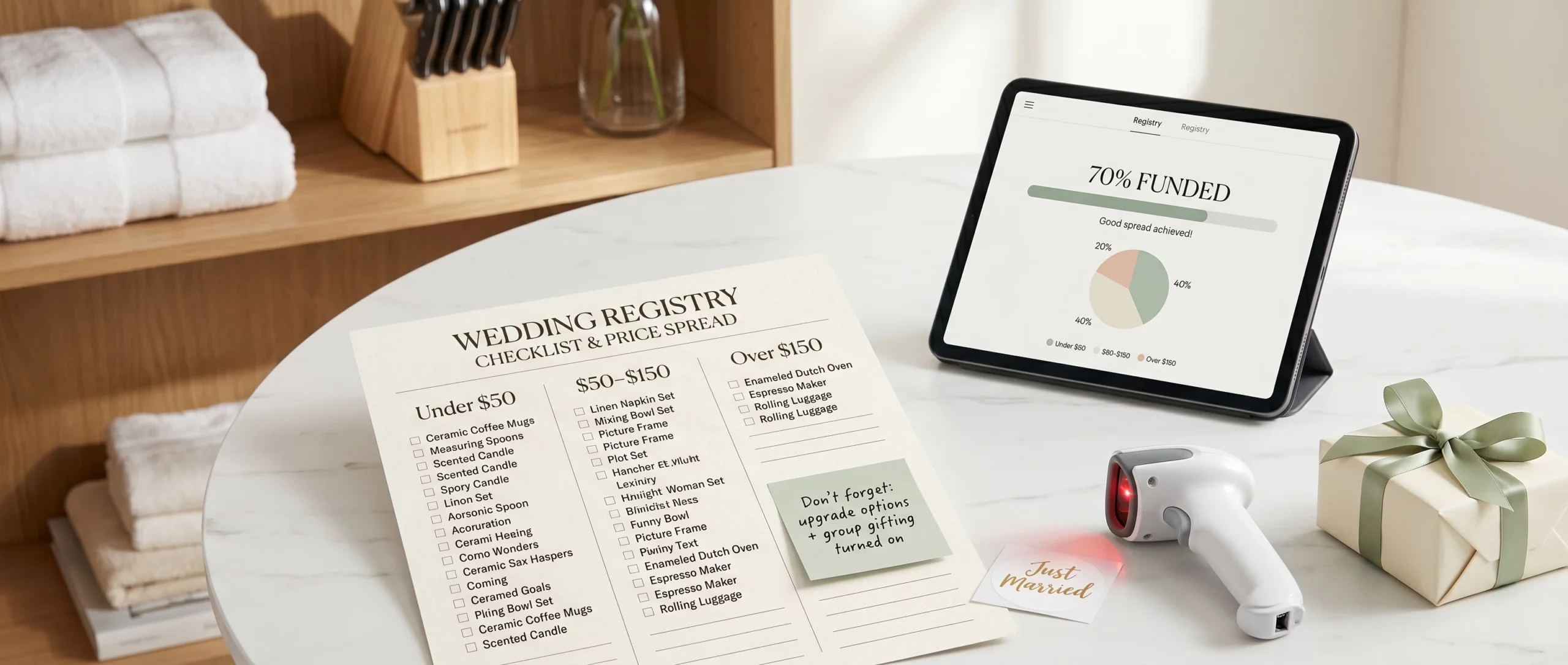
Most couples approach a wedding registry like a wishlist — they add things they want without thinking much about the people who’ll be buying from it. The result is a registry that’s frustrating for guests, inadequate for the couple, and picked over within the first two weeks.
A well-built registry is a carefully considered guest experience. It has options at every price point, enough items that every guest can find something, and the right mix of practical and special. This guide covers the wedding registry price spread that makes all of that work, how many items to register for, and the mistakes that leave guests defaulting to a cash card.
Why Price Spread Matters
Your guest list spans a wide range of relationships and budgets. A colleague who met you last year is buying a gift. Your best friend’s parents are buying a gift. Your grandmother is buying a gift. Your closest friend of twenty years is buying a gift. Each of these people has a different relationship with you, a different budget, and a different sense of what’s appropriate to spend.
A registry with only items over $200 leaves the colleague in an awkward position — they either overspend or go off-registry. A registry with only items under $75 makes it hard for close family to give something that feels significant to them. The price spread isn’t about maximising what you receive; it’s about making it easy for every single guest to find something appropriate for their relationship and their budget.
The Right Price Distribution
For a typical 100–150 person guest list, a functional registry should have roughly:
| Price tier | Number of items | Who it’s for |
|---|---|---|
| Under $50 | 20–30 items | Colleagues, distant acquaintances, casual friends |
| $50–$150 | 20–30 items | Friends, extended family, co-workers you’re closer to |
| $150–$300 | 15–20 items | Close friends, aunts and uncles, family you see regularly |
| $300–$500 | 8–12 items | Close family, parents’ close friends |
| $500+ | 4–8 items | Parents, grandparents, close family giving significant gifts |
| Group-gifting items | 2–5 items | For multiple guests to contribute together toward one item |
These are starting numbers — adjust for your actual guest count. For 200 guests, add proportionally to each tier. The under-$50 and $50–$150 tiers are the ones couples most often shortchange, and they’re the ones the largest share of your guests will shop from.
How Many Items Total?
A common guideline: register for 1.5 to 2 times your guest count in total items. For 120 guests, that’s 180–240 items. That sounds like a lot until you factor in the realities:
- Not every guest buys from the registry — many give cash, gift cards, or off-registry gifts
- Some items sell out before other guests have a chance to choose them
- Group and family members often buy multiple items together
- You want options still available for late RSVPs and gifts that arrive after the wedding
Running out of registry items mid-celebration is a real and common experience. It leaves guests uncomfortable and usually results in duplicate gifts or a scramble for a last-minute gift card.
Categories to Cover
Kitchen and dining essentials
The heart of most registries: everyday dinnerware, good cookware (a quality set or individual pieces), knives (chef’s, bread, paring), cutting boards, mixing bowls, baking equipment if you bake, and small appliances you’ll actually use — a stand mixer, food processor, quality coffee maker. Avoid registering for the appliance that sounds appealing and ends up in a drawer.
Bedding and bath
High-quality sheets in your size (register for multiple sets), a duvet insert and cover, pillows, bath towels (more sets than you think you need), and a good bathrobe.
Entertaining
Serving platters and bowls, bar accessories (wine opener, cocktail shaker, ice bucket), cheese and entertaining boards, and nice water and wine glasses.
Experience funds and cash registries
A honeymoon fund with specific contributions — “our first dinner in Rome” performs better than an abstract amount — a home fund if you’re saving toward a property, or specific home-improvement contributions. Cash-based items framed around a specific memory tend to get funded because guests feel they’re contributing to an experience rather than a number.
Less common but worth considering
A house-cleaning-service subscription (genuinely practical, wide appeal), a fine-dining experience or cooking class, luggage (often expensive, often useful, often forgotten from registries), art for your home, or plants.
Common Registry Mistakes
- Too few items at low price points. The single most common error. A registry packed with $200+ items leaves budget-conscious guests scrambling, and many default to giving cash rather than shop an inaccessible list.
- Registering at only one store. Splitting across two or three — one department store, one specialty shop, one online or cash fund — gives guests more access and more selection.
- Adding items without checking reviews. A registry is only as useful as the quality of the items in it. Check at least a few reviews before adding anything; a cookware set with widespread quality complaints shouldn’t be on your list regardless of how it looks.
- Not updating after gifts are purchased. Some platforms update automatically; others need manual maintenance. Stay on top of what’s been bought, both to send thank-you notes promptly and to avoid duplicates.
- Registering for things you already have. If you’ve been living together for years, your registry should reflect the upgrades you actually need — not generic “starter” versions of things you already own.
Registry Platforms Worth Knowing
- Zola — comprehensive, clean interface, supports both product and experience registries, strong group-gifting features.
- The Knot Registry — broad retailer network, aggregates items from multiple stores into one list.
- Amazon — enormous selection and price range, familiar for guests of all ages, though less “special” as a primary registry.
- Crate & Barrel / CB2 — strong for kitchenware and home goods; works well as a secondary registry.
- Anthropologie / Williams Sonoma — for couples with specific aesthetic preferences; higher price points, useful for the $150+ tier.
Using two platforms — one aggregator (Zola or The Knot) and one specialty retailer — covers most guest preferences without overwhelming anyone.
Frequently Asked Questions
Is it rude to register for expensive things?
No — as long as your registry also includes accessible options at every price level. The expensive items are there for close family who want to give something significant; they’re not an expectation for everyone.
Should we register for things we need or things we want?
Both, but practical needs typically see higher purchase rates. A $300 stand mixer will get bought; a $300 piece of art with a specific taste may not. Mix high-use practical items with personal wish-list pieces.
What if we already have everything we need?
A cash or honeymoon fund pointed toward something specific — a renovation, a trip, an experience — is entirely appropriate, and most guests understand and appreciate it.
When should we create our registry?
Before your save-the-dates go out, ideally. Guests sometimes give gifts at the engagement party, and having a registry available early reduces awkward gift-giving moments.
How do we handle off-registry gifts?
Graciously. Write the same quality thank-you note whether the gift was on the registry or not. If you receive a duplicate, handle the return quietly.
Should we list the registry on our wedding website?
Yes — this is standard and expected. You don’t need to include it on the formal invitation itself, but the wedding website is the right place for it.
A Registry That Works for Everyone
The goal isn’t a registry that reflects your perfect taste in isolation — it’s one that works for every person on your guest list. Enough items, the right spread, real things you’ll use. Check your price distribution before you share the link with the free Wedding Gift Registry Analyzer, and if you already share a home, see our guide to the best registry options for couples who already live together.