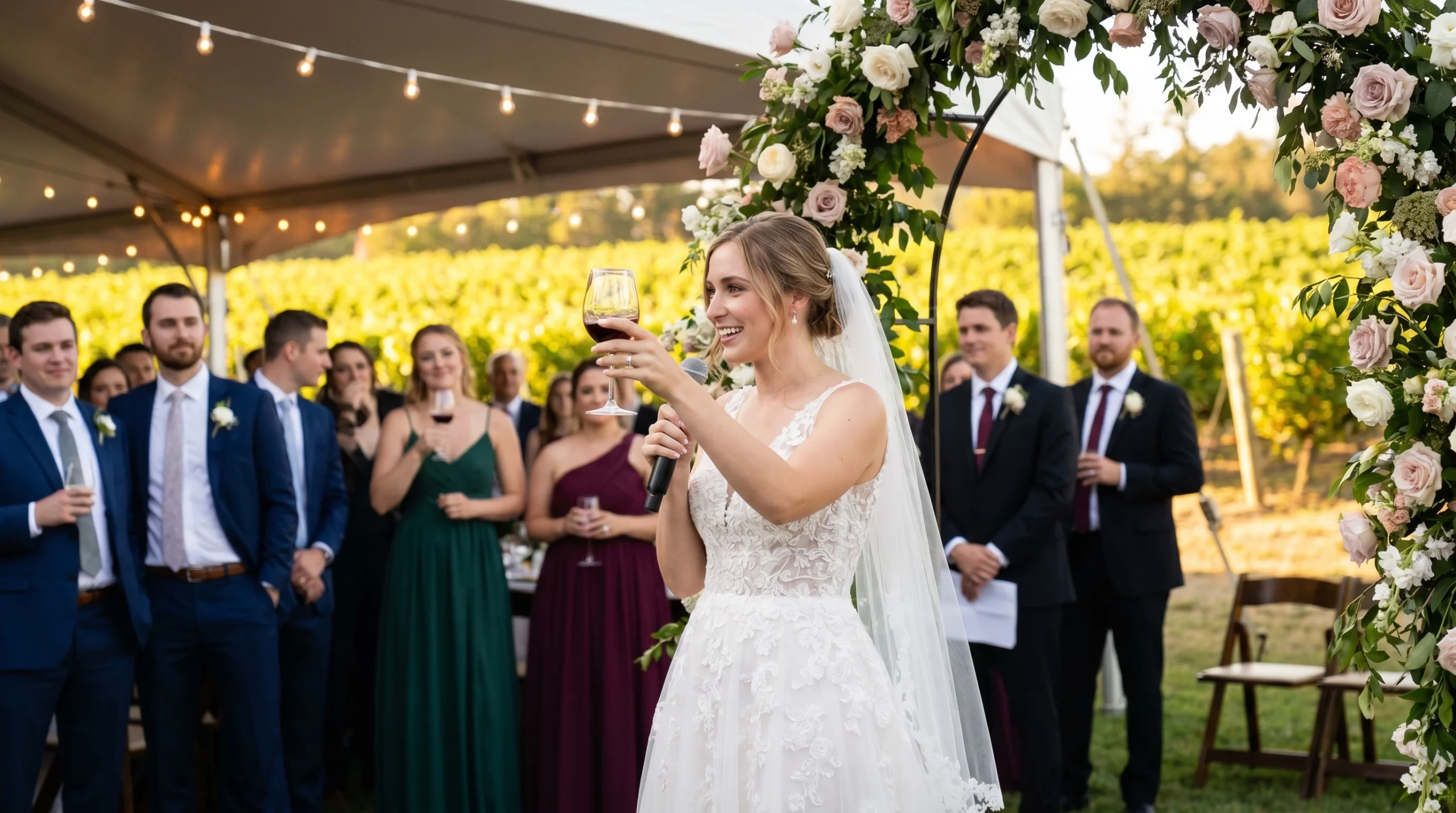
The reliable way to give a wedding toast without crying or freezing is to open with context instead of emotion, follow a five-part structure from bullet notes, keep it to 60–120 seconds, and write your closing line word for word. You don’t need to be a good public speaker. You need a plan that keeps you steady and gives your nerves fewer places to hijack you.
Start with the goal, not perfection
A toast is a small gift, not a TED talk. Your job:
- Honor the couple
- Share one or two true, specific moments
- Offer a warm wish for their life together
- Sit down before people start eyeing the bread basket
Do that and you’ve won.
The five-part structure
When nerves hit, structure is oxygen. Use a template so your brain doesn’t have to invent anything live:
- Quick hello and who you are
- How you know the couple (or one of them)
- One short story that shows who they are
- What you admire about them together
- A simple wish, then the toast
Fill-in-the-blanks version
Hi everyone, I’m [Name], [relationship to couple]. I’ve known [Partner A] since [how/when], and I met [Partner B] [how/when]. One thing I’ll always remember is [short specific story]. Seeing them together, what stands out is [quality: steadiness, kindness, fun, teamwork]. So here’s to [Couple] and a life full of [three good things]. Cheers.
You’re not staring at a blank page, and you’re not relying on vibes in the moment.
Why people cry — and how to prevent it
Most people cry because they start with the emotional part. They open with “I just love you both so much” and their throat closes immediately.
Start grounded instead. Facts, context, a light line — not a roast, just gentle:
- “Hi everyone, I’m Alex. I’m Maya’s older brother, and yes, I’m already trying to keep it together.”
- “I promised myself I’d keep this short, and I promised the couple I’d keep it sincere. So here goes.”
These put you in your speaking voice first. You can get emotional later, once you have momentum.
Keep it short on purpose
| Length | Word count | Best for |
|---|---|---|
| 1 minute | 130–160 words | Nervous speakers, simple toasts |
| 90 seconds | 170–220 words | Most best man / maid of honor toasts |
| 2 minutes | 230–300 words | Confident speakers with a clear story |
If you’re worried about freezing, aim for 170–200 words. Enough to feel meaningful, not enough to get lost.
Make it personal without oversharing
Personal doesn’t mean private. It means specific. Use the one story, one meaning method: pick one moment you witnessed, describe it in two or three sentences, then say what it shows in one sentence.
“Last winter I watched Chris show up at 6 a.m. to help Taylor move, and Taylor had coffee waiting and a playlist ready. It wasn’t dramatic. It was just quiet teamwork. That’s what I love about them — they make life lighter for each other.”
That kind of story is almost impossible to fake, and it’s far less likely to trigger tears than a heavy childhood montage.
Tear triggers to avoid if you’re sensitive
- Anyone who has passed away
- Describing the bride or groom as a child
- “I remember the day we met” love-story retellings
- “You deserve this after everything you’ve been through”
Swap big feelings for steady admiration. Instead of “you’ve been through so much,” try “I’ve watched you grow into someone who shows up with so much steadiness.”
Notes, script, or memorized?
Memorizing usually makes freezing worse — one missed line and your brain goes white. The safest approach: write it out fully once, make a short bullet version for a note card or phone, and practice the flow rather than the exact words.
| Method | Best if you… |
|---|---|
| Bullet notes | freeze under pressure — gives your brain a track without a script to lose your place in |
| Short written script | tend to cry — following text keeps you steadier than following feelings |
| Memorized | are genuinely comfortable speaking; risky otherwise |
Practice that actually reduces freezing
Reading it silently isn’t practice — your mouth, breath, and pace matter. Read it out loud and time it. Underline where you speed up or choke. Write “breathe” in the margins. Do three full runs the day before — not twenty; over-practicing makes you tense. Record one voice note and listen back once. You’ll catch the unclear parts, and you’ll notice you sound more normal than you think.
Body, hands, microphone
- Set your glass down before you start — holding a glass, notes, and a mic turns into a circus, and putting the glass down also reduces visible shaking
- Mic in one hand, notes in the other
- Feet about hip-width, soft knees
- Adjust the mic stand before you begin — take the ten seconds, nobody minds
- Look at the couple most of the time, then glance around the room
A table-side breathing trick
Crying often starts with breath stuck high in your chest. Before you stand:
- Inhale through your nose for 4
- Exhale slowly for 6
- Repeat three times
The longer exhale signals to your nervous system that you’re safe. Even more subtle: press your tongue gently to the roof of your mouth and unclench your jaw.
In the moment
- Start slower than feels natural — about 80% speed for the first two sentences. Rushing creates more panic.
- Use anchor phrases you can always return to if you lose your place: “One thing I love about them is…” “And that brings me to…”
- Look at one friendly face for your opening lines, then widen your gaze.
- Let yourself pause. A pause feels like an eternity to you and like confidence to everyone else.
If you start crying anyway
It’s common and it’s not a failure — it means you care. Stop speaking. Smile if you can. Take one slow breath. Say a small line to buy a moment: “Give me one second.” “I’m okay, just a lot of love in the room.” Then continue with your next sentence, not the one you got stuck on.
If tears keep coming, shorten: “I’ll keep this simple. I love you both, I’m so happy for you, and here’s to a lifetime of good days and strong teamwork. Cheers.” Still a great toast.
End strong
Freezing often happens at the end because you don’t know how to land it. Write your final line word for word and don’t improvise:
- “To [Name] and [Name]. Cheers.”
- “Let’s raise a glass to the newlyweds. Cheers.”
Then lift your glass, look at the couple, drink, done.
Frequently asked questions
How do I stop shaking while giving a wedding toast?
Set your glass down, hold your notes with both hands if needed, plant your feet, and slow your first two sentences. A little shaking is normal and usually not noticeable to the room.
Is it okay to read my wedding toast?
Yes. Most guests prefer a clear toast read smoothly over a panicked improv. Print it large or use big text on your phone, and look up every couple of lines.
What do I do if I forget everything mid-toast?
Pause, look at your notes, use an anchor phrase like “One thing I love about them is…”, and continue. If needed, jump straight to your final wish and the toast. Short is completely fine.
How long should a wedding toast be?
For a nervous speaker, 60–90 seconds (about 130–200 words). Long toasts increase the odds of crying, freezing, or rambling.
How do I avoid crying during the toast?
Don’t open with the most emotional line. Start with context, keep it to one short story, build in breathing pauses, and avoid known tear triggers like describing the couple as children or mentioning people who’ve passed.
Where to take it next
If you’re the maid of honor and the toast is one of several things on your plate, the full list of maid of honor duties puts it in context, and how to write a maid of honor speech covers the drafting side in more depth. You’re there to be sincere for ninety seconds — that’s it, and the room is rooting for you.