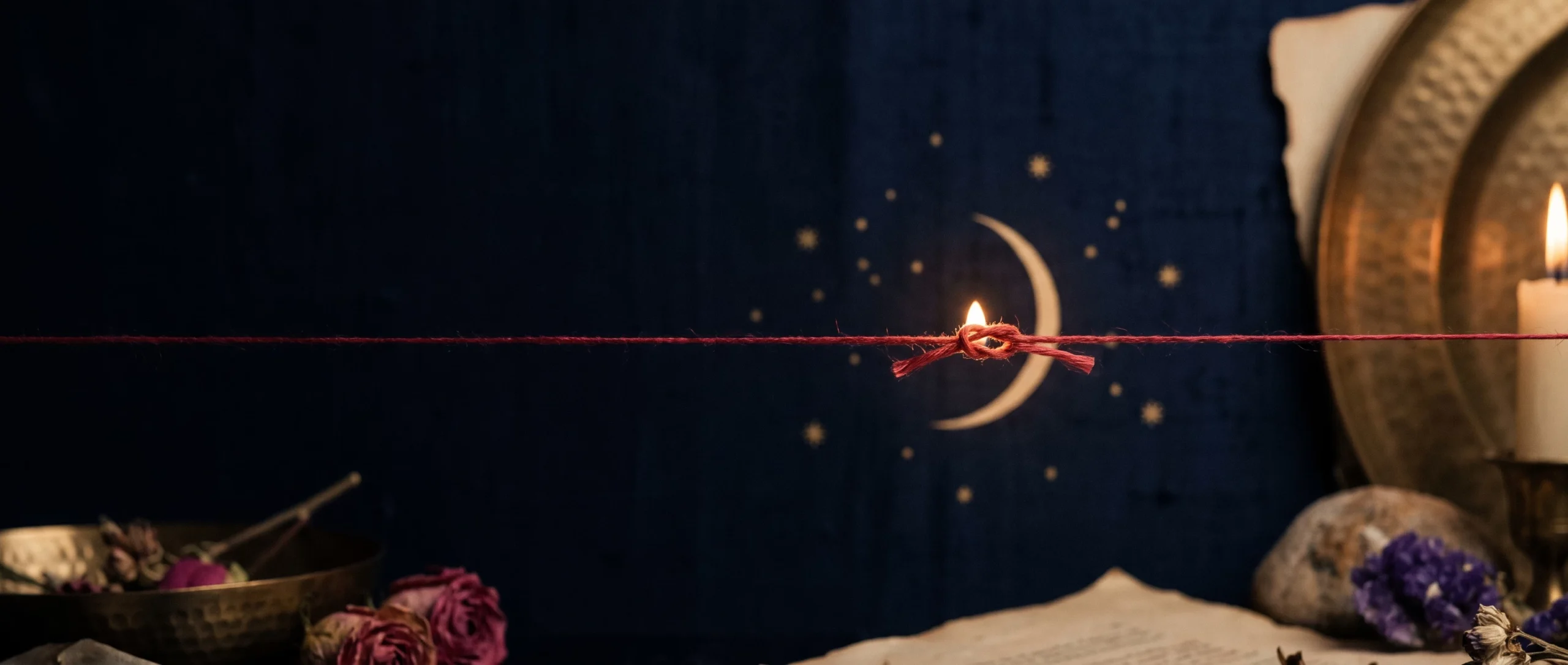
The red thread of fate — also called the red string of fate — is an East Asian legend that says an invisible red cord connects people who are destined to meet. The thread is tied at the ankle (in the Chinese version) or the little finger (in the Japanese version). It may stretch or tangle, but it never breaks, and the two people it binds will find each other regardless of time, place, or circumstance.
Here’s the myth, what the thread means, and how couples fold it into weddings today.
The Legend
The Chinese version centers on Yuè Lǎo (月老), the “Old Man Under the Moon” — a lunar deity who keeps a book of marriages and ties a red cord around the ankles of two people fated to wed. Once tied, the outcome is set; the two are bound to marry no matter what stands between them. Yuè Lǎo is still a figure of active devotion — temples dedicated to him, particularly in Taiwan and Hangzhou, draw single people leaving offerings and prayers for a good match.
A famous folktale: a young man asks Yuè Lǎo who he’s destined to marry. Told it’s a poor vendor’s toddler daughter, he’s disgusted and pays a servant to kill the child. The servant only wounds her. Years later the man marries a beautiful young woman from a good family — and discovers a scar on her brow from a childhood attack. She is the same girl. The thread held.
The Japanese version (unmei no akai ito, 運命の赤い糸) ties the thread to the little finger, which is why the pinky appears so often in the modern iconography. A common Japanese explanation for why the little finger: an old belief that a vein or nerve ran directly from it to the heart.
What the Red Thread Means
- Destiny over circumstance. The core idea: the people you’re meant to be with, you’ll find — background, distance, and bad timing don’t sever the connection.
- A bond that stretches but holds. The thread tangling or stretching represents the difficulty and delay a relationship goes through; it not breaking represents the connection surviving all of it.
- Not just romance. Some tellings extend the thread to all the people who’ll matter in your life, not only a spouse.
It’s an optimistic myth — it says the hard parts of finding your person are part of the story, not a sign it won’t happen. For someone who’s had a long or rocky path to a relationship, that reframe is the whole appeal: the years apart, the near-misses, the wrong relationships were the thread tangling, not the thread failing.
In Popular Culture
The red thread appears constantly in anime, manga, K-dramas, and C-dramas — often literally visualized as a glowing cord between two characters. That visibility is a big part of why the search interest is so high: people encounter the image in a show and look up what it means. It also shows up widely as a tattoo (a small red line around the pinky or wrist) and as red-cord bracelets worn by couples. In several countries it’s become a standard “matching couple” item, sold in pairs.
Red Thread in Weddings
Couples with a connection to the tradition use it in a few ways:
- A red cord in the ceremony — a handfasting-style binding of the couple’s wrists or little fingers with red thread, sometimes tied by a parent or grandparent.
- Matching red-string bracelets exchanged alongside or instead of a unity ritual.
- Red thread motifs in the stationery, the signage, or a custom illustration of the couple’s two hands.
- A nod to Yuè Lǎo in a bilingual ceremony program for couples honoring Chinese heritage.
- A guest thread — a spool of red cord passed through the guests during the ceremony, each person touching it, so the couple’s bond is symbolically tied to everyone present.
If you’re drawing on this tradition and it isn’t part of your own heritage, treat it with the same care you’d give any borrowed custom: understand the Yuè Lǎo story, credit the origin in the program, and lean toward the broadly shared folk version rather than anything tied to a specific living religious practice.
The Golden Thread version — binding not just the two people but their finances and futures as newlyweds — is a related idea some couples use for the more practical side of merging lives.
Explore the “binding” ritual for merging your lives with the free The Golden Thread — a handfasting-style reading framed around joining two people (and two futures) as one, rather than a logistics conversation.
Frequently Asked Questions
What is the origin of the red thread of fate?
It’s an East Asian legend. The Chinese version centers on Yuè Lǎo, the “Old Man Under the Moon,” who ties a red cord around the ankles of destined couples. The Japanese version ties the thread to the little finger.
What does the red thread of fate mean?
That destined people will find each other regardless of time, distance, or circumstance. The thread may stretch and tangle — representing hardship and delay — but it never breaks.
What is the significance of the color red in the red thread of fate?
Red is the color of luck, joy, celebration, and marriage across Chinese culture — the color of wedding dresses, red envelopes, and festival decoration. A red cord is the natural color for a marriage bond.
Is the red thread of fate about soulmates?
It’s the closest East Asian equivalent to the Western soulmate idea, though it emphasizes destiny and inevitability more than perfect compatibility. Some versions extend the thread to all significant people in your life, not just a spouse.
How is the red thread of fate used in weddings?
As a red-cord handfasting or finger-binding in the ceremony, as matching red-string bracelets exchanged by the couple, or as a visual motif in the stationery and décor — especially at weddings honoring Chinese or Japanese heritage.
Why is the thread tied to the pinky in the Japanese version?
An old belief held that a vein or nerve connected the little finger directly to the heart — the same idea behind the Western tradition of wearing a wedding ring on the “ring finger.” So the pinky became the anchor point for the fate thread.
The Hard Parts Are in the Story
The red thread of fate is a myth that treats delay, distance, and difficulty as part of finding your person — not evidence against it. The thread tangles. It doesn’t break.
If you want the “binding two lives” idea applied to the practical merge of a marriage, try the free The Golden Thread.
