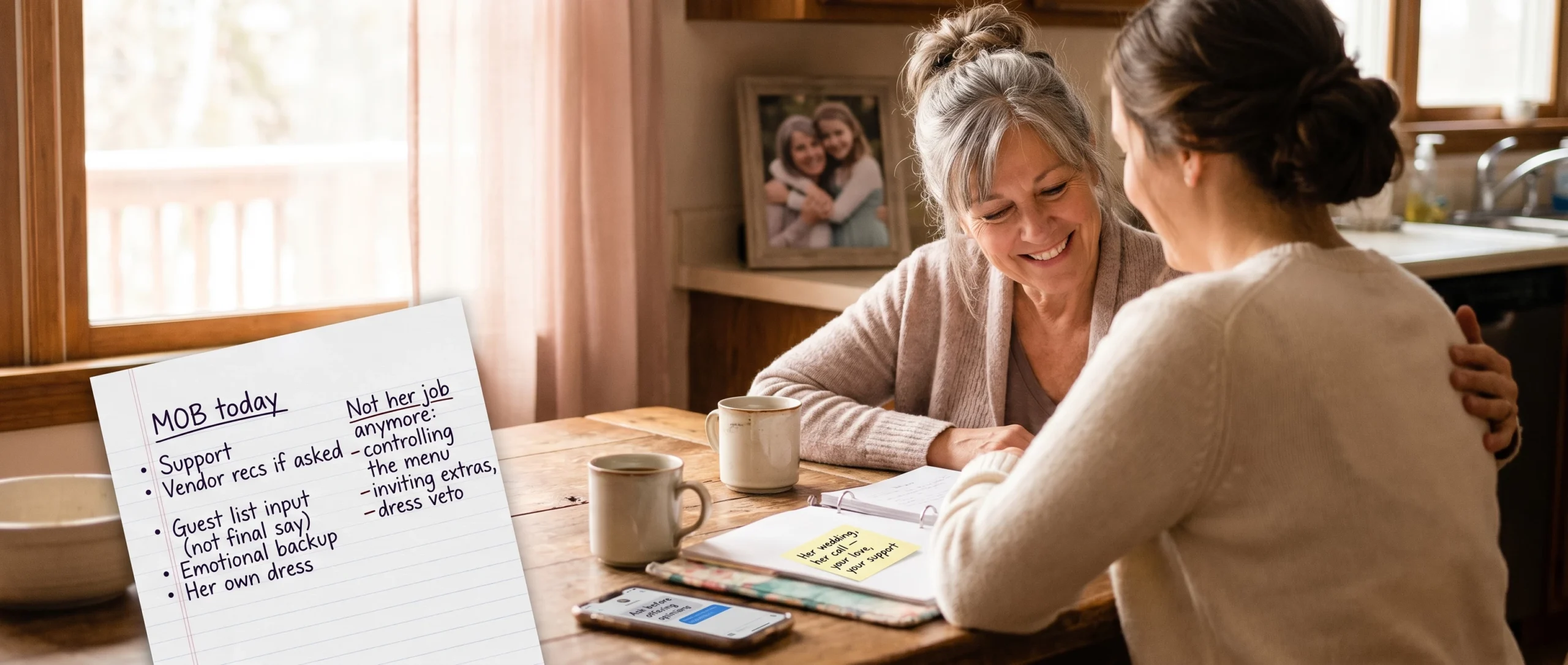
The mother of the bride has always been central to a wedding. What that centrality looks like has changed significantly.
A generation ago, the mother of the bride often drove planning decisions — venue, guest list, caterer, décor — while the bride collaborated in her own wedding. Today’s couples plan their own weddings, and the mother of the bride’s duties are meaningful but distinctly different from what they once were. This guide covers what the modern mother of the bride actually does, what belongs clearly to the couple, and how to navigate the relationship in a way that strengthens it.
What Has and Hasn’t Changed
The same: the mother of the bride is still an emotionally significant presence. She’s usually among the first to know about the engagement, often contributes meaningfully to the celebration, and plays a visible role on the day.
Different: the couple is the decision-maker. The mother’s role is supportive, not authoritative. Her input is welcomed in the areas where the couple invites it — and the couple defines which areas those are.
This shift creates a genuine adjustment period for many mothers, particularly those who imagined a more central planning role. Navigating that adjustment with care, on both sides, is one of the more underappreciated challenges in wedding planning.
What the Mother of the Bride Typically Does
Around the engagement
There’s often no formal role before the announcement, but the mother of the bride is usually among the first people told — finding out via social media or from someone else can hurt a relationship in ways that take time to repair. At the engagement itself: celebration, support, and the first conversations about vision. This is also where different assumptions about planning involvement can surface, and where clarity matters most.
Dress shopping
In most weddings, the mother of the bride attends at least one dress-shopping appointment and often has a strong emotional investment in the moment. Bring her to an appointment where you genuinely want her input — not necessarily the first (which is often exploratory) and not one where the decision is already made.
The bridal shower
Traditionally the mother of the bride co-hosted or was the primary host. This persists, though the maid of honour increasingly takes the lead. Clarify early whether your mother wants to be involved in hosting or would prefer to attend as a guest.
Financial contributions
Many mothers of the bride contribute financially. When this happens, clear conversations about what the contribution covers and what decision-making authority (if any) comes with it should happen before any money changes hands. Contributions without clear expectations create the conditions for the most common source of conflict in wedding planning.
Day-of presence
The mother of the bride is seated prominently, typically in the front row, and in many ceremonies is the last person escorted to her seat before the processional — a signal to guests that the ceremony is about to begin. She may help with the bride’s morning preparation, assist with last-minute logistics, and serve as a familiar, calming presence.
After the wedding
Thank-you calls and notes to guests from her side, and sometimes help with post-wedding logistics like returning rentals or coordinating overnight guests.
What Belongs to the Couple
A useful framework: the couple owns all decisions; the mother of the bride provides input where it’s invited. The categories where boundaries most often need clarifying:
- The guest list. The mother of the bride often has people she’d like to invite — colleagues, long-time friends, extended family. Those requests are reasonable to consider but are not automatic additions. The couple sets the guest count; family input is considered within that constraint.
- Décor and aesthetic. The visual look of the wedding belongs to the couple. Warm appreciation of her input, paired with a clear decision, is the right response.
- Timing and format. Whether the ceremony is religious or secular, how long the reception runs, who stands in the wedding party — couple decisions. Input can be invited; override isn’t appropriate.
When the Mother Is Contributing Financially
Financial contributions change the dynamic in ways that are easy to underestimate before the money changes hands. The clearest path: agree on the amount and what it’s designated for before it’s given. “We’d like to contribute $5,000 toward the catering” is a clean, bounded contribution. “We’re contributing and we’d like to be involved in the decisions” is much murkier. If accepting a contribution means accepting input into a specific category, be explicit about which one — and if the condition is unclear, it’s better to have an awkward conversation before accepting than a damaging one mid-planning.
How to Navigate the Relationship Well
- Start with appreciation. Whatever the dynamic, your mother’s interest comes from caring about you. Starting from that premise makes conversations easier than starting from frustration.
- Be proactive about involving her. Many mothers who push for involvement are responding to feeling excluded. Finding one meaningful, genuine area — the bridal shower, seating input for her side, the morning-of getting ready — often reduces pushback elsewhere.
- Communicate in person where possible. Texting about decisions, or sending information through your partner or a sibling, tends to amplify misunderstandings.
- Your partner handles their own family. If the mother-in-law is creating more friction than your own mother, your partner navigates that relationship directly.
Frequently Asked Questions
How do I involve my mother without giving up control?
Find something specific and genuinely meaningful to involve her in — not a symbolic role, a real one. A mother who feels truly useful in one area is much less likely to push for control in others.
What if my mother and I have a difficult relationship?
Wedding planning tends to surface existing dynamics rather than change them. Being clear about what you want from her during planning — a loving presence, a specific kind of help, or simply attendance — is more productive than hoping the wedding fixes something.
My mother keeps sharing opinions I didn’t ask for. What do I do?
A single, warm, clear response — “We’ve made that decision and we’re happy with it” — repeated as many times as needed. Not defensive, not detailed.
Is it rude not to invite my mother to dress shopping?
Not inherently, though it will likely matter to her. Tell her early: “I want to explore on my own first and then bring you when I’m closer to a decision.” That’s much easier to hear than being excluded without explanation.
My mother wants to invite 30 extra guests. How do I handle this?
Give her a number before the conversation about names: “We have 10 spots available for your side beyond immediate family.” That’s a manageable constraint; “add your list and we’ll figure it out” is an invitation to escalate.
How do we acknowledge the mother of the bride during the wedding?
A dedicated mention in the ceremony or during toasts, and a private moment with a gift or letter on the morning of the wedding, are both meaningful. A corsage or specific floral for the day is a traditional marker of her role.
A Partnership, Not a Handover
The most harmonious mother-of-the-bride relationships are genuine partnerships — where the bride communicates clearly, the mother is involved in real ways, and both know where the decisions rest. That balance rarely happens automatically; it’s built through early, direct conversations and realistic expectations. For the wider family picture, see dealing with family during wedding planning, and keep the logistics tracked with the free Wedding Planning Checklist.