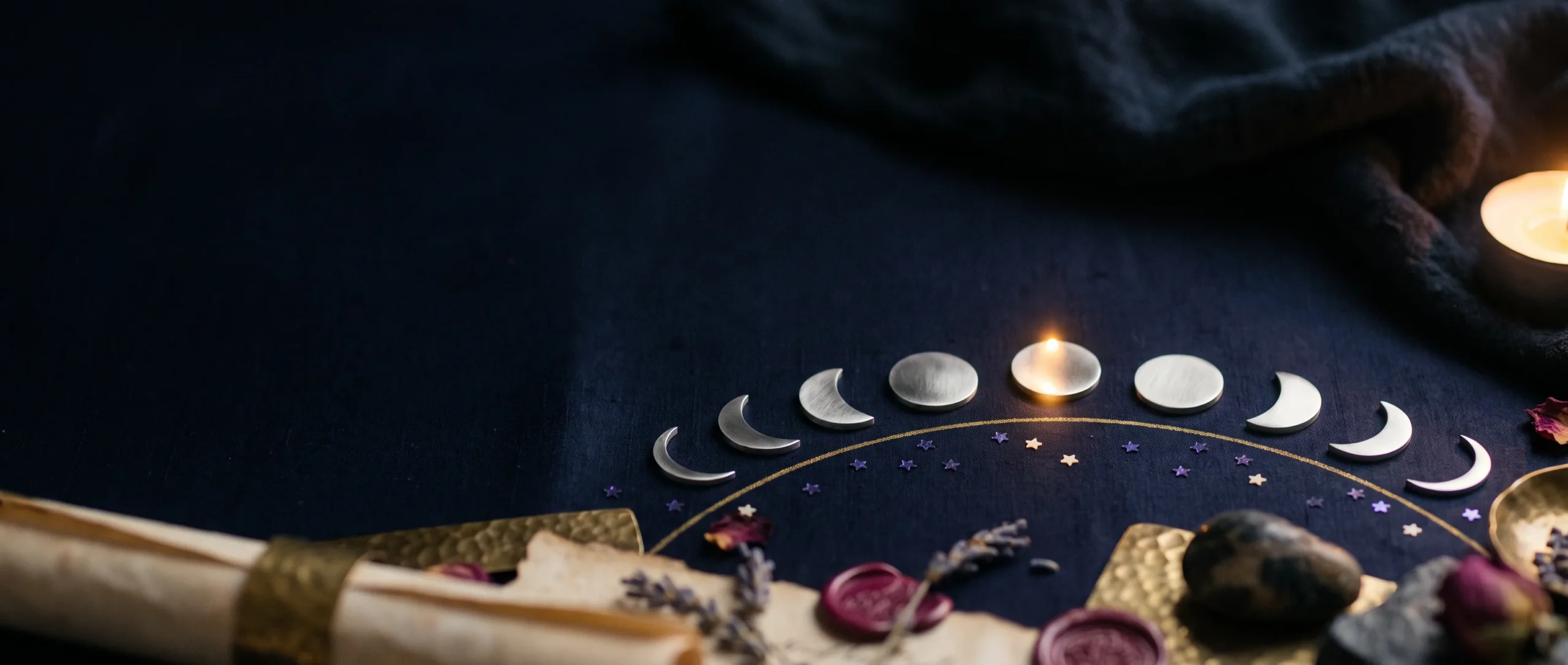
There are eight moon phases, and the cycle from new moon to new moon takes about 29.5 days. Each phase is read as a stage in a process — the new moon plants, the full moon reveals, the waning moon releases — which is why people use the lunar cycle to time intentions, rituals, and rest. It’s also why “what moon phase were you born under” is a meaningful question: the phase active at your birth is said to describe how you move through your own cycles.
Here’s each phase and what it means.
The 8 Phases
| Phase | Looks like | Meaning | Good for |
|---|---|---|---|
| New Moon | Dark / invisible | Beginnings, intention-setting, planting seeds | Deciding what you want; starting quietly |
| Waxing Crescent | Thin sliver, right side | Hope, first steps, gathering resources | Taking the first small action; commitment |
| First Quarter | Half-lit (right) | Decision, friction, pushing through resistance | Making the hard choice; problem-solving |
| Waxing Gibbous | Almost full | Refinement, adjustment, near-completion | Editing, tweaking, staying the course |
| Full Moon | Fully lit | Culmination, revelation, heightened emotion | Celebration, gratitude, seeing clearly; also release |
| Waning Gibbous | Just past full | Gratitude, sharing, digesting what happened | Reflecting on results; teaching others |
| Last Quarter | Half-lit (left) | Release, forgiveness, letting go of what didn’t work | Clearing space; ending things cleanly |
| Waning Crescent | Thin sliver, left side | Surrender, rest, integration | Doing nothing on purpose; preparing to begin again |
The two halves: waxing (new → full) is for building and doing; waning (full → new) is for releasing and resting. If you only remember one thing about lunar timing, remember that — build in the first two weeks, clear out in the second two.
Why the New and Full Moon Get the Attention
Most moon rituals happen at the two extremes:
- New moon — the sky is dark, so it’s the traditional time to set intentions “in the dark,” before anything is visible. New moon lists, vision boards, and quiet commitments.
- Full moon — everything is lit, emotions run high, and it’s read as both a peak (celebrate what’s come to fruition) and a turning point (name what you’re ready to let go of). Full moon water, gratitude practices, and release rituals.
Used together, they’re a two-week rhythm: set an intention at the new moon, check in and release what’s not moving at the full moon two weeks later.
The Lunar Cycle as a Project Structure
The reason the moon phases have stuck around as a planning tool is that almost anything with a start, a middle, and an end maps onto them cleanly. A wedding-planning year, for example:
- New moon energy — deciding the kind of wedding you want, before you’ve booked anything.
- Waxing crescent to first quarter — the first bookings, and the first real friction (the guest-list argument, the budget reckoning).
- Waxing gibbous — the long middle: refining the details, second-guessing, staying the course.
- Full moon — the wedding itself: the culmination, the high emotion, everything visible at once.
- Waning phases — the thank-you notes, the name change, the settling in; releasing the planning identity and becoming just married.
You don’t have to believe the moon causes any of it to find the structure useful.
Some couples also check the moon phase for their wedding date itself — a waxing or full moon reads as “growing / abundant”; a waning moon as “releasing.” See wedding date numerology for the fuller date-meaning picture.
Your Birth Moon Phase
The phase the moon was in when you were born is read as your natural rhythm — a new moon person is instinctive and always starting; a full moon person is expressive and works in bright bursts; a last quarter person is a natural editor and endings-manager. See what moon phase was I born under for how to find yours.
Turn the moon of a meaningful night into a keepsake with the free Moon Phase Soul Portrait — it renders the moon the night you met and the moon on your wedding day as a single graphic.
Frequently Asked Questions
What are the 8 moon phases in order?
New Moon, Waxing Crescent, First Quarter, Waxing Gibbous, Full Moon, Waning Gibbous, Last Quarter, Waning Crescent — then back to New Moon. The full cycle takes about 29.5 days.
What does each moon phase mean spiritually?
New = beginnings and intention; waxing = building and action; full = culmination and revelation; waning = release and reflection; the final crescent = rest before the next cycle.
What’s the difference between waxing and waning?
Waxing means the lit portion is growing (new moon toward full) — a time for building. Waning means it’s shrinking (full toward new) — a time for releasing and resting.
Which moon phase is best for manifesting?
The new moon for setting a new intention, and the full moon for amplifying and celebrating one that’s underway. See new moon ritual for a simple practice.
What does a full moon do emotionally?
It’s traditionally associated with heightened emotion, vivid dreams, and restlessness. Whether or not that’s measurable, many people use the full moon deliberately as a night to feel things fully and then let some of them go.
How do I know what phase the moon is in tonight?
Any lunar calendar, weather app, or a quick search will tell you. As a rough guide: if the lit side is on the right and growing, it’s waxing; on the left and shrinking, it’s waning; fully dark is new, fully lit is full.
Do the moon phases actually affect people?
Sleep researchers have found small, inconsistent effects around the full moon (slightly worse sleep for some people); beyond that, the evidence for behavioural effects is weak. The phases are most useful as a shared calendar for intention-setting and reflection — a rhythm to hang a practice on.
A Cycle You Can Work With
The moon’s phases are a ready-made structure for anything that has a beginning, a peak, and an ending — including a relationship or a wedding-planning year. Plant at the new moon, celebrate at the full, release at the last quarter.
Make a keepsake of a meaningful moon with the free Moon Phase Soul Portrait.