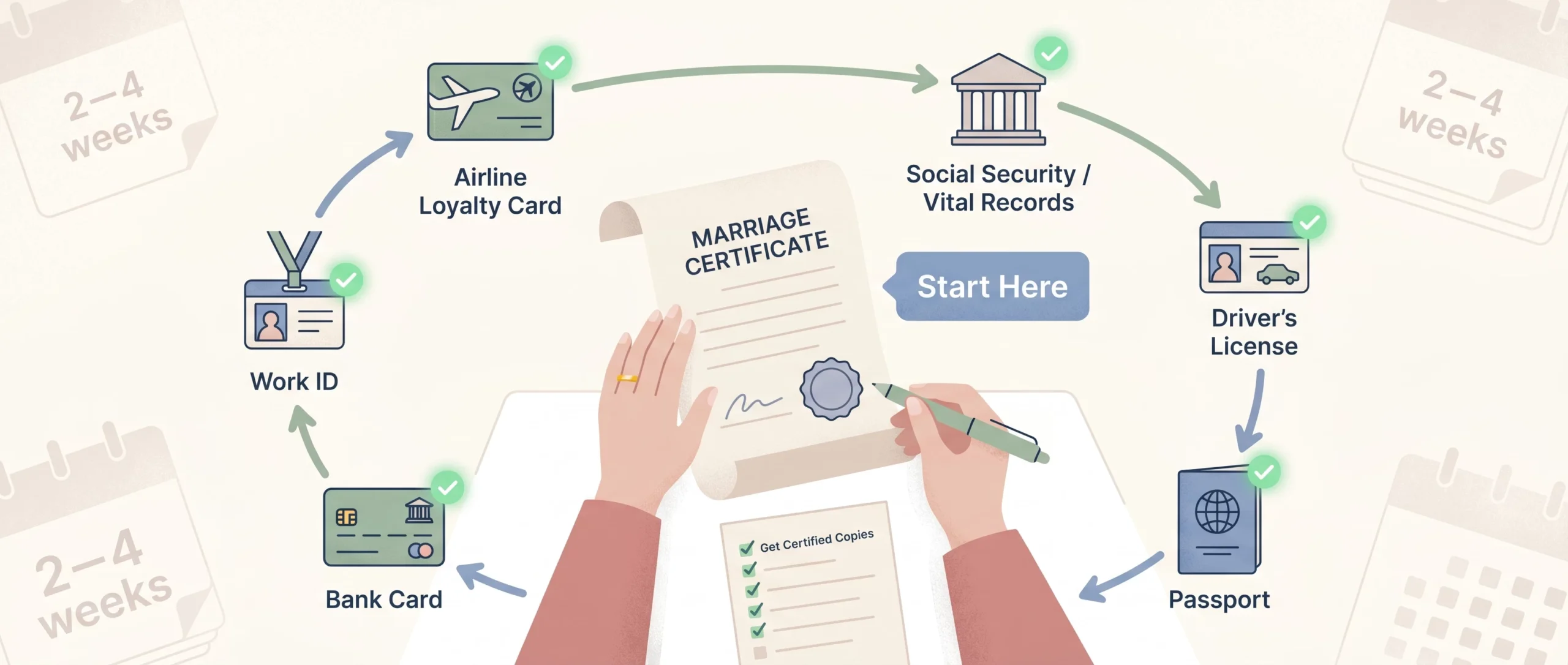
Changing your name after marriage sounds straightforward until you start looking into it — and then you discover it involves multiple government agencies, a stack of certified documents, and a whole category of accounts you forgot you’d signed up for.
The good news: it’s genuinely manageable. The process has a clear starting point, a logical order, and a realistic timeline, and most of it can be done without hiring anyone or paying more than a small fee. This guide covers how to change your name after marriage in the US and Canada, what order to do it in, and how to avoid the mistakes that slow people down.
The Golden Rule: Start With Social Security
For US residents, this is the non-negotiable first step. Everything else flows from your updated Social Security record. Your bank will ask for a government ID with your new name; your government ID requires your Social Security record to already match. If you try to update your driver’s license before Social Security, you’ll hit a wall.
The correct order for US residents:
- Social Security Administration (SSA) — update first
- State driver’s license or state ID — once SSA is updated
- US passport — in parallel with or after the driver’s license
- Everything else — financial accounts, employer, insurance, subscriptions
The SSA process is free. You’ll need your marriage certificate (original or certified copy), your current ID, and Form SS-5. You can do this in person at your local SSA office or by mail; in-person appointments usually take under 30 minutes.
For Canadian residents: the process varies by province. Most provinces require updating your provincial health card and provincial ID before financial institutions will accept the change; federal documents (Social Insurance Number, passport) come next. Your provincial service centre — ServiceOntario, ServiceBC and equivalents — is your starting point, the equivalent of the SSA step above.
Your Driver’s License and State ID
Once your Social Security record reflects your new name, go to the DMV with your updated Social Security card (or confirmation letter), your marriage certificate, your current license, and proof of address if it’s changed. Most states issue a temporary paper license immediately and mail the permanent one within 2–3 weeks. Fees are typically $10–$30.
Your Passport
If you have international travel planned within six months of the wedding, prioritise the passport update — standard processing runs 6–8 weeks, expedited 2–3 weeks at extra cost. You’ll need your current passport, the completed DS-82 form (if your passport is less than 15 years old and you have it) or DS-11, one certified copy of your marriage certificate, and a new passport photo. If your passport was issued less than a year ago, you may be able to change the name at no charge.
Financial Accounts: Banks, Cards, and Investments
Banks and credit unions each have their own process, but almost all require a government ID with your new name (your updated license) and your marriage certificate. Most let you start online or by phone; some require a branch visit to finish. Credit card companies are usually straightforward — a phone call or online request is generally enough. Don’t forget brokerage and investment accounts, retirement accounts (401k, IRA), and any joint accounts where your name appears.
Your Employer and Work Accounts
Notify HR directly — they update payroll, W-2 records, benefits enrolment and your work email if applicable. Coordinate with IT if your email address includes your name. Also update LinkedIn and professional profiles, business cards and email signatures, and any professional licenses or certifications. Licensing boards (real estate, nursing, teaching) each have their own name-change process, usually a copy of the marriage certificate plus a small fee, and these have the longest processing windows — start them early.
Documents People Commonly Forget
- Health insurance (contact your insurer or update through HR)
- Dental and vision insurance
- Life insurance policies
- Car and home insurance
- Vehicle titles and registration
- Mortgage or lease agreement
- Voter registration (many states allow online updates)
- Utilities and internet service
- Subscription services that hold your payment information
None of these are urgent the way your government IDs are, but handle them within the first few months to keep your records consistent.
How Long Does the Full Process Take?
| Phase | Typical timeline |
|---|---|
| Social Security update | 2–4 weeks for the new card |
| Driver’s license | Same day (temp) + 2–3 weeks for permanent |
| Passport (standard) | 6–8 weeks |
| Passport (expedited) | 2–3 weeks |
| Bank accounts | 1–2 weeks |
| Professional licenses | 4–8 weeks (varies by board) |
| Everything else | Ongoing over 1–3 months |
Most people complete the core government-ID updates within 6–8 weeks of the wedding. The full list — financial, professional, everyday accounts — typically takes 3–4 months to work through.
Name Options to Consider Before You Change
Changing your name after marriage doesn’t mean taking your spouse’s surname in full. Common approaches:
- Take your spouse’s name entirely — the most common choice, simplest administratively.
- Hyphenate both surnames — one or both spouses can do this; states handle hyphenated names slightly differently in document processing.
- Keep your birth name — entirely valid; marriage doesn’t legally require a change.
- Use your birth name as a middle name — a growing approach that preserves it while adding your spouse’s surname.
- Create a new blended surname — both spouses adopt a completely new shared name. This requires a court-ordered name change, not just a marriage certificate, but it’s legally possible.
Whatever you choose, your marriage certificate is the legal foundation. Order multiple certified copies from the county clerk or vital records office — most institutions require originals or certified copies, not photocopies.
Common Mistakes That Slow the Process Down
- Not ordering enough certified copies. Order 6–10 when you register your marriage. Each costs a few dollars; running out and reordering adds weeks.
- Going out of order. Updating your bank before Social Security produces a mismatch and a rejected request.
- Forgetting professional licenses. Longest processing windows, easiest to overlook.
- Inconsistent spelling. If your new name is hyphenated or unusually spelled, verify each institution records it identically — discrepancies cause problems for passports, mortgages and background checks.
Frequently Asked Questions
Do I have to change my name after getting married?
No. Marriage does not legally require a name change. It’s entirely a personal choice.
How long after the wedding can I change my name?
There’s no time limit. Your marriage certificate is valid indefinitely. Many people wait until after the honeymoon; some take years.
Can I change my name before the wedding?
Not using the marriage certificate — it doesn’t exist yet. Some people legally change their name before marriage through a court process, but the post-marriage certificate route is far simpler.
What if I want my spouse to take my name?
Exactly the same process — your spouse updates their Social Security record, then ID, using the marriage certificate. It’s identical regardless of which spouse changes their name.
What happens to my credit score when I change my name?
Nothing. Your credit history follows your Social Security number, not your name. Accounts link to your new name automatically once each institution is updated.
Do I need a lawyer to change my name after marriage?
No — the marriage certificate is your legal documentation. A court-ordered process is only required if you want a completely new surname that neither spouse currently holds.
Getting It Done Without the Overwhelm
The process looks like a lot because it is a lot — but none of the individual steps are complicated, and most require the same two documents (your ID and your marriage certificate) plus patience while things process. Start with Social Security, work outward from there, and give yourself 3–4 months for the full list. Track which updates are done and which are pending with the free Name Change After Marriage Checklist.