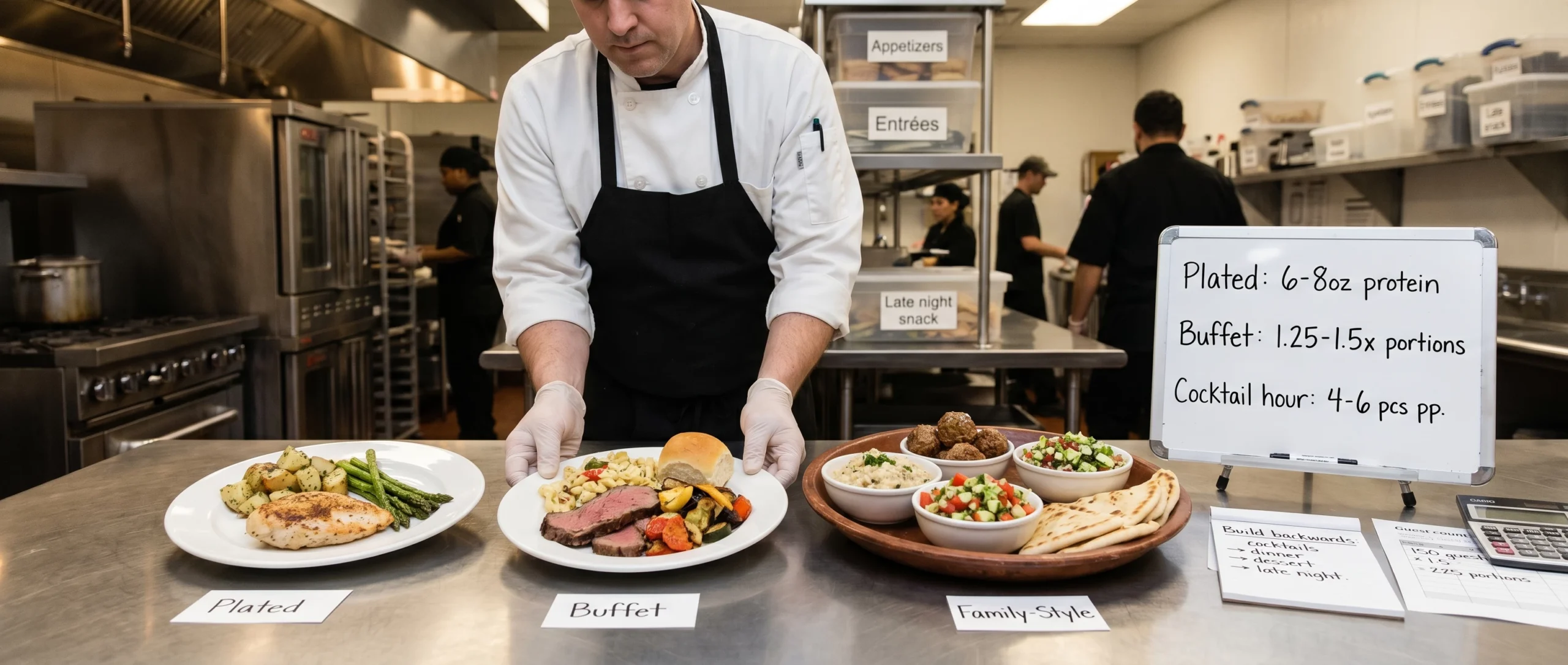
Wedding catering quantities are one of the most practical decisions in planning and one of the most consistently misunderstood. Order too little and the cocktail hour empties early and guests arrive at dinner irritable. Order too much and you’ve spent thousands on food that gets scraped into bins at the end of the night.
Caterers use established formulas, but they don’t always share them. Knowing how much food you need for a wedding before your catering consultation means you can evaluate proposals intelligently, ask better questions, and spot padding that inflates your bill without improving the experience. This guide gives real per-person quantities for every format.
The Variables That Change Everything
Before any formula applies, a few variables shift quantities significantly:
- Time of day. An 11am brunch wedding needs less food per person than a 7pm dinner. Appetites track with meal timing.
- Duration. A 4-hour reception has different catering needs than a 7-hour one. Every additional hour of open bar typically means additional food and drink consumption.
- Guest demographics. A guest list skewing older or younger consumes differently than one centred on 25–40-year-olds. Weddings with many children reduce total consumption per head.
- Service style. Buffet service typically produces 20–30% more food consumption than plated, because guests serve themselves and often take larger portions or go back for seconds.
- Weather. Hot weather reduces appetite for heavy food and increases bar consumption, especially beer and non-alcoholic drinks.
Cocktail Hour
The cocktail hour runs while the wedding party finishes photos — typically 60–90 minutes. The goal is to keep guests comfortable without filling them before dinner.
Passed hors d’oeuvres: 4–6 pieces per person per hour of cocktail hour. For a 90-minute cocktail hour, that’s 6–8 pieces per person. Lean toward the lower end if dinner follows immediately, or if there are also stationary displays or food stations.
Stationary displays — cheese and charcuterie boards, crudités, bread stations — are consumed on top of passed hors d’oeuvres, not instead of them. A typical medium board for 100 guests uses roughly 2–3 lbs of cheese, 2–3 lbs of charcuterie, 2–3 baguettes or cracker assortments, plus supporting garnishes (fruit, nuts, spreads).
Plated Seated Dinner
Plated service controls portions more precisely than buffet. Quantities per person for a standard three-course plated dinner:
| Course | Per person |
|---|---|
| Salad | 2–3 oz greens / 4–5 oz composed salad |
| Protein (main) | 5–6 oz for chicken or fish, 6–8 oz for beef |
| Starch | 4–5 oz (pasta, potato, rice) |
| Vegetables | 3–4 oz |
| Bread | 1–2 rolls per person |
For a fourth course (a plated soup or additional appetiser), add 4–6 oz per person. And remember vendor meals: many catering contracts charge for the photographer, videographer, second shooter, DJ and officiant at the full per-head rate — four to six extra covers to budget separately.
Buffet Service
Buffet quantities run higher than plated because people serve themselves more and often return for a second pass.
| Item type | Plated amount | Buffet adjustment |
|---|---|---|
| Protein | 6 oz per person | 8–9 oz |
| Starch / carb | 4 oz | 5–6 oz |
| Vegetables | 3 oz | 4 oz |
| Salad | 3 oz | 4–5 oz |
For a buffet with two protein options (say chicken and a vegetarian alternative), plan for roughly 60% of guests choosing the primary protein and 40% the secondary — then add 10% contingency across all dishes so the last table through the line isn’t choosing from scraps.
Food Stations
Food stations — taco bars, pasta stations, carving stations, sushi stations — are popular and interactive, but quantities vary significantly by station type:
- Taco or burrito station: 3–4 tacos per person (or 2 burritos), 2–3 oz protein per taco. Calculate for 90% of guests visiting the station.
- Pasta station: 4–5 oz dry pasta per person (roughly 8–10 oz cooked). Plan for 80% of guests visiting over a 2-hour dinner window.
- Carving station: a whole roasted turkey serves roughly 6–8 people per bird; a 5-lb beef tenderloin serves 15–20 at a 4–5 oz portion. Carving stations work best as one of several stations rather than the sole dinner option.
Wedding Cake
Wedding cake is priced per slice or per tier depending on the bakery. Standard servings:
| Tier diameter | Approximate servings |
|---|---|
| 6-inch | 10–12 |
| 8-inch | 20–24 |
| 10-inch | 35–40 |
| 12-inch | 50–60 |
| 14-inch | 75–85 |
For a 150-person wedding, a combination of 8-, 10- and 12-inch tiers provides roughly 105–124 servings — enough if not everyone eats dessert. Many couples order for 80% of their guest count, supplemented by a small sheet cake kept in the kitchen for overflow. If your venue charges a cake-cutting fee for outside cakes, that fee applies per slice served — factor it in before deciding between the venue cake and an outside bakery.
The Bar
Bar quantities are the hardest to estimate because consumption varies enormously. A general starting framework per person for a 4-hour open bar:
| Drink type | Estimate per person |
|---|---|
| Wine | 1 bottle per 4–5 guests for a full evening |
| Beer | 2–3 beers per person |
| Spirits | 1 litre per 10 guests |
| Non-alcoholic (water, soft drinks) | 2–3 servings per person |
Adjust significantly for your guest list’s habits — an older, mixed crowd typically drinks less than a younger, predominantly single one. If you’re offering two beers, plan roughly 60/40 between lager and ale or craft. For a signature cocktail, plan for 30–40% of guests to order one during cocktail hour, then standard bar consumption for the rest of the night.
Late-Night Snacks
If your reception runs past 10pm, late-night snacks noticeably extend guest energy on the dance floor:
- Mini sliders or sandwiches: 2–3 per person
- Pizza: 2–3 slices per person
- Fries or tater-tot station: 3–4 oz per person
- Doughnut wall or dessert station: 2 pieces per person
Late-night food is typically consumed by 60–70% of the guests still present at that point in the evening, so you can order for a fraction of your total headcount.
Frequently Asked Questions
What’s the biggest catering mistake couples make?
Underestimating cocktail hour. If cocktail hour runs light on food, guests arrive at dinner hungry and the pace of the whole evening shifts uncomfortably. Build cocktail-hour quantities first, then dinner.
Do children count as full portions?
Children under 10 typically count as half-portions for catering estimates. Confirm your caterer’s policy — many price children differently, and a kids’ menu is usually cheaper per head.
How much food goes to waste at a typical wedding?
Studies suggest 15–20% of food prepared at catered events goes uneaten. Some venues allow you to donate unused food to a shelter; most don’t allow guests to take food home due to liability concerns.
Should I trust my caterer’s quantity estimates?
Generally yes — a reputable caterer has done this hundreds of times. But understanding the formulas yourself means you can flag a proposal that seems too thin for your guest count or format, or too generous in a way that inflates the bill.
What if we’re running significantly over budget on catering?
Changing the format (buffet to stations, stations to plated) doesn’t always save money — sometimes it costs more because of staffing. Ask your caterer which levers actually affect price before you make format changes.
Do we need to account for dietary restrictions in our quantities?
Yes. If 20% of your guests are vegetarian or vegan, your protein quantities need to reflect that in the mix. Collect dietary information through your RSVP so your caterer can plan accurately rather than guessing.
Know Your Numbers Before the Meeting
Walking into a catering consultation with a working grasp of per-person quantities puts you in a much stronger position — you can evaluate whether the proposal makes sense, ask targeted questions about what’s driving the price, and negotiate from knowledge rather than trust. Run your guest count, event format and timing through the free Wedding Catering Quantity Calculator to get estimates you can compare directly against your caterer’s proposal, and see the hidden wedding costs — vendor meals, service charges, bar overtime — that catering contracts often carry.