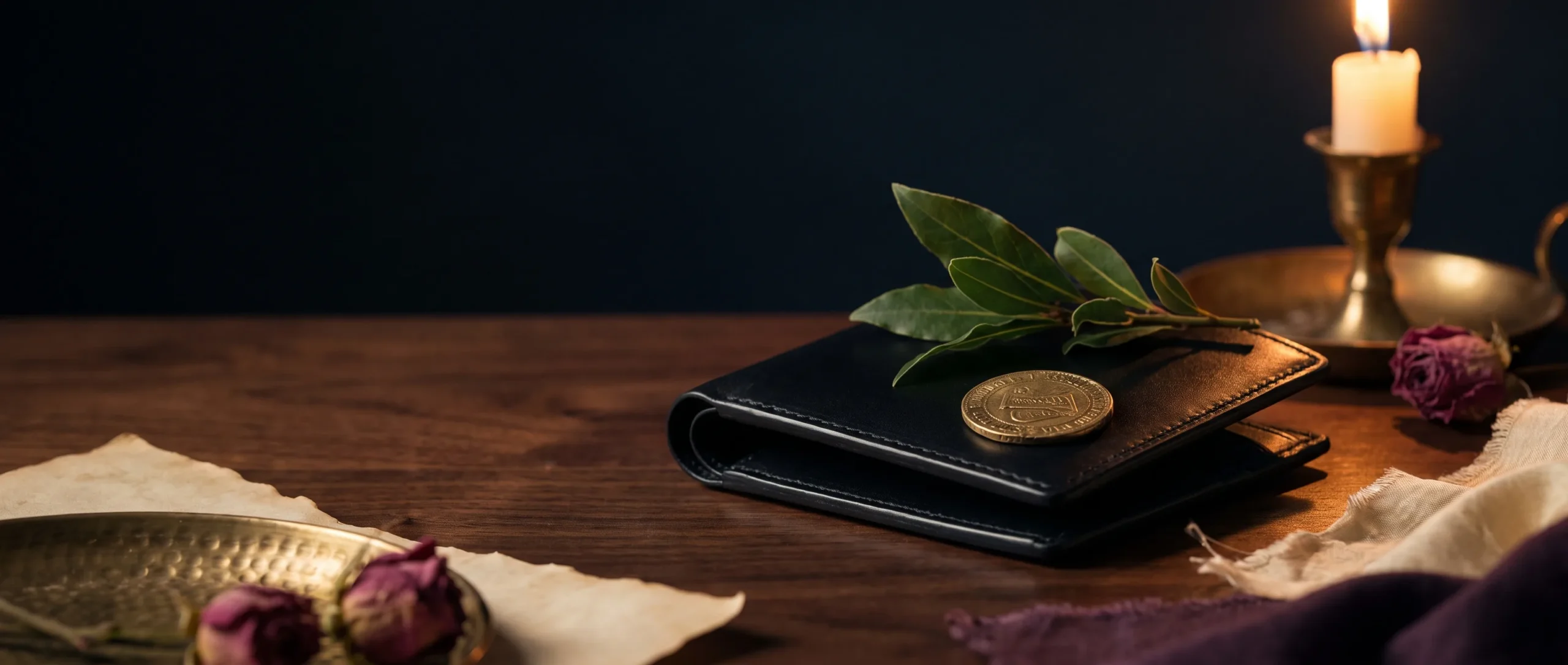
In feng shui, your wallet is money’s home — and the idea is that money, like a guest, stays where it’s welcomed and cared for. A cramped, cluttered, worn-out wallet is read as an unwelcoming home; a tidy, quality, well-colored one invites money to settle. It’s folklore, not finance, but as a small daily ritual of respecting your money it’s harmless and mildly motivating.
Here’s the guidance.
Entertainment and inspiration, not financial advice.
Lucky Wallet Colors
| Color | Feng shui reasoning |
|---|---|
| Black | Wealth, stability, water element — money “held” securely. The safest all-round choice. |
| Gold / brown / tan | Earth element — grounding, saving, money that stays |
| Green | Growth, new income, the wood element |
| Red | Activates energy and luck — but also “fire,” which can burn money; used sparingly or as an accent/lining |
| Blue / navy | Water element — flow of income |
| Avoid | Bright white (associated with loss/emptiness in this tradition) and heavily worn or torn wallets of any color |
If you want one rule: a good-quality black or dark wallet in good condition covers it. The colour advice matters less than the condition advice — a beautiful gold wallet falling apart at the seams is read worse than a plain black one that closes properly.
What Feng Shui Says to Keep In Your Wallet
Keep in:
- Bills laid flat and facing the same way (respect for the money)
- A “seed” or lucky note — a bill you never spend, often the largest denomination you can spare, as a magnet for more
- A small gold object or a coin given by someone generous
- One meaningful photo (people, not clutter)
Keep out:
- Old receipts, expired cards, loyalty cards you don’t use — clutter is the main “money blocker” in this system
- Photos of the deceased (in traditional practice)
- Too many coins weighing it down
Also: don’t leave your wallet empty, don’t put it on the floor, and replace it when it’s visibly worn — a “tired” wallet is read as tired finances.
The one habit that actually does something
Strip away the metaphysics and the practice that has a real effect is the weekly clear-out: every Sunday, take everything out, bin the receipts and dead cards, straighten the bills, and check the seed note is still there. People who do this are, unsurprisingly, more aware of what they’re spending — because they’re handling their money deliberately once a week instead of never. That’s the mechanism, and it’s a good one.
Where the Idea Comes From
Feng shui (literally “wind-water”) is a Chinese practice of arranging spaces and objects to support the flow of qi, or energy. The wallet guidance is a modern, portable offshoot — the same logic applied to the object you handle money with most. Similar wallet and purse traditions exist across cultures: keeping a coin from a bride’s shoe, an arras of thirteen coins in some Hispanic weddings, red envelopes at Lunar New Year, a sixpence in a British bride’s shoe for prosperity.
For a newly married couple, the equivalent ritual is a shared “first note” — a bill from the wedding day (or a coin from a meaningful place) kept in a drawer, never spent, as a small symbol of the household’s foundation.
Take a respectful tour of money-blessing traditions across cultures with the free The Blessing Purse — red envelopes, coin customs, and dowry folklore, told as heritage rather than advice.
Frequently Asked Questions
What color wallet attracts money?
In feng shui: black (stability), gold or brown (saving), and green (growth) are the classic “lucky” colors. Black in good condition is the safe default. Bright white is traditionally avoided.
How do I make my wallet lucky?
Keep it tidy and in good condition, store bills flat and facing the same way, add a “seed” note you never spend, remove old receipts and dead cards, and never leave it completely empty or on the floor.
Where do you put a lucky coin or charm?
In a dedicated compartment away from the bills you spend — the idea is that it stays put and “anchors” the wallet rather than circulating out.
Does a feng shui wallet actually work?
There’s no financial mechanism. As a habit of keeping your wallet organized and treating your money with a bit of ceremony, it can make you slightly more mindful about spending — which is the real (small) benefit.
When should you replace your wallet?
Feng shui suggests every 1–3 years, or whenever it’s visibly worn, on the logic that a “tired” wallet reflects tired finances. Practically: when it stops closing properly or looks shabby.
Is a wallet a good wedding or engagement gift in this tradition?
Yes — a quality wallet given full (with a “seed” note tucked inside by the giver) is a traditional prosperity gift in several cultures. Never give an empty wallet or purse as a gift in this framing; add a coin or note first.
Does the “seed note” have to be a large bill?
No — it’s the largest you can comfortably set aside and genuinely never spend. For some people that’s a $100 bill; for others it’s a $5. The point is that it stays put permanently as a symbol of “the wallet is never empty.”
Money’s Home
A feng shui wallet is a tiny ritual: keep the place your money lives tidy, respectful, and never empty. It won’t change your balance, but treating money with a little care rarely hurts — and the weekly clear-out genuinely helps.
Explore money-blessing traditions with the free The Blessing Purse.