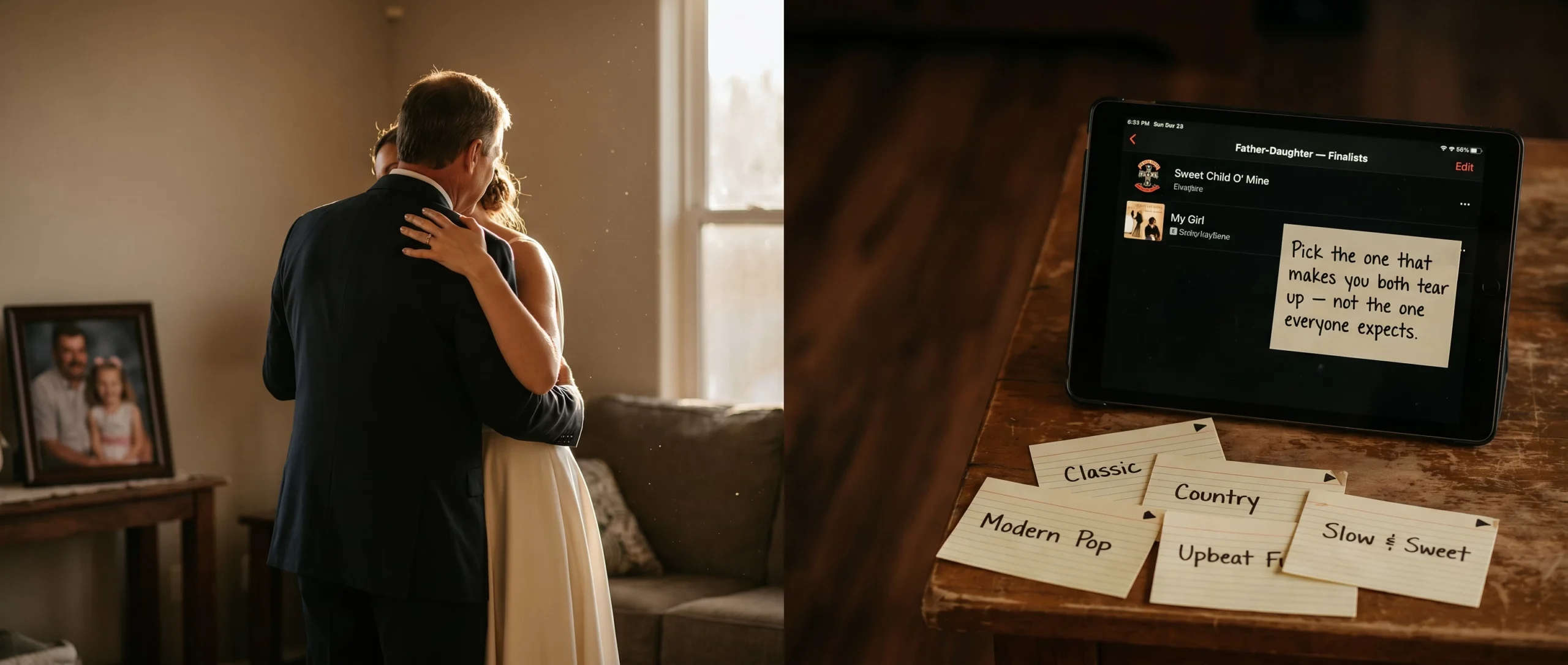
The father-daughter dance is different from every other moment at a wedding reception. It’s not about the couple — it’s about a relationship that has existed for the bride’s entire life, and that emotional weight shows in the room.
Choosing the right song matters more than most brides expect. The wrong choice can feel generic; the right one can stop the room. This guide gives you 50 father-daughter dance songs organised by style, plus a practical framework for choosing between them.
How to Choose the Song
A few questions narrow the list fast:
- What is your relationship like? A close, emotional relationship lends itself to tender, traditional choices. A playful, unconventional one might prefer something upbeat or unexpected. The song should reflect who you actually are together — not who you think you’re supposed to be at a wedding.
- What will he be comfortable with? The dance involves two people. A song that makes one person cry while the other stands stiff serves the moment less well than something you can both move through. Have the conversation before you finalise.
- How long do you want to dance? Most father-daughter songs run 3–4 minutes. If your father isn’t a natural dancer, shorter is usually better — and your DJ can arrange a clean fade.
- Is there an existing song between you? A song he used to play in the car, one from a childhood memory — that will almost always beat anything on a list.
Classic and Timeless
These have endured because they carry real emotional weight and work in most venues with most guests.
- “My Girl” — The Temptations
- “Isn’t She Lovely” — Stevie Wonder
- “You Are the Sunshine of My Life” — Stevie Wonder
- “What a Wonderful World” — Louis Armstrong
- “Stand By Me” — Ben E. King
- “You Are So Beautiful” — Joe Cocker
- “Have I Told You Lately” — Van Morrison
- “How Long Will I Love You” — Ellie Goulding
- “In My Life” — The Beatles
- “Moon River” — Andy Williams
Country
Country dominates father-daughter playlists because the genre writes explicitly about this relationship, with a sentiment most fathers genuinely feel.
- “I Loved Her First” — Heartland
- “My Little Girl” — Tim McGraw
- “There Goes My Life” — Kenny Chesney
- “I Hope You Dance” — Lee Ann Womack
- “Butterfly Kisses” — Bob Carlisle
- “Humble and Kind” — Tim McGraw
- “She’s Everything” — Brad Paisley
- “My Wish” — Rascal Flatts
- “In My Daughter’s Eyes” — Martina McBride
- “Holes in the Floor of Heaven” — Steve Wariner
- “Watching You” — Rodney Atkins
- “Then They Do” — Trace Adkins
Pop and Contemporary
For something recognisable but not rooted in a traditional genre — broad emotional resonance and strong production.
- “You Raise Me Up” — Josh Groban
- “Forever Young” — Rod Stewart
- “Unforgettable” — Nat King Cole / Natalie Cole duet
- “Hero” — Mariah Carey
- “The Living Years” — Mike + The Mechanics
- “Landslide” — Fleetwood Mac (or the Dixie Chicks cover)
- “She Used to Be Mine” — Sara Bareilles (unconventional but resonant)
- “Slipping Through My Fingers” — ABBA
- “Never Grow Up” — Taylor Swift
- “The Best Day” — Taylor Swift
Upbeat and Joyful
For fathers and daughters who would rather celebrate than cry, or a pairing that’s naturally playful.
- “Dancing Queen” — ABBA
- “Happy” — Pharrell Williams
- “Can’t Stop the Feeling” — Justin Timberlake
- “I Will Always Love You” — Dolly Parton (original, upbeat version)
- “Tiny Dancer” — Elton John
- “Sweet Child O’ Mine” — Guns N’ Roses (works better than expected)
- “Brown Eyed Girl” — Van Morrison
- “Build Me Up Buttercup” — The Foundations
- “Don’t Stop Me Now” — Queen
- “Come On Eileen” — Dexys Midnight Runners
Short Options (Under 3:30)
Some pairs prefer a shorter dance — less exposure, easier to pace. These run naturally brief or fade cleanly.
- “My Girl” — The Temptations (3:19)
- “Isn’t She Lovely” — Stevie Wonder (fade at 3:00)
- “In My Life” — The Beatles (2:25)
- “Stand By Me” — Ben E. King (2:57)
- “Brown Eyed Girl” — Van Morrison (3:04)
- “Moon River” — Andy Williams (2:42)
- “Happy” — Pharrell Williams (fades clean at any point)
- “Forever Young” — Rod Stewart (edit to the first verses)
Tips for the Dance Itself
- Tell your father the song in advance. Even if you keep it a secret from guests, play it for him a few weeks before and see how he responds.
- Practise once or twice. A single run-through in your living room makes the real dance much more comfortable — you don’t need choreography, just to know how you’ll move and where to stand.
- Give your DJ a cue for the ending. Decide in advance: invite the groom and his mother to join, open the floor to all parent-child pairs, or have your partner cut in.
- Consider a hybrid. Some brides start slow and transition mid-song into an upbeat finish, or into a dance that pulls in other family members. Plan the transition with the DJ well ahead.
Map all your ceremony and reception music in one place — processional, first dance, this one, cocktail hour, dinner — with the free Wedding Music Playlist Calculator so you can hand your DJ a complete brief.
Frequently Asked Questions
What if my father has passed away?
Many brides honour their father differently — a reserved chair, a candle, a dedicated moment in the reception — rather than a dance. Some dance with a brother, stepfather, grandfather, or a close male figure; some dedicate a song without a dance; some skip the moment entirely. All are valid.
What if my parents are divorced and my relationship with my father is complicated?
You are not obligated to have a father-daughter dance — many modern weddings don’t include one. If you’d rather dance with your mother, a stepparent, or skip it, that’s your call.
My father can’t dance — what should we do?
Most guests don’t care whether you dance well. A simple slow sway with a genuine, warm moment is always more affecting than a technically proficient dance. If he’s truly uncomfortable, a shorter song or a DJ-arranged exit after 90 seconds helps.
Should we take dance lessons?
Only if you both want to. One or two sessions can help an anxious father, but the emotional truth of the moment matters far more than dance skill.
Can the groom join partway through?
Yes — a popular variation is the father dancing the first half and the groom cutting in for the second. It works especially well with a song that shifts tempo. Let your DJ know exactly how to handle it.
The Right Song Is Already There
You probably know the song already — the one that means something, the one your father would recognise without being told. That instinct is almost always right. If you’re still undecided, play a few shortlisted options with your father present; his reaction will tell you which one it is. For the rest of the reception, see our first dance songs and wedding processional songs guides.