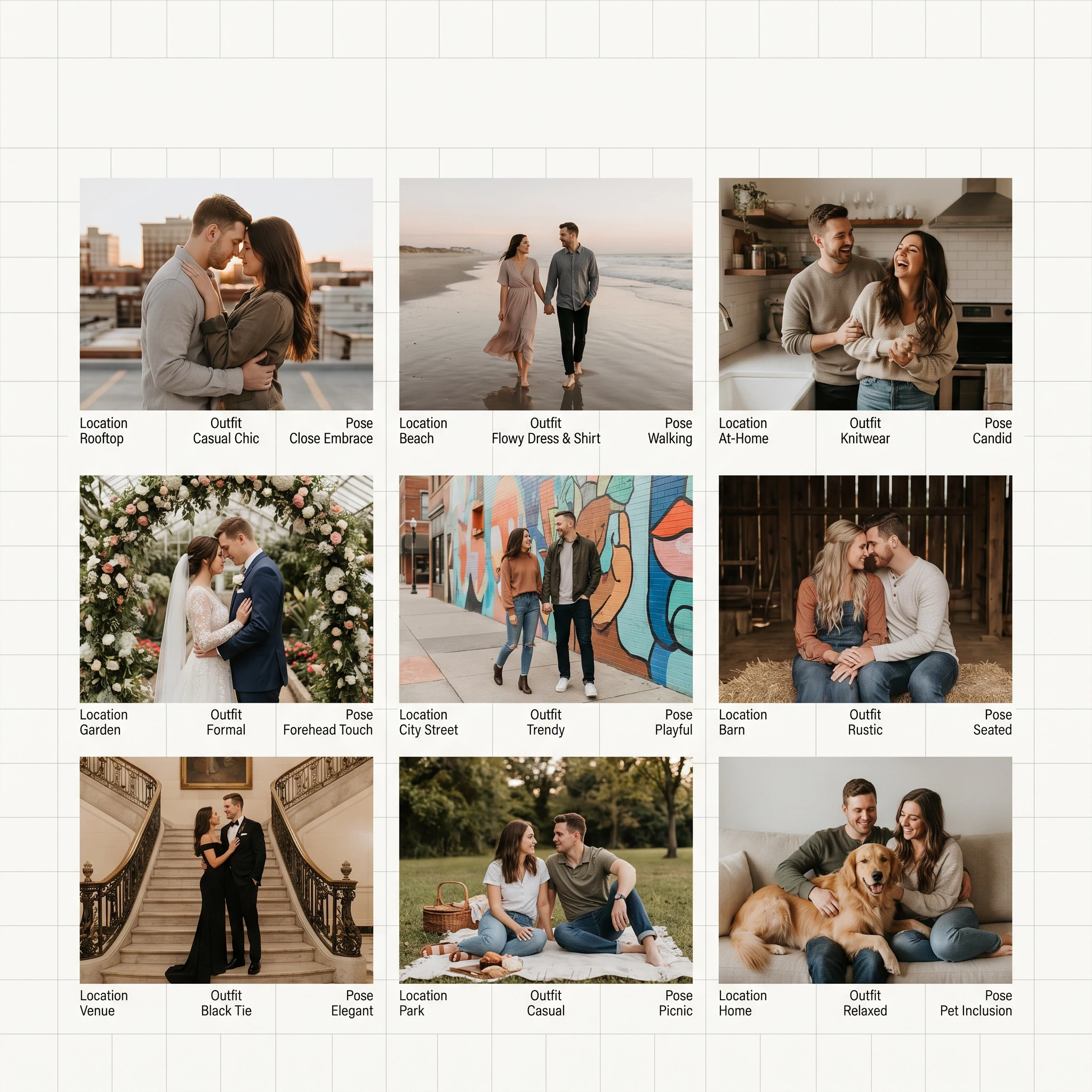
Engagement photos are the first visual story of your engagement — and one of the few times you’ll get professional photos of just the two of you before the wedding day itself.
They’re used everywhere: save-the-dates, wedding websites, frames, gifts for parents, and the social post that makes everyone jealous. This guide covers everything you need to plan a session you’ll genuinely love — engagement photo ideas for locations, outfits and poses, plus timing and how to use the results.
When to Schedule Your Engagement Photos
- Ideal window: 6–12 months before the wedding. This gives you time to use the photos for save-the-dates (typically sent 6–8 months out) and lets you get comfortable on camera before the wedding day.
- Minimum runway: 8 weeks before you need the photos. Most photographers deliver galleries within 3–6 weeks.
- Seasonal note: golden hour in summer hits around 7:30–8:00pm; in fall it’s closer to 5:30–6:00pm. If you have a specific light aesthetic in mind, book your session time to match your season.
Location Ideas
Urban and city
- City streets and alleyways — brick walls, murals and quiet morning streets create a cinematic, editorial look
- Rooftop views — city skyline as a backdrop, especially at dusk
- Coffee shops or restaurants you actually go to — intimate, candid, personal
- Your own neighbourhood — the bench you sat on, the corner you always pass
Nature and outdoor
- Golden-hour meadow or field — soft backlit light, wildflowers, open sky
- Beach or lakeside — movement, reflections, natural light
- Forest or wooded trail — dappled light, texture, privacy
- Vineyard or orchard — fall colour, rows of vines, a romantic atmosphere
- Mountain or desert — drama and scale, best for adventurous couples
Meaningful personal locations
- Where you got engaged — a full-circle story if it’s accessible
- Where you had your first date — genuinely personal, never generic
- Your home — relaxed and intimate, especially good for couples who are uncomfortable in front of cameras
What to Wear
The core principle: dress for each other, then for the location. Coordinate rather than match — same colour family, complementary tones, not identical outfits.
- Bring two outfits for a 2–3 hour session: one casual, one more dressed up
- Avoid busy patterns — small florals, fine stripes and logos get distracting in close-ups
- Consider the location — a flowy dress works in a field; a tailored set works in a city
Colour palettes that photograph well: neutral plus one rich tone (navy + ivory, sage + cream, rust + tan); earth tones (caramel, terracotta, forest green, warm white); soft pastels for spring and summer; deep jewel tones for fall and winter.
What to avoid: all-white or all-black on both of you (contrast imbalance); neon and bright primaries (they pull attention from your faces); new shoes you haven’t broken in (you’ll be walking a lot).
Pose and Style Ideas
Candid and action
- Walking together while actually talking (not posing-while-walking)
- One partner spinning the other
- Laughing at something genuine — tell your photographer to say something unexpected
- Dancing, even if neither of you usually dances
Close and intimate
- Forehead-to-forehead
- Looking at each other, not at the camera
- Hands clasped, rings naturally visible
- One partner tucked into the other’s shoulder
Classic portraits
- Side profile against a wall or doorframe
- Facing the camera holding hands, slightly angled to each other
- A wide-angle shot that includes the full location as context
The ring shot
Make sure your photographer knows you want ring shots — close-up, styled, natural light. If your ring sizing isn’t finalised yet, use the free Ring Size Converter to confirm the fit before the shoot.
What to Tell Your Photographer Before the Session
- The vibe — documentary/candid? Editorial? Romantic? Playful? Give them 2–3 words.
- Light preference — bright and airy, or moody and dark?
- What you’re NOT comfortable with — anything that feels performative or awkward
- Your best side — most people have one
- Any planned moments — if you’re surprising your partner with something, coordinate in advance
- Your deadline — when you need the gallery for save-the-dates, gifts or announcements
A Session That Won’t Feel Awkward
Most people are nervous before an engagement session and relaxed 20 minutes in. You can shorten that adjustment period:
- Start with movement, not portraits. Walking, a slow dance, one partner making the other laugh — motion loosens body language faster than being told to “look natural.”
- Bring a prop with a purpose. A dog, two coffees, a blanket, a picnic. Having something to do with your hands removes the “where do my arms go” problem.
- Pick a location you already like being in. A trail you hike, a bar you go to. Familiarity does half the work.
- Look at each other, not the lens. Almost every image where a couple looks genuinely connected is one where they’re looking at each other and the photographer caught it.
- Let a few be silly. The outtake where someone trips or laughs too hard is often the one that ends up framed.
How to Use Your Engagement Photos
- Save-the-dates — design around one hero image
- Wedding website — header photo and gallery
- Bridal shower invitations — a personal touch guests notice
- Gifts — canvas prints, custom ornaments, photo books for parents
- Social announcement — if you haven’t posted publicly yet, this is the perfect vehicle
- Day-of décor — a photo display at the welcome table or cocktail hour
For engagement-related gift ideas, see our guides to gifts for a newly engaged woman and engagement party gift ideas.
Frequently Asked Questions
How long does an engagement session take?
Most run 1.5–2.5 hours. A mini session (30–45 minutes) gives you a handful of images; a full session gives you 80–120 edited photos.
Should we do an engagement session if we have a wedding photographer?
Yes — it’s valuable practice for both of you and builds the working relationship before the wedding day, when everything is higher stakes.
Do engagement photos have to be romantic?
Not at all. Fun, playful, or even quirky sessions that better reflect your relationship make for more memorable photos than generic romantic poses.
What if one of us hates having photos taken?
Tell your photographer before the session. A good photographer will shift to more movement, more candid approaches, and less posing.
Are engagement photos included in wedding photography packages?
Often yes — most photographers include them or offer them as an add-on. If yours does, use it.
What’s the best time of day?
Golden hour — the hour before sunset — is universally the most flattering natural light. Book your session to end at sunset.
Make It Yours
Engagement photos are one of the few parts of wedding planning that’s just about the two of you — no guest lists, no vendor negotiations, no family opinions. Choose a location that means something, wear something you feel genuinely good in, and let the photographer do their job. Our wedding photography styles guide helps you match a photographer to the look you want.