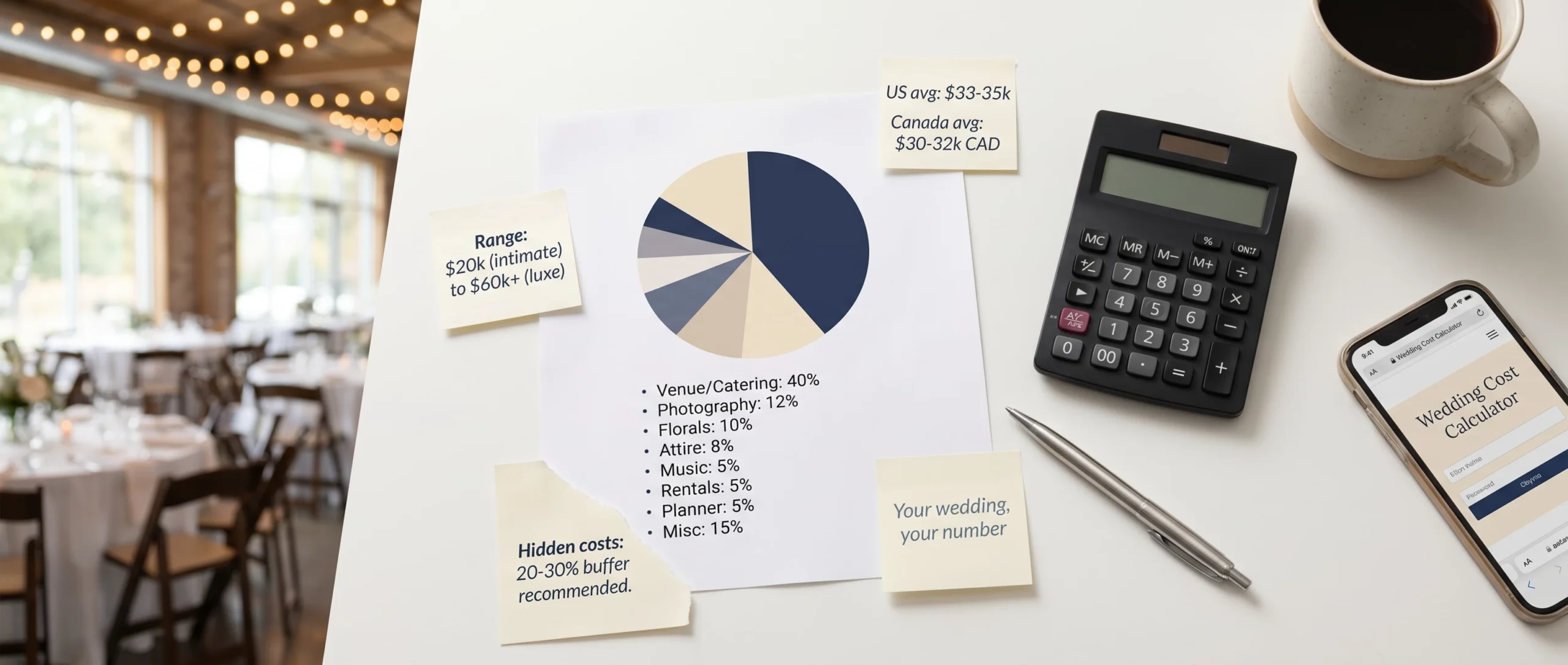
The “average wedding cost” figure gets quoted constantly, and it creates almost as much confusion as clarity. A national average blends a $9,000 backyard wedding with a $180,000 estate event, then hands you a number that describes neither. This guide breaks the average wedding cost in 2026 down the way it’s actually useful — by guest count, by region, and by category — and explains what the headline number leaves out.
The US national average in 2026
The commonly cited US average sits in the $33,000–$38,000 range for the wedding itself (ceremony and reception, excluding the engagement ring and honeymoon). But that average is pulled upward by a minority of very expensive weddings.
A more useful figure: the median US wedding — the true midpoint, where half cost more and half cost less — is closer to $20,000–$25,000. Most couples plan a wedding well below the “average” because the average isn’t a typical wedding; it’s a mean skewed by outliers.
How to read this: if you see “$38,000 average” and feel behind, you’re not. Look at the median and the by-guest-count figures below instead.
Average cost by guest count
Guest count is the single biggest driver, because it multiplies catering, bar, rentals, invitations, favors, cake, and often venue.
| Guest count | Typical total range (US) | Rough cost per guest |
|---|---|---|
| Up to 50 (micro) | $8,000–$20,000 | $150–$350 |
| 50–100 (small) | $15,000–$32,000 | $200–$400 |
| 100–150 (average) | $25,000–$50,000 | $225–$425 |
| 150–200 (large) | $40,000–$75,000 | $250–$450 |
| 200+ | $60,000–$150,000+ | $275–$550 |
Cutting the guest list is the highest-leverage way to lower a wedding budget — every 10 guests removed typically saves $2,000–$4,500. Model your own number with the free Wedding Cost Per Guest Calculator.
Average cost by region (US)
| Region | Typical total (100–150 guests) |
|---|---|
| Northeast (NY, NJ, MA, CT) | $45,000–$80,000 |
| West Coast (CA metro) | $40,000–$70,000 |
| Mid-Atlantic (DC, VA, MD) | $35,000–$55,000 |
| Midwest | $22,000–$38,000 |
| South | $22,000–$40,000 |
| Mountain West | $25,000–$42,000 |
| Rural areas (any region) | 20–35% below the regional metro figure |
The gap between a New York City wedding and a rural Midwest wedding of the same size can easily be $40,000 — location matters more than almost any other single choice.
Average cost by category
For a mid-range US wedding around $30,000, a typical split:
| Category | Share of budget | Typical spend |
|---|---|---|
| Venue (rental + tables/chairs) | 20–30% | $6,000–$12,000 |
| Catering + bar | 25–35% | $8,000–$14,000 |
| Photography | 8–12% | $2,800–$4,500 |
| Videography | 5–8% | $1,800–$3,500 |
| Flowers + décor | 8–12% | $2,500–$5,000 |
| Music (DJ or band) | 5–10% | $1,500–$5,000 |
| Attire (dress, suit, alterations) | 5–8% | $1,800–$3,500 |
| Cake / dessert | 2–3% | $500–$1,000 |
| Stationery | 2–3% | $600–$1,200 |
| Hair + makeup | 2–3% | $500–$1,200 |
| Officiant | 1–2% | $250–$600 |
| Planner / coordinator | 5–15% | $1,500–$6,000 |
| Rings (wedding bands) | 2–4% | $1,000–$3,000 |
| Misc / buffer (10%) | — | ~$3,000 |
Catering and venue together are typically half the budget — which is why guest count and location dominate the total.
What the average doesn’t include
The headline figure almost always excludes:
- The engagement ring (US average ~$5,000–$6,000)
- The honeymoon (US average ~$5,000–$8,000)
- Pre-wedding events — engagement party, showers, bachelor/bachelorette trips
- Guest-side costs — your own travel and lodging if it’s a destination wedding
- Vendor tips (often $1,000–$2,000 total)
- Alterations, overtime fees, and delivery charges that don’t show up in the first quote
Those hidden and adjacent costs commonly add 20–35% to the “wedding” figure. Catch them before they surprise you with the free Wedding Hidden Fee Detector, and see our full guide to hidden wedding costs.
Canadian wedding costs (2026)
The Canadian average runs roughly CA$30,000–$35,000 for the wedding, with the same regional pattern — Toronto and Vancouver weddings cost 30–50% more than the national figure, while the Prairies and Atlantic Canada run below it. The category splits are nearly identical to the US.
How to use these numbers
- Ignore the “average.” Start from your guest count and region, using the tables above.
- Set a total you’re actually comfortable with — not one anchored to a national figure.
- Allocate by category using the percentages, then adjust for what matters to you (most couples over-fund one or two things and cut hard elsewhere).
- Add a real 10% buffer and account for the excluded costs.
- Track spend against the plan from the first deposit, not from memory.
Build your full budget with the free Total Wedding Budget Calculator, and see what a wedding budget should include for the complete category list.
Frequently asked questions
What is the average cost of a wedding in 2026?
The commonly cited US average is around $33,000–$38,000 for the ceremony and reception, but the median — a more typical wedding — is closer to $20,000–$25,000. The average is skewed upward by a minority of very expensive weddings.
How much does a wedding cost per guest?
Typically $200–$450 per guest for a mid-range US wedding, covering catering, bar, rentals, stationery, favors, and cake. This is why reducing the guest list is the most effective way to lower the total.
What is the most expensive part of a wedding?
Catering and bar (25–35% of the budget) and the venue (20–30%) — together usually about half the total. Both scale directly with guest count.
Does the average wedding cost include the ring and honeymoon?
No. The standard figure covers only the ceremony and reception. The engagement ring (~$5,000–$6,000) and honeymoon (~$5,000–$8,000) are separate, as are pre-wedding events and vendor tips.
How can I have a wedding well below the average?
Keep the guest list under 75, choose a non-peak date and a venue that allows outside catering, prioritize two or three things and cut the rest, and skip the elements that don’t matter to you. Sub-$15,000 weddings are common and often the most personal.
Are weddings getting more expensive?
Yes — venue, catering, and vendor costs have risen steadily with inflation, though guest counts have trended smaller, which partly offsets it. Regional variation still dwarfs year-over-year change.
Understand the numbers, then set your own
The average wedding cost is a data point, not a target. Use the by-guest-count and by-region figures to get a realistic starting range, allocate by category, account for what the average leaves out, and then plan the wedding you actually want.
Start with the free Total Wedding Budget Calculator and pressure-test it with the Wedding Hidden Fee Detector.
Related reading
- Honeymoon Budget 2026: Real Cost Ranges by Destination Type
- How Much to Spend on a Wedding Dress in 2026 (Real Budget Breakdown)
- How Much Does a Rehearsal Dinner Cost in 2026? (Real Ranges by Format)
- How Much Food Do You Need for a Wedding? (Per-Person Quantities by Format)
- How Many Wedding Guests Can You Actually Afford?
- Wedding Photographer Cost 2026: What You're Actually Paying For
- How Much Does a Wedding Venue Cost in 2026? (By Region + Hidden Fees Exposed)
- How Much to Tip Wedding Vendors: Etiquette, Timing, and Who to Include
- The Rich Era Oracle