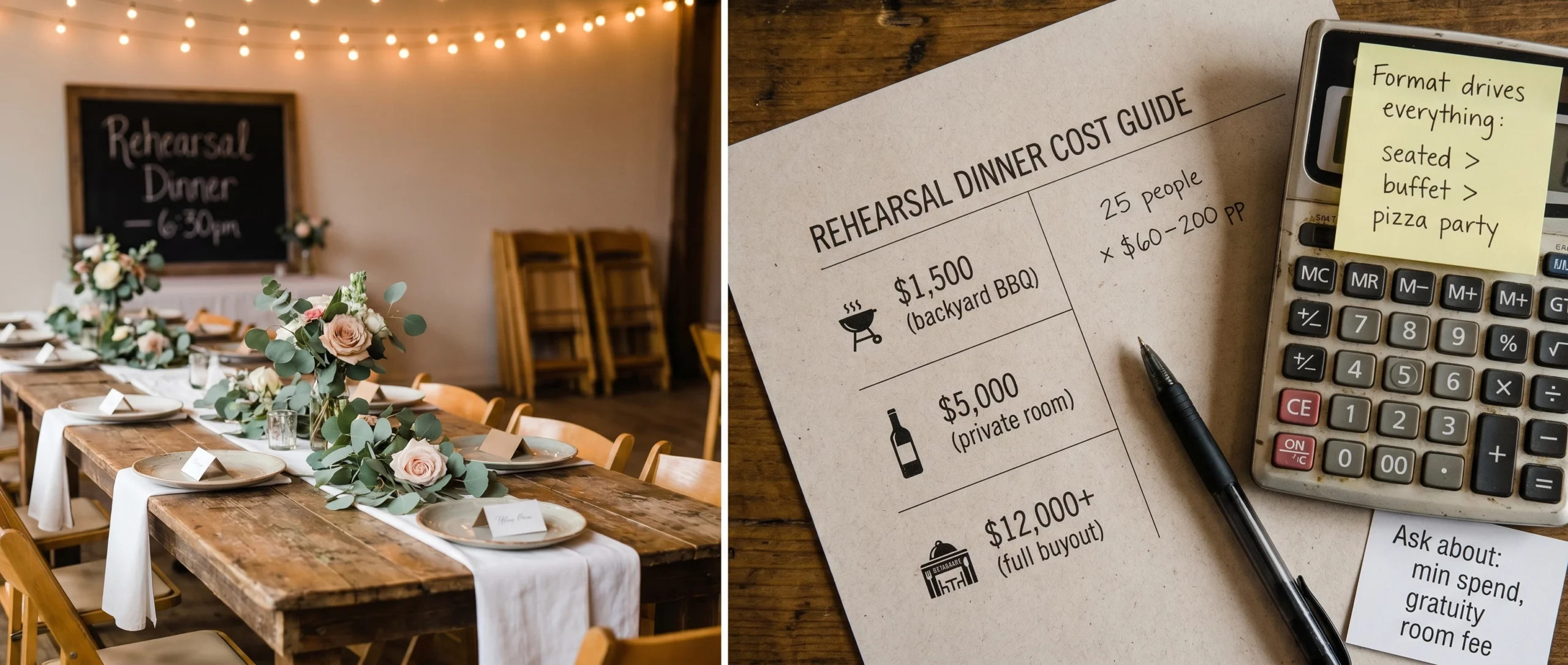
The rehearsal dinner is often treated as a secondary event — smaller than the wedding, less formal, easier to budget. In practice, it surprises many couples who discover too late that a dinner for 30–50 people at a restaurant costs significantly more than a comparable dinner at home.
This guide covers real rehearsal dinner cost ranges for different formats, what drives those costs up, who traditionally pays, and how to build a budget that reflects your actual situation rather than a vague sense that “it’s just dinner.”
Figures are 2026 US planning estimates, not financial advice — costs vary widely by city, menu and bar choices.
What the Rehearsal Dinner Covers
The rehearsal dinner happens the evening before the wedding, typically right after the ceremony rehearsal. Attendees usually include:
- The wedding party and their partners
- Immediate family on both sides
- Out-of-town guests who have already arrived
- The officiant and any key ceremony participants (readers, musicians)
- Sometimes close friends, at the couple’s discretion
The typical guest count is 20–60 people, though very large or very intimate weddings push this in either direction. The single biggest driver of cost is how far this list stretches beyond the wedding party and immediate family.
Cost Ranges by Format
| Format | Typical total (30–40 guests) | Per-person food & beverage |
|---|---|---|
| Casual restaurant reservation (no private room) | $1,000–$4,000 | $50–$90 |
| Restaurant private dining room / buyout | $2,500–$10,000+ | $75–$150 |
| Catered venue or rented space | $4,000–$15,000+ | $85–$175 |
| Home / private property (professionally catered) | $1,000–$5,000 | $40–$80 |
| Home cooked | $500–$2,500 | $15–$35 |
Per-person figures are food and beverage only. Décor, florals, entertainment, audio, parking and staffing all add to the effective per-head number.
Restaurant private dining room or buyout
A private dining room at a mid-range restaurant for 30–40 guests typically runs $2,500–$5,000 all-in for a multi-course dinner with wine. A restaurant that requires a full buyout, a more premium menu, or a larger guest list can reach $8,000–$10,000 and beyond. Most restaurants offering private dining have a minimum-spend requirement — the room is “free,” but you must hit a food-and-beverage minimum to use it. Confirm that number in writing before booking, and ask whether tax and the service charge count toward it.
Catered venue or rented space
A catered event in a rented space — a private room at a hotel, a historic venue, a standalone event space — mirrors the wedding in structure: you pay for the space separately from catering, and catering is priced per person. At $75–$150 per head for food and beverage plus a venue rental of $500–$2,500, a 40-person catered dinner runs $3,500–$8,500 before you’ve added florals, décor or entertainment. This is the format most likely to creep, because once you’re renting a room it feels natural to dress it up.
Home or private property
A dinner at a parent’s home, a private garden, or a rented house is the most cost-effective format. The primary costs are catering or food, beverage, and any rental items (tables, chairs, linens, place settings) if the space isn’t equipped. A home-cooked or lightly catered dinner for 30 can be done for $1,000–$3,000. The trade-off is logistics — hosting at home requires significantly more setup and cleanup coordination, usually falling on a family member the night before the wedding.
Casual restaurant reservation
For smaller guest lists (under 25), a block of tables at a well-liked restaurant — without a private room — is often the most practical option. Costs are per-person at standard menu prices plus a 20–22% tip. At $60–$100 per person for dinner and drinks, 20 guests typically runs $1,440–$2,400 before tip. No minimum spend, no room fee, and the restaurant handles everything.
For scale, The Knot 2026 Real Weddings Study puts the average rehearsal dinner at $2,800, and The Knot’s rehearsal dinner data reports that over 74% of couples hosted one.
What Drives the Cost Up
- Open bar duration. An evening rehearsal dinner with a full open bar for 3–4 hours adds $35–$60 per person on top of food. Many couples switch to wine-and-beer-only at the rehearsal and skip spirits — this typically saves 30–40% on beverage costs and is barely noticeable in atmosphere.
- Guest-count creep. The list often expands from “just the wedding party” to “and their partners” to “and the out-of-town cousins who arrived early.” Every additional person at a catered event is real money. Set the guest list before venues are contacted, not after.
- Speeches and AV. Many rehearsal dinners include toasts and a slideshow. If the venue has to accommodate AV equipment, extended seating time and event staffing beyond a standard dinner booking, those logistics carry costs.
- Premium venues and cities. Rehearsal dinners in New York, Los Angeles, San Francisco and Toronto run 40–80% higher than comparable events in mid-size cities. If your wedding is in an expensive market, budget accordingly.
Who Traditionally Pays
Traditionally, the groom’s family hosted and paid for the rehearsal dinner. This has become far less prescriptive in modern weddings — couples now commonly pay themselves, split with both families, or let whoever offers to contribute do so. If a parent offers to host or pay, clarify early whether they mean a particular venue and budget, or whether they’re open to input on format and guest list. Misaligned expectations about what “hosting the rehearsal dinner” means are a common source of late-stage family friction.
Ways to Reduce Costs Without Reducing Quality
- Limit the bar. Wine and beer service during dinner is often indistinguishable in atmosphere from a full open bar, at meaningfully lower cost.
- Choose a lunch or brunch format. A rehearsal brunch (when the ceremony rehearsal happens in the morning) costs 25–40% less than an equivalent evening dinner and is often less rushed.
- Host at home with professional catering. The space cost drops to near zero, and you control the menu by choosing the caterer directly.
- Keep the guest list deliberate. Out-of-town guests who arrived the day before don’t automatically need to be included. A dinner that’s genuinely just the wedding party and immediate family is more intimate and substantially less expensive.
Frequently Asked Questions
Is a rehearsal dinner required?
No. Some couples skip it entirely, particularly for destination weddings where a welcome dinner serves the same social function. Others have a relaxed gathering at someone’s home rather than a formal dinner. What matters is that out-of-town guests have somewhere to be and the wedding party has a moment together before the day.
Can we combine the rehearsal dinner with a welcome party?
Yes — this is increasingly common, particularly for destination weddings or when most guests are travelling. A single welcome dinner for all guests replaces both events and often simplifies logistics significantly, though it costs more than a rehearsal dinner alone because the guest count is larger.
Who does and doesn’t attend?
The core is the wedding party and their partners, immediate family, and key ceremony participants. Out-of-town guests are often included as a courtesy, but this is discretionary. Local guests typically aren’t invited unless the dinner is very small.
What if we can’t afford a full rehearsal dinner?
A casual gathering at home — pizza, a backyard barbecue, takeout from somewhere everyone loves — serves the same relational purpose as a formal dinner at a fraction of the cost. The function of the rehearsal dinner is connection before the wedding day, not a particular format.
Does the rehearsal dinner have to happen the night before?
Convention says yes, but some couples host it two nights before to reduce pre-wedding-day exhaustion. If your ceremony rehearsal is Friday afternoon, a Thursday dinner can give everyone a calmer Friday evening.
Do we need to do speeches at the rehearsal dinner?
Not formally. Some couples use the rehearsal dinner for toasts that are more personal or family-facing than what would work at the full reception. Others keep it conversational. Neither is wrong — it depends on your family’s expectations.
Budget for the Full Picture
The rehearsal dinner is a real event with real costs — not a footnote to the wedding budget. Decide on the format before contacting venues, set the guest list before you discuss it with family, and project your total with the free Rehearsal Dinner Cost Estimator. Track it alongside the main day in your wedding budget breakdown, and watch for the hidden wedding costs — minimum spends, service charges — that private dining rooms carry.
A note on the numbers: where a figure above links to a source, it comes from that source. The remaining ranges in this guide are planning rules of thumb and vendor-reported estimates rather than survey results, so confirm them against quotes in your own market.