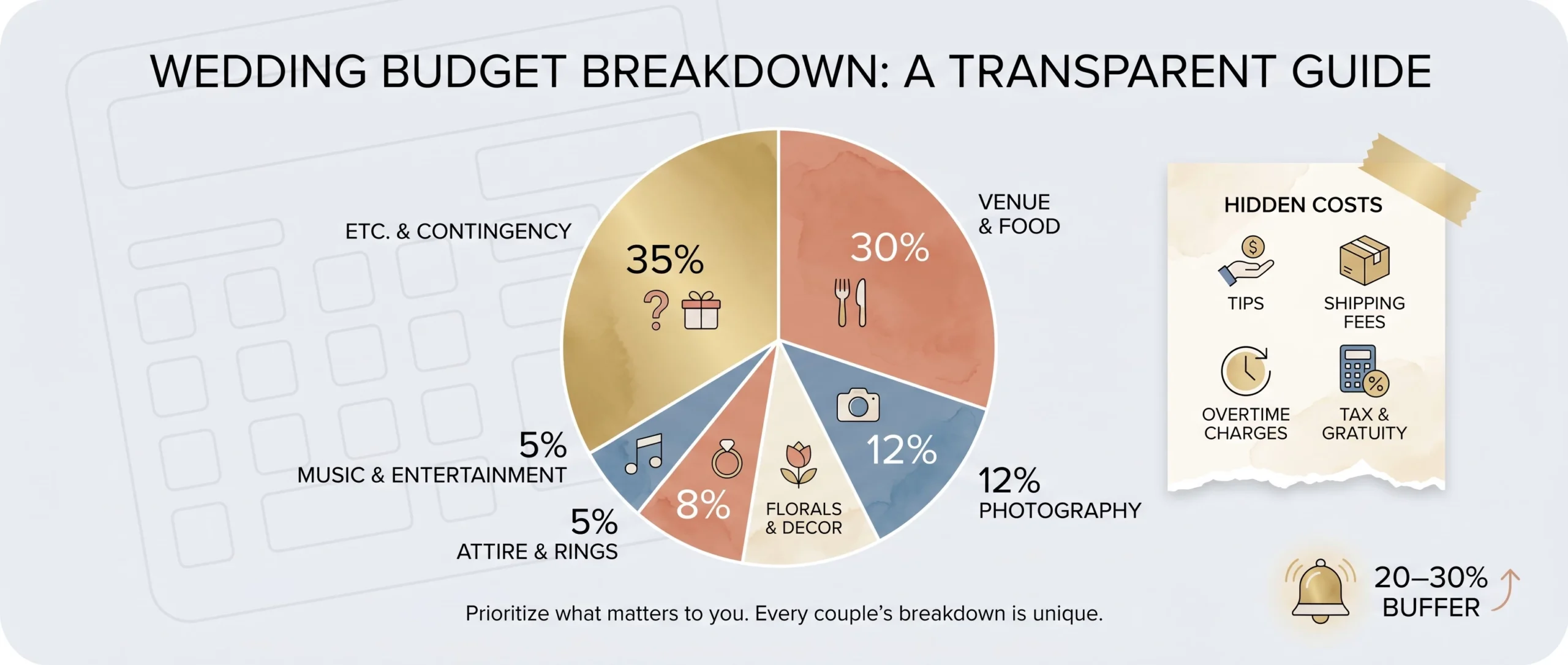
Most couples set a wedding budget. Far fewer stick to it — usually because the budget was built wrong to begin with.
A working wedding budget breakdown doesn’t just list what you plan to spend. It accounts for everything you’ll actually be asked to pay, including the line items that never appear in a venue quote. This guide covers every category a complete budget includes, the percentage most couples allocate to each, and the costs that consistently get missed.
The figures below are 2026 US national-average planning estimates, not financial advice. Real prices vary widely by region, season, and guest count — use them as a starting framework, then replace them with your own quotes.
Start With Your Total — Before You Break It Down
Before you divide anything into categories, you need a real total. Most couples start from a vague number that hasn’t accounted for who is contributing what.
Answer these first:
- What are you personally contributing?
- Are your families contributing, and is that money confirmed or just discussed?
- Are there strings attached — a required vendor, guest-list additions?
Until those conversations have happened and the amounts are confirmed, your total is theoretical. Build the budget on confirmed money, not hoped-for contributions.
Once you have a real number, subtract 10% immediately and set it aside as a contingency buffer. The remaining 90% is your working budget. This isn’t pessimism — it’s the pattern. Most weddings incur 5–15% in costs that weren’t anticipated when the budget was first drafted.
The Major Budget Categories (and Typical Percentages)
Every wedding budget divides into the same fundamental areas. What changes is the share you give each one based on your priorities.
| Category | Typical share | What it covers |
|---|---|---|
| Venue & catering | 40–50% | Rental, food, beverage, service charges, site fees, minimums |
| Photography & videography | 12–18% | Coverage hours, second shooter, albums, engagement session |
| Flowers & décor | 8–12% | Bouquets, centrepieces, ceremony florals, rentals, lighting |
| Music & entertainment | 5–10% | Reception DJ or band, ceremony musicians, cocktail-hour music |
| Attire & rings | 8–15% | Dress and alterations, veil, suit, wedding party attire, bands |
| Stationery, hair, makeup, extras | 8–12% | Invitations and postage, hair/makeup, favours, transport |
| Contingency buffer | 10% | Price increases, rush fees, last-minute additions |
Venue and catering: 40–50%
The single largest category — and the most frequently underestimated. Venue rental is just the starting point. Many venues require you to use their catering, bundle a beverage package, or charge a site fee plus a per-head food minimum. Get an all-in total before you book, not just the room rate.
Photography and videography: 12–18%
Most couples call this their top priority, yet it’s often the first thing cut when budgets tighten. In major metros, experienced photographers commonly run $4,000–$8,000 for full-day coverage; a cinematic video adds roughly $2,500–$5,000 on top. Photos are what remain after every other vendor is forgotten.
Flowers and décor: 8–12%
Floral pricing swings enormously by season and by how much of the venue needs filling. A simple garden ceremony can run under $2,000; a fully floralled ballroom can pass $15,000. The biggest lever: use in-season blooms, which cost a fraction of imported out-of-season alternatives.
Music and entertainment: 5–10%
A DJ typically runs $1,500–$3,500 for a full reception. A live band starts around $5,000. Ceremony musicians are usually priced separately at $500–$2,000. Couples underestimate this because entertainment feels optional — until the day, when the energy in the room depends on it.
Attire and rings: 8–15%
This covers the dress and alterations (which are billed separately — budget $300–$800 on top of the gown price), veil and accessories, shoes, the suit or tux, wedding party attire, and both rings.
Stationery, hair, makeup, and extras: 8–12%
Professional hair and makeup, save-the-dates and invitations (including postage, which adds up fast for large lists), favours, and transport. Each item seems small; together they routinely add $3,000–$6,000 that wasn’t clearly budgeted.
Categories Couples Most Commonly Miss
- Marriage license fee — small ($25–$100), genuinely forgotten.
- Vendor meals — most caterers charge full per-head rates for the photographer, videographer, DJ and officiant. Confirm the policy in writing.
- Hair and makeup trials — a separate service from the wedding-day appointment.
- Gratuities — not included in any quote. For a 100-guest wedding, total tips across all vendors typically run $500–$1,500+.
- Postage — invitation suites often exceed a standard letter’s weight. Hand-weigh one at the post office before buying stamps.
- Day-of transportation — party shuttles, a couple’s getaway car, guest transport from the hotel.
- Cake-cutting fee — many venues charge $3–$5 per person to serve a cake from an outside baker.
- Alterations — billed separately from the gown, typically $300–$800 depending on the dress.
- Postage twice — if you include a pre-stamped RSVP return envelope, you’re paying wedding-weight postage on both directions.
- Welcome bags, favours and signage — small per unit, real money across 120 guests.
A Worked Example: A $30,000 Budget
After setting aside 10% ($3,000) as contingency, the working budget is $27,000. A typical allocation for a 100-guest wedding:
| Category | Share | Amount |
|---|---|---|
| Venue & catering | 46% | $12,400 |
| Photography & videography | 15% | $4,050 |
| Flowers & décor | 10% | $2,700 |
| Music & entertainment | 8% | $2,150 |
| Attire & rings | 11% | $2,970 |
| Stationery, hair, makeup, extras | 10% | $2,700 |
Then the $3,000 buffer absorbs the marriage license, vendor meals, gratuities, postage overruns and the venue’s final-walkthrough surprises. If the buffer isn’t fully used, it becomes honeymoon money — not an excuse to upgrade the flowers in month eight.
How to Prioritise When the Budget Doesn’t Cover Everything
Almost every couple reaches a point where the total they want to spend is less than the total of everything they want. Rank each element on a simple scale:
- Must-haves — the elements that define your wedding. Protect this budget no matter what.
- Nice-to-haves — things you’d love but can downgrade, substitute, or delay. This is where flexibility comes from.
- Tradeoffs — elements you’re genuinely indifferent about that you’re including because they seem expected. The easiest cuts.
Couples who make explicit tradeoffs — “we’ll skip the videographer and put that toward live music” — stay within budget with far more satisfaction than couples who try to include everything at lower quality.
Budget vs. Tracker
A budget is your plan. A tracker is your working document: what you’ve actually been quoted, what deposits are paid, what’s outstanding, and how your real spend compares to plan as bookings are made. Most couples build a budget but never maintain a tracker — and lose visibility three or four months in, after contracts are already signed.
Build your budget somewhere that calculates your running total automatically. You want to see at a glance: total budgeted, total committed, total outstanding, and the difference.
Frequently Asked Questions
What percentage of a wedding budget should go to the venue?
Venue and catering combined typically represent 40–50% of the total. If your venue is unusually expensive, expect to compress other categories to compensate.
What’s the most common area couples go over budget?
Catering — primarily because quotes don’t always include beverage service, the service charge, or venue-required add-ons. Flowers and décor are second.
Should the honeymoon be in the wedding budget?
Most couples keep them separate. The honeymoon is a very different spending category, and mixing it into wedding tracking creates confusion.
Is it possible to have a beautiful wedding under $15,000?
Yes — with deliberate tradeoffs. Prioritise what matters most (usually photography and food), use in-season flowers, and be selective about which traditional elements you include.
When should I finalise my wedding budget?
Set your total and major category allocations before you book any vendors. Venue and photographer are usually the first big commitments — without a framework, they box in everything else.
Build Your Framework First
Map your total across these categories before you start collecting quotes, and set aside the 10% buffer before anything else. Run your numbers with the free Total Wedding Budget Calculator to see how your total breaks down by category, then keep it visible as bookings are made. For a category-by-category price picture, see our guide to the average wedding cost in 2026 and the hidden wedding costs that blow budgets when they surface late.
Related reading
- Honeymoon Budget 2026: Real Cost Ranges by Destination Type
- How Much to Spend on a Wedding Dress in 2026 (Real Budget Breakdown)
- How Much Does a Rehearsal Dinner Cost in 2026? (Real Ranges by Format)
- How Much Food Do You Need for a Wedding? (Per-Person Quantities by Format)
- Wedding Invitation Postage Guide: US and Canada
- How Many Wedding Guests Can You Actually Afford?
- Wedding Photographer Cost 2026: What You're Actually Paying For
- How Much to Tip Wedding Vendors: Etiquette, Timing, and Who to Include
- Wedding Dress Sizing Guide: Why Bridal Sizes Run Small + Brand-by-Brand Chart
- Wedding DIY Mistakes That Cost More Than They Save
- Bridal Circle — Full Reading
- The Garden Gate
- More in Wedding Budget