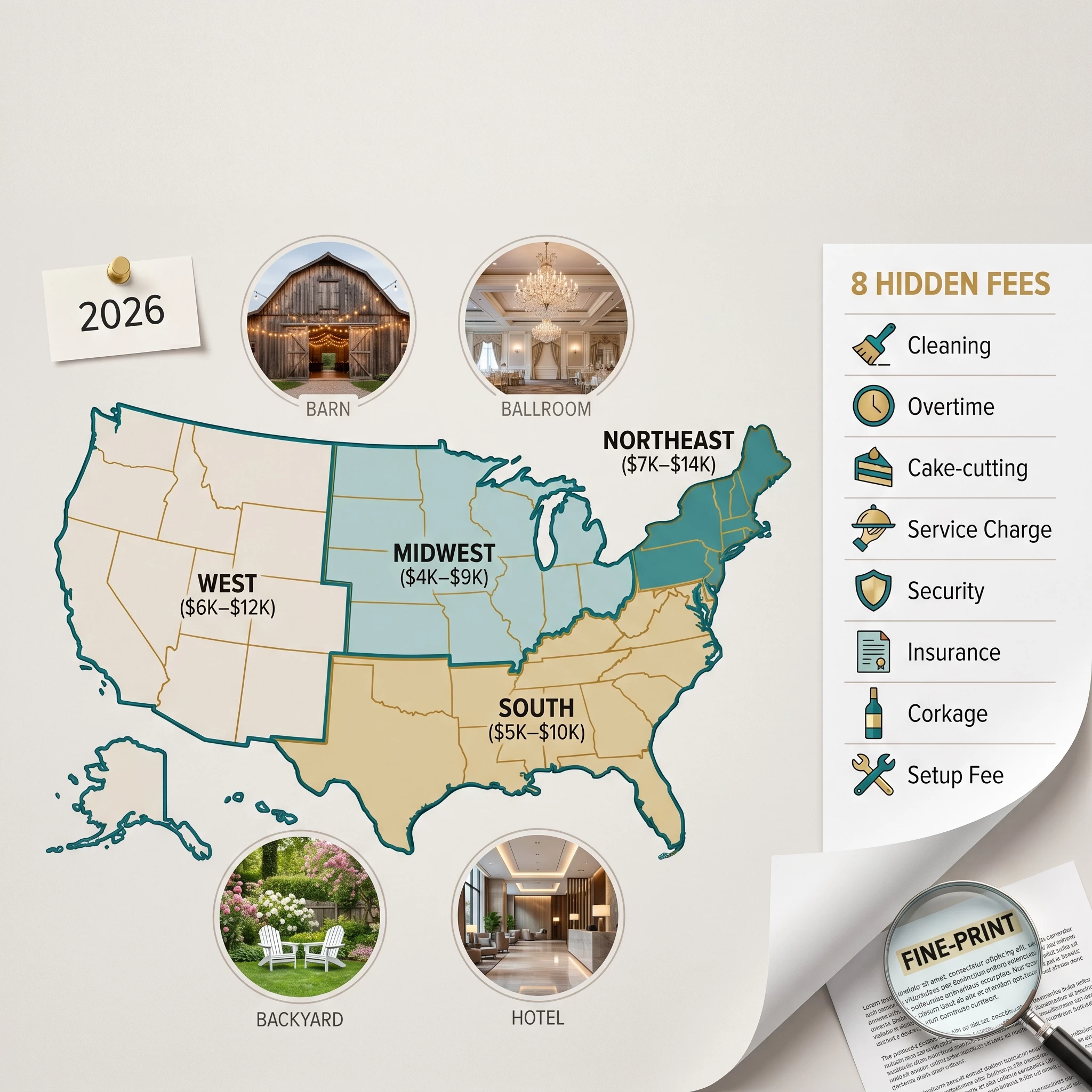
Your venue is almost always the biggest single line item in your wedding budget. It also shapes everything else: your guest count, your catering options, your photographer’s timing, your floral budget, your parking situation. Getting the venue number right — at the beginning — makes every other decision downstream easier.
The national average for a wedding venue in the United States is 6,000–11,000, but that range is nearly meaningless without context. A ballroom at a luxury hotel in Manhattan will cost 20,000+ before anyone sits down. A family-owned vineyard in the Midwest might be 2,500 all-in. Here’s what actually determines venue cost — and what to watch for in the contract.
National Average Wedding Venue Cost in 2026
| Venue Type | US Average | Canadian Average |
|---|---|---|
| Hotel ballroom | 8,000–18,000 | 9,000–20,000 CAD |
| Vineyard / winery | 5,000–12,000 | 6,000–14,000 CAD |
| Barn / farm | 3,500–8,500 | 4,000–10,000 CAD |
| Country club | 7,000–16,000 | 8,000–18,000 CAD |
| Restaurant (buyout) | 3,000–8,000 | 4,000–9,000 CAD |
| Garden / botanical | 4,000–10,000 | 5,000–12,000 CAD |
| Historic estate | 6,000–15,000 | 7,000–17,000 CAD |
| Public park / outdoor | 500–2,500 | 500–3,000 CAD |
| Community hall | 800–3,000 | 1,000–4,000 CAD |
Most venue fees are rental-only and do not include catering, bar service, florals, or staffing.
→ Use the Wedding Venue Cost Estimator to get a realistic total for your region, venue type, and guest count — including typical add-on costs.
Cost by Region: How Location Moves the Number
Geography is the single biggest driver of venue price variance.
United States — Regional Averages
| Region | Average Venue Cost |
|---|---|
| Northeast (NY, MA, CT, NJ) | 10,000–20,000+ |
| West Coast (CA, WA, OR) | 9,000–18,000 |
| Southeast (FL, GA, NC, SC) | 5,000–10,000 |
| Midwest (IL, OH, MN, WI) | 3,500–7,500 |
| Southwest (TX, AZ, CO, NM) | 5,000–10,000 |
| Mountain States (MT, ID, WY) | 3,000–7,000 |
| Mid-Atlantic (DC, VA, MD, PA) | 7,000–15,000 |
Practical implication: if you’re flexible on location and willing to drive 45–90 minutes outside a major metro area, you can often cut venue cost by 30–50% while getting the same aesthetic.
Canada — Regional Averages
| Province | Average Venue Cost (CAD) |
|---|---|
| Ontario (Toronto metro) | 9,000–20,000 |
| British Columbia (Vancouver) | 8,000–18,000 |
| Alberta (Calgary/Edmonton) | 6,000–12,000 |
| Quebec (Montreal) | 5,000–10,000 |
| Atlantic provinces | 3,000–7,000 |
For a state-specific look at one of the most popular wedding destinations in the US, see our Florida wedding venues guide.
What’s Usually Included — and What Isn’t
Most venue rental fees cover:
- Exclusive access during your event window (typically 4–6 hours for reception, plus setup time)
- Basic tables and chairs (linens are usually separate)
- Bridal suite and groom’s room access
- On-site parking
Most venue rental fees do not cover:
- Catering (unless it’s an all-inclusive venue)
- Bar and beverage service
- Linens, napkins, chair covers
- Florals and centerpieces
- Lighting and décor
- Wedding cake cutting fee
- Ceremony fee (if separate from reception space)
- Required security staff
- Sound system and AV equipment
The 8 Hidden Fees Venues Don’t Mention Until You Sign
This is where budgets get blindsided. Couples typically discover these after falling in love with a venue — exactly when they’re least likely to walk away.
1. Mandatory Catering Minimum
Many venues require you to spend a minimum dollar amount on food and beverage — often 8,000–20,000 — regardless of guest count. The “rental” fee may be waived if you hit the minimum, which looks attractive until you realize you’re locked into their pricing and menu tiers.
2. Service Charge and Gratuity
Typically 18–22% added automatically on top of catering costs. On a 12,000 catering bill, that’s 2,160–$2,640 that wasn’t visible in the per-plate price.
3. Cake Cutting Fee
If you bring in an outside cake, many venues charge 3–8 per person to cut and serve it. For 150 guests, that’s 450–1,200 to cut a cake you already paid for.
4. Corkage Fee
Bringing your own wine or champagne? Expect 15–35 per bottle, or a flat rate. Run the full math against buying through the venue before assuming outside alcohol saves money.
5. Vendor Restrictions and Access Fees
Some venues only allow vendors from their preferred list. If your photographer or caterer isn’t on it, you either pay a “vendor access fee” (500–1,000) or lose your vendors of choice.
6. Early Access and Overtime Fees
If decorators need extra setup time — or the reception runs long — venues typically charge 250–750 per additional hour beyond the contract window.
7. Damage Deposit
Refundable if returned in perfect condition, but typically 1,000–5,000 tied up until after the event. Factor this into your cash flow planning.
8. Parking and Shuttle Requirements
Many venues charge for on-site parking (especially hotels and country clubs) or require you to arrange and pay for guest shuttles from off-site lots. Budget 500–2,000 for transportation logistics at venues without free parking.
Questions to Ask Any Venue Before Signing
Print this and bring it to every venue tour:
- What is the all-in rental cost, and what exactly is included?
- Is there a food and beverage minimum, and does it include the service charge?
- Do you have a preferred vendor list, and what is the outside vendor policy and fee?
- What is the setup/teardown window, and what does overtime cost?
- Are there restrictions on décor (open flames, confetti, hanging installations)?
- What happens if we need to reschedule or cancel?
- What is the damage deposit and refund timeline?
- Is the ceremony space separate from the reception, and is there an additional ceremony fee?
- What does the parking situation look like for 100/150/200 guests?
Venue sales teams are practiced at highlighting the attractive parts and leaving the rest for the contract. Ask these questions before you’re emotionally attached to the space.
How to Reduce Your Venue Cost
Book a Friday or Sunday. Saturday is peak demand at virtually every venue. A Friday evening or Sunday afternoon wedding can save 20–35% on the same space.
Book during off-season. In most of the US and Canada, January–March (excluding Valentine’s Day) offers the most competitive venue pricing. Late October and November are the next best.
Consider a shorter event window. Reception-only venues with a 4-hour window cost less than venues with full-day access. If your ceremony is elsewhere, you may not need the full-day rate.
Go outside the metro. A 45-minute drive from a major city can cut venue costs by 3,000–6,000 for equivalent venue quality.
Ask about minimums vs. site fees. Some venues waive the site fee if you hit a catering minimum — but the minimum may be well above what you’d naturally spend. Run the full math before deciding which arrangement is cheaper.
Your venue budget connects directly to everything else. Build it into a complete wedding budget before you fall in love with a space — it’s far easier to negotiate from a position of clarity.
FAQ: Wedding Venue Cost in 2026
How much does a wedding venue cost on average? The US national average is 6,000–11,000 for the venue rental. The true all-in cost — including catering minimums, service charges, and add-ons — is typically 40–80% higher than the base rental price.
What’s the cheapest type of wedding venue? Public parks, community halls, and non-profit event spaces range from 500–3,000. They often require you to bring in all rentals (tables, chairs, linens), which adds cost — but still saves significantly versus hotel ballrooms and country clubs.
How do I get a venue discount? Book off-peak days (Friday, Sunday), off-season months (January–March), and venues outside the major metro area. Booking early (12–18 months out) or last-minute (if a date opens) can also create negotiating room.
What’s a realistic all-in venue budget? Take the base rental quote and multiply by 1.5–2x to estimate the true all-in cost. For a precise projection, use the Venue Cost Estimator.
Should venue cost include catering? Some venues are all-inclusive (venue + catering + bar in one quote). Others are venue-only. All-inclusive venues are often more expensive upfront but easier to budget. Venue-only spaces give more vendor flexibility but require you to build the full cost yourself.
How early should I book a wedding venue? 12–18 months out for peak season (May–October) at popular venues. The most sought-after spaces in major metros book up to 24 months in advance. Off-season dates can be booked 6–12 months out.
Your Venue Budget Is Your Foundation
Everything else in your wedding budget — catering, photography, florals, music — scales with your venue decision. Getting that number right at the start of planning is one of the highest-leverage moves you can make.
Use the Wedding Venue Cost Estimator before you tour. Walk in knowing your ceiling.
Your ceremony florals and the atmosphere they create will also connect back to your venue — see our wedding ceremony floral arrangements guide for how venue type shapes floral choices and budget.
If managing the full picture — venue, vendors, budget, timeline — feels overwhelming to coordinate on your own, the Wedding Serenity Club offers a guided weekly planning system covering every decision, with editable tools and expert weekly support, starting at $50 as a gift.